An innovative and popular design from the early 1980s
Issue 85 : Jul/Aug 2012
Warren Luhrs founded Hunter Marine in 1972 and within a year introduced his first sailboat, the Hunter 25. For his initial designs, Warren relied on outside talent. This first offering came from the drawing board of Robert Seidelmann, a champion one-design sailor, sailmaker, and founder of Seidelmann Yachts (see the Seidelmann 295 review, November 2010). The Hunter 25 was soon followed by a series of cruisers designed by John Cherubini of Cherubini Yachts fame (see “What about those good old Cherubini Hunters?” March 2001). As the company grew, Warren assembled an in-house design team that became responsible for all sailboat designs, including the Hunter Legend 37.
Today, Hunter Marine is the second largest, full-line, U.S. sailboat manufacturer and has built up to around 2,000 boats per year, selling them through a network of 140 dealers. Its current boats feature contemporary styling and are easily recognized by their B&R (Bergstrom & Ridder) rigs and arches that support the mainsheet traveler above the cockpit.
Over the years, Hunter Marine produced several 37-foot boats. The first was the Cherubini-designed Hunter 37, which was in production from approximately 1978 to 1985. After that, from 1986 to 1989, came the Hunter Legend 37, the subject of this review. That was replaced in 1990 by the Hunter 37.5, which was in turn followed in 1996 by the Hunter 376.
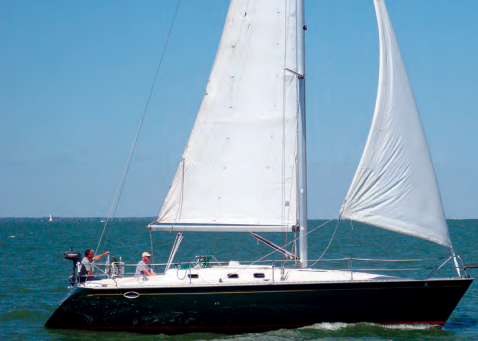
Irish Rover is a 1987 Hunter Legend 37 owned by Ted and Lynn Ambers. They were initially drawn to the boat by its styling, known performance, and exceptional roominess. It was also for sale at a favorable price. Ted’s own careful personal inspection and a pre-sale survey revealed some deficiencies. Ted, being an experienced sailor and capable do-it-yourselfer, was confident that these could be overcome and the sale was consummated.
Since the purchase, Ted has invested additional capital in Irish Rover in sweat equity (more than 1,500 man-hours) and in dollars. Three of the most significant repairs/improvements were swapping the corroded and leaking aluminum holding tank for one constructed of polyethylene, replacing 84 square feet of rotted plywood deck core with Corecell, and painting the topsides and deck with two-part polyurethane. In the area of upgrades, Ted replaced all the electronics, installed air conditioning, and built a wine cooler.
“I know that I’ve spent more on the boat than I should have,” Ted says, “but we really like the boat and don’t see us selling it.”
Design
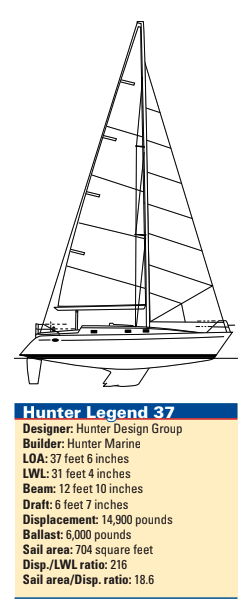
At first glance, the Legend 37 doesn’t resemble typical Hunters, neither those that preceded it nor those that followed. The overall design gives the general appearance of a high-performance boat, its flat sheer complemented by the sharp, aggressive bow and reverse transom. Generous freeboard is offset by a low coachroof that slopes forward to merge into the foredeck in a manner reminiscent of Nautor’s line of S&S-designed Swans from the same era. Under the water, the boat has a balanced spade rudder and was offered with either a deep fin or shoal-draft keel with a bulb and winglets.
The relatively low displacement/length ratio of 216 suggests the boat will be fairly quick, especially as its sail area/displacement ratio is fairly high at 18.6. One consequence of light displacement that isn’t always apparent to new sailors is the shallow canoe body that leads to minimal stowage space below the sole and a shallow bilge that holds little water.
Construction
The Legend 37 has a solid fiberglass hull and a deck cored with plywood. The hull-to-deck joint is an outward flange that’s chemically bonded and capped with a slotted aluminum toerail fastened with carriage bolts on 4-inch centers. In addition to the support provided by molded interior liners, there are additional structural features. A beefy transverse stiffener supports the mast compression post and its broad, white-gelcoated top divides the saloon sole. Also in the boat’s midsection, longitudinal stringers are situated on each side of the externally bolted lead keel.
While Hunter’s engineering has a respectable reputation, the actual execution sometimes fails to meet the same standard. Shortcuts taken during manufacturing to keep selling prices relatively low often result in later maintenance issues or simple annoyances. Ted refers to these annoyances as “Hunterisms.”
Deck
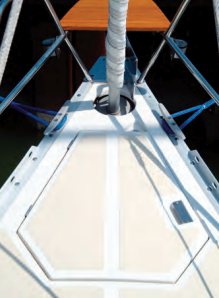
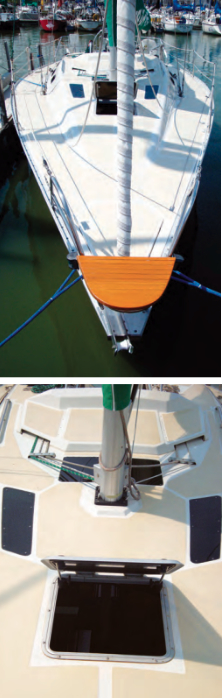
The bow pulpit of the Legend 37 incorporates a teak platform that can function as either a seat or as a step when boarding the boat at the bow. Beneath this novel structure are both the stemhead fitting/bow roller and the headsail’s roller furling drum, cleverly recessed below deck level where it doesn’t obstruct the anchor. Immediately aft of the furler, flanking a large anchor locker, is a pair of 10-inch open-throat cleats. The balance of the boat’s expansive foredeck is free of obstructions.
To allow close-sheeting the headsail, the shrouds and jibsheet tracks are inboard next to the coachroof. This, together with the tracks being recessed, aids free movement for the crew along the comfortably wide sidedecks. Double lifelines and stainless-steel handrails on the cabintop provide handholds.
On the forward portion of the coachroof are a 19 x 19-inch hatch and, aft of it, a pair of smoked skylights. Another skylight and the sea hood are aft of the mast. There are six opening portlights in the trunk, two more in the cockpit footwell, and another in the topsides in the starboard quarter.
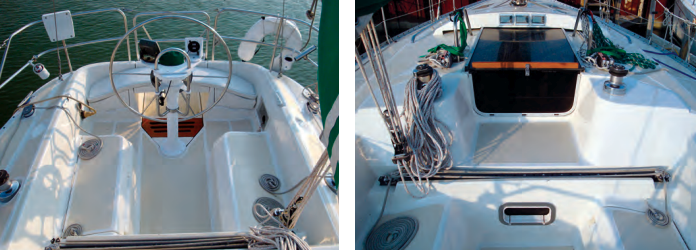
The cockpit is T-shaped and quite roomy. The coamings are properly sloped and well over 12 inches high. Beneath the starboard seat is a shallow convenience locker, suitable for small items such as flares and sailing gloves. Two seat lockers flank the helmsman’s seat, which lifts out to give access to the partially open transom. A gate in the two-piece stern pulpit affords easy access to steps molded into the transom and a stainless-steel boarding ladder. Additional cockpit features include a large bridge deck, a teak grating beneath the helmsman’s seat, wheel steering, and a pair of 10-inch mooring cleats.
Accommodations
Access below is via a compact companionway hatch (perfect for offshore sailing) and a rather steep, six-step companionway ladder.
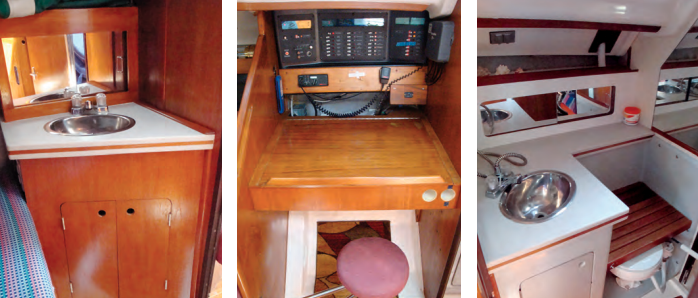
Forward, the V-berth cabin is generous and somewhat luxurious. In addition to the usual port and starboard outboard shelves, it has two lockers in the bow, a hanging locker and bureau top to port, and a vanity with sink and mirrored cabinet to starboard. The vanity top is Corian; the stainless steel sink has faucets for pressurized hot and cold water. A one-piece cushion covers the V-berth. Beneath it is the aluminum potable-water tank and two small lockers. A door separates the V-berth from the saloon and creates privacy and a small changing area when closed.
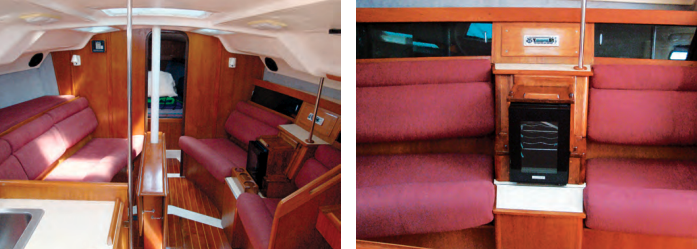
The saloon is open, airy, and bright. To starboard are two seats. They were originally separated by a small entertainment center, but Ted removed most of the dated electronics from Irish Rover and replaced them with a small wine cooler. There’s stowage space beneath and behind the seats, lockers with sliding doors above the seats and, above them, a fiddled bookshelf.
On the port side is a long settee, behind which is the CNG (compressed natural gas) tank and storage. The water heater and new air conditioning unit are under this settee. Above the port settee is a nice surprise — a bona fide pilot berth! A centerline drop-leaf table with a white laminate top wraps around the compression post.
All wooden surfaces are varnished teak-veneered plywood and all exposed hull areas are covered with fabric. The sole is teak and holly. Several hatches give access to the bilge and keel bolts, and a teak grating at the foot of the companionway drains to the bilge. Except for the compression post and a couple of grabrails, there are no overhead handholds. Headroom is a generous 6 feet 3 inches.
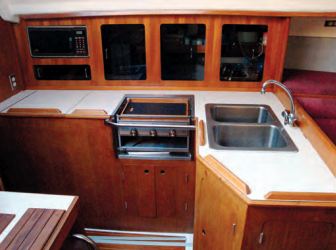
The L-shaped galley is on the port side and gains valuable extra inches from being near the widest part of the boat. As a result, there is plenty of room for a double stainless-steel sink close to the boat’s centerline. Outboard is a two-burner CNG cooktop with broiler and aft of it a large top-loading icebox and a microwave. A reasonable amount of counter space and numerous lockers make for a usable galley.
One unique locker, located beneath the sink and facing inboard, cleverly hides a stack of drawers and is one of those “Hunterisms” Ted mentioned. Every locker door on the boat has an elbow latch — except this one. This normally doesn’t pose a problem, but when on port tack, at 15 degrees or so of heel, the door often swings open and the drawers slide out, spilling their contents all over the cabin sole.
On the starboard side, opposite the galley, is the outboard-facing navigation station, which provides a good-sized chart table with storage beneath its lift top, a pair of tubes for rolled charts, and its own swing-out stool. Above and outboard of the chart table is the electrical panel and a limited amount of space for the VHF radio and other electronics.
A door separates the navigation station from the walk-through head compartment. Arranged on the outboard side of this compartment and incorporated into a single compact fiberglass module are the vanity with a single stainless-steel sink and Corian countertop, a toilet covered by a teak changing/shower seat, and a handheld shower. The walls are covered with a white plastic laminate and the sole is a teak grate, which drains to the bilge. The 15-gallon holding tank is sandwiched between the vanity and the hull side.
The navigation station and head take up about the same amount of space as the galley does, thus balancing out the boat’s accommodations.
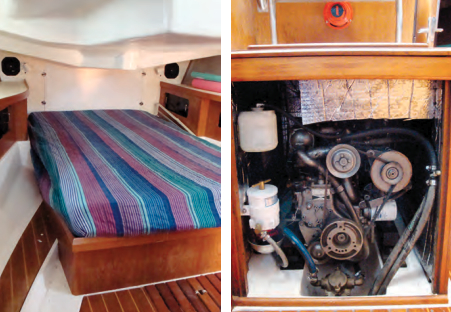
The owner’s stateroom is beneath the cockpit and is huge. It can be entered through the galley or the head compartment, both of which have privacy doors. The suite features a centerline double berth with his-and-hers hanging lockers and vanities on either side. A large mirror at the foot of the berth adds to the sense of space. There’s stooping headroom in almost half of the compartment and sitting headroom in the berth. Three opening portlights provide the suite with light and cross ventilation. The boat’s fuel tank is located beneath the berth and removing the teak grate in the cabin sole provides access to the packing gland.
Rig
The Legend 37 has a fractional sloop rig featuring B&R double swept-back airfoil spreaders. A downside of this rig is the inability to let the boom out 90 degrees when running. The deckstepped mast is supported by three sets of shrouds (caps, intermediates, and lowers) and a split backstay. Halyards are sheaved internally and all control lines are led aft to line stoppers and Lewmar 30 self-tailing winches on the cabintop either side of the companionway. The mainsail, which came standard with a Dutchman flaking system, is sheeted near the end of the boom to a traveler on the aft end of the bridge deck. The primary headsail winches are self-tailing Lewmar 43s mounted on the cockpit coamings.
Under way
According to Ted, one of the best attributes of the Legend 37 is the way it sails. Its best point of sail is a close reach; its worst, he says, is close-hauled. With a bit of tweaking and a fresh wind, the boat will sail quite well just within 45 degrees. While the jib is small, the main is reasonably large and can handle heavy air without too much weather helm. The sail area/displacement ratio of 18.6 suggests a light air performer. At nearly 15,000 pounds displacement, it accelerates well, but it’s no rocket.
For auxiliary power, the Legend 37 has a 34-horsepower Yanmar 3HM35F diesel. Coupled to a 16×10 two-blade propeller on a 1-inch diameter bronze shaft, it easily moves the boat at hull speed. Access to the engine for maintenance is excellent from all sides. While the engine’s control panel is located near the helm in the cockpit footwell, it does not contain all the controls — another Hunterism. The fuel shut-off (engine stop) is mounted on the bulkhead above the engine, halfway down the companionway ladder, inside the boat!
Things to check out
Delamination of the plywood-cored deck due to water saturation is said to be a common problem with the Hunter Legend 37. Any area where the deck’s fiberglass has been penetrated is a potential point for water entry — deck fittings, hatches, and portlights. The presence and extent of any water intrusion can be detected by judicious soundings and the use of a moisture meter.
Ted reported he felt vibration with the engine in gear. Replacing the propeller shaft with one made of stainless steel appears to have solved the problem.
Do a bit of sniffing around the head and its holding tank. Aluminum and waste are not the best combination. Odors may be from poor housekeeping or may indicate a more serious problem.
Conclusion
While its style matches that of its contemporaries from other builders, the Legend 37 was a transitional design that does not conform visually with the common perception of a Hunter. It’s a performance cruiser that provides amenities and comfort for a family of four. Hunter outfitted the Legend 37 with some luxury features (Corian counters, centerline double berth, microwave, and an entertainment center) while keeping the price low. Hunter owners will often tell you, “You get a lot of boat for your money.” You also get those Hunterisms.
Asking prices for the Hunter Legend 37 range from $45,000 to near $65,000, depending on equipment and, most important, condition.
Gregg Nestor, a contributing editor with Good Old Boat, has had a lifelong interest in all things aquatic. He and his wife, Joyce, are currently refitting, upgrading, and sailing a 1994 Caliber 35.
Thank you to Sailrite Enterprises, Inc., for providing free access to back issues of Good Old Boat through intellectual property rights. Sailrite.com