A “bag of tricks” has the power to connect you, anywhere
Issue 65 : Mar/Apr 2009
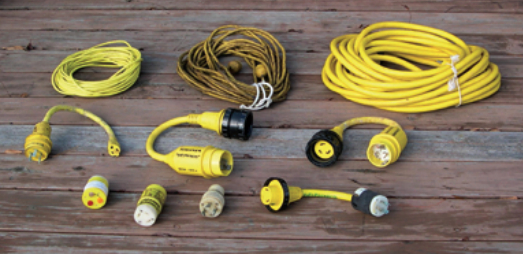
Cruising is full of surprises, but one you don’t need, and can easily avoid, is arriving in a strange marina to find that your shorepower cord doesn’t match any of the marina’s shorepower receptacles. The answer is to put together a “bag of tricks” so, wherever you go, you can literally pull an adapter to solve any connection puzzle “out of the bag.”
Voltage and power options
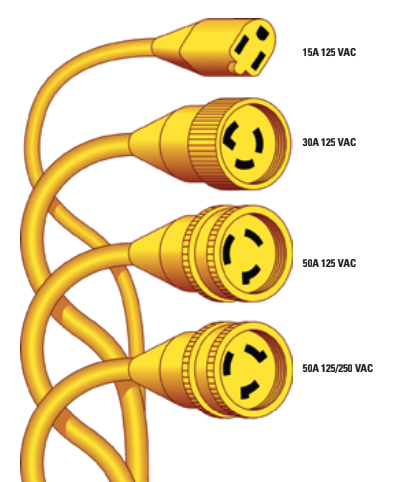
- Many small sailboats have a simple 15-amp system. This requires little more than a 15-amp 125-volt AC extension cord, similar to an extension cord used in the home but made to marine specifi cations.
- Mid-sized sailboats, with more AC appliances, use a 30-amp 125-volt shorepower connection. Threaded collars on the shorepower cord provide secure, watertight connections between the shorepower pedestal and the boat. This power is then distributed through the boat by wiring called branch circuits.
- Larger yachts that have one or more air-conditioning units as well as refrigeration need a 50-amp 125-volt system to deliver the high currents those appliances draw.
- Yachts that have large appliances such as electric ranges and clothes dryers need a 50-amp 125/250-volt supply. The matching power cord contains four conductors: the white neutral, the green ground, and red and black conductors that each carry 125 volts.
- Marinas that cater to very large yachts will also provide 100-amp 125/250-volt connections.
The shorepower bag
For safety reasons, each of these systems uses different connectors specifically designed so they cannot be used interchangeably. Thus, if the marina’s electrical system is not identical to your boat’s electrical system, to plug into shorepower, you will need an adapter.
The prudent cruiser’s shorepower bag will contain all the accessories needed to get plugged in at any marina. Along with the shorepower cord, you will want adapters that will connect it into any of the four common shorepower configurations, a telephone cord (unless you use a cell phone), and a cable-TV cord.
Adapters also come in a Y-configuration. The one most often needed is a Y-adapter that plugs into a 50-amp 125/250-volt receptacle, splits the supply, and delivers it to two 30-amp 125-volt receptacles.
Test the supply’s polarity
Before turning on any AC circuit in the boat, you should check the polarity of the shorepower supply to ensure that the marina’s system is wired correctly. On many sailboats, a reverse-polarity indicator is built into the electrical control panel. To use this indicator, first turn off your main power switch or circuit breaker, then connect your shorepower cable. If your indicator gives the shorepower a clean bill of health, you can turn on the main switch. If it indicates reverse polarity, unplug the shorepower cable and alert the marina’s management to the problem.
If you have no built-in reverse-polarity indicator, purchase a plug-in type and add it to your shorepower bag. Before you plug in your cord, check the system by plugging the indicator directly into the dockside power pedestal, using an adapter if necessary.
I always check polarity at a marina or yacht club before connecting my shorepower cable. It’s a routine. I never expect any problems and had one only once. I took a slip at a yacht club and plugged my polarity checker into the shorepower pedestal. I couldn’t believe my eyes. The hot wire was connected to the ground terminal and vice versa — a potentially lethal wiring error. I checked the other outlets on the docks and they were all fine. Mine was the only bad one. I notified the club, and the electrician was there in minutes.
Guard against corrosion
Loose, corroded, or leaking connections are the most common cause of shorepower problems, both at the dock’s power pedestal and at your boat’s power-input socket. Corrosion, often the result of a non-waterproof connection, causes resistance, and resistance creates heat. This not only leads to a fire hazard, but also ends up destroying the plug on the shorepower cable and the socket on your boat or at the dock pedestal.
The terminals on a shorepower cable should be protected from moisture by vinyl covers and a sealing collar system. The covers protect the plug and connector and the collar system provides both protection from moisture and a mechanical seal between the cordset and the connector.
Don Launer, a Good Old Boat contributing editor, has held a USCG captain’s license for more than 20 years and has sailed the east coast from Canada to the Caribbean. He built his two-masted schooner, Delphinus, from a bare hull.
Thank you to Sailrite Enterprises, Inc., for providing free access to back issues of Good Old Boat through intellectual property rights. Sailrite.com