To avoid engine troubles, fit the right propeller
Issue 65 : Mar/Apr 2009
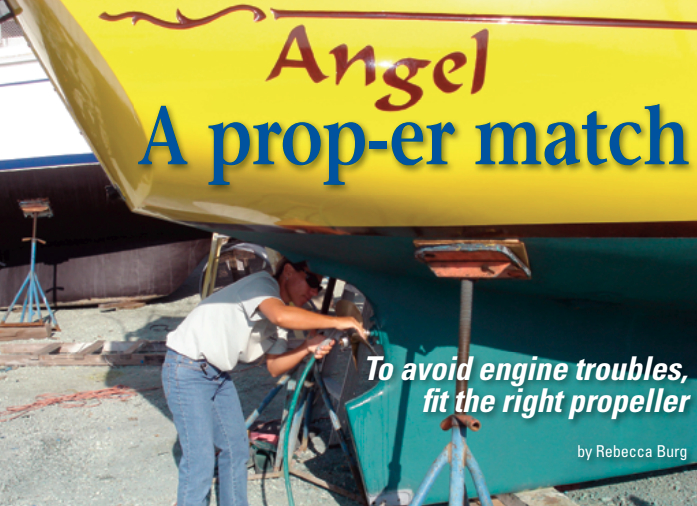
The shark meandered toward my right foot. It was so close I could see brown spots on its nose. Loaded with tools and dive gear, I froze, not sure whether to laugh or slink away. The creature was barely more than a foot long. Still, a shark is a shark. The tiny interloper snooped around Angel’s keel while I proceeded to remove her rudder in order to get at and remove her propeller. I was in the final tuning stages of matching the prop to the engine I’d newly installed in Angel, my 1978 Bayfield 29.
Although we sometimes don’t think about what’s hidden below the waterline, an auxiliary sailboat’s drivetrain is worthy of serious consideration. In my case, I was ensuring that I fitted the correctly sized propeller that’s crucial for long engine life and optimum performance.
Biggest is best
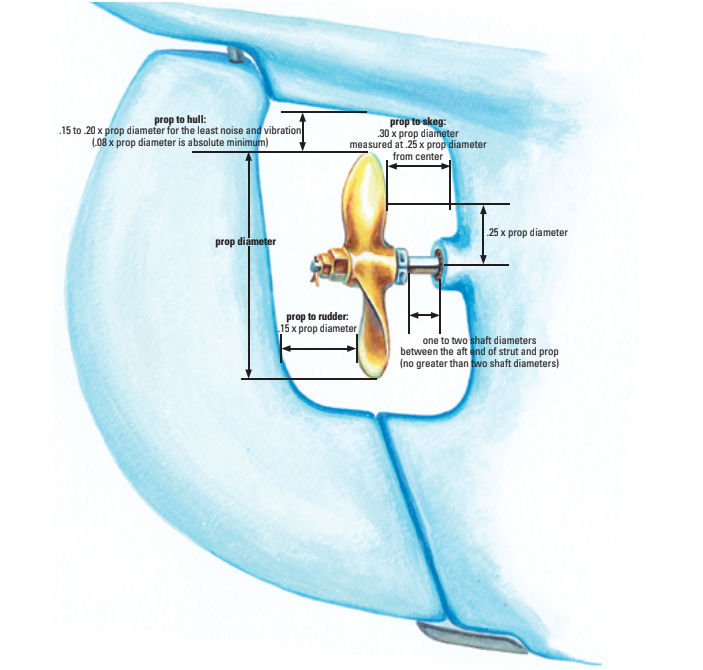
Most sailboats have been designed to accommodate a propeller of a particular diameter. As a consequence, the location and angle of the shaft and strut — as well as perhaps the rudder and skeg, and even the shape of the hull — will impose a practical limitation on the maximum diameter of propeller that can be used. For the propeller to operate efficiently, minimum clearances must be maintained between the blades and the hull, skeg, and rudder:
- prop to hull: 15 to 20 percent of prop diameter, to give the least noise and vibration and 8 percent of prop diameter as the absolute minimum;
- prop to rudder: 15 percent of prop diameter;
- prop to skeg: 30 percent of prop diameter.
Ideally, the engine should reach 90 percent of its rated rpm under load with the propeller. A prop that’s too large will overload the engine, preventing it from reaching its rated rpm while it emits smoky, black exhaust. A prop that’s too small will allow the engine to race beyond its rated rpm while failing to propel the vessel at its hull speed. Either condition will reduce engine life and can create needless complications down the road.
Taking all of this into account, you want to select the largest diameter prop that you can and adjust the pitch to match it to the engine.
Matching prop to boat
If you repower your vessel, you’ll have to play the drivetrain-matching game. You might also need to follow the same steps if you purchase a used auxiliary sailboat and wish to optimize her for your needs or assure that the existing prop is the correct one.
If your boat was designed for an Atomic 4 engine, there is a good chance the transmission was 1:1 in forward gear. In other words, there is no reduction ratio. Such an installation was intended to use about half of the maximum rpm and horsepower that the Atomic 4 could produce. Because the prop shaft turned very rapidly, it was fitted with a very small-diameter prop. If you repower with a diesel, you will fi nd that the engine comes with a marine gear that gives about 2:1 reduction in forward gear. Because the prop is turning much more slowly, the new engine will need a much larger propeller. Installations of this nature often require significant compromises to be made because the boat’s design does not provide enough room for the larger propeller.
Matching prop to purpose
Along with being an appropriate match in terms of size and pitch, a propeller should be suited to a vessel’s specific uses. Cruisers on a schedule appreciate the efficient motoring that a three-bladed prop can provide. Sailors mostly engaged in racing prefer a two-bladed prop for its lower drag. A fixed two-bladed prop is a good compromise between motoring efficiency and sailing speed.
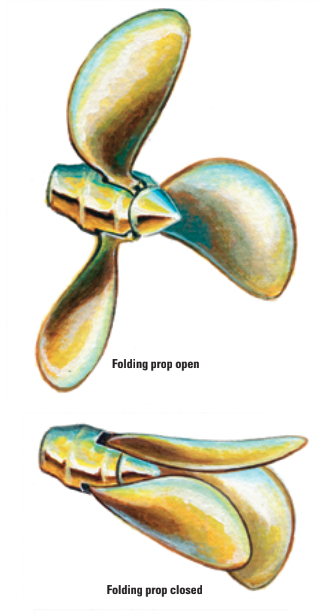
Racers often choose a folding prop, on which water flow pushes the blades back in line with the shaft when sailing. If properly sized, a folding prop can deliver good thrust when motoring ahead, but it doesn’t have good thrust in reverse. When reversing, it’s necessary to use very high engine speeds to make a folding prop bite.
The blades on feathering props, rather than folding, rotate to align with the water flow. This does not reduce drag as much as folding, but feathering props do have significantly less drag than fixed props and offer a noticeable improvement in sailing speed. Many feathering props have blades with symmetrical cross sections — both the top and bottom surfaces of the foil are curved. This creates a small loss in efficiency when powering forward but they have noticeably more thrust in reverse than a fixed prop, which uses asymmetrical blades and is optimized for powering forward.
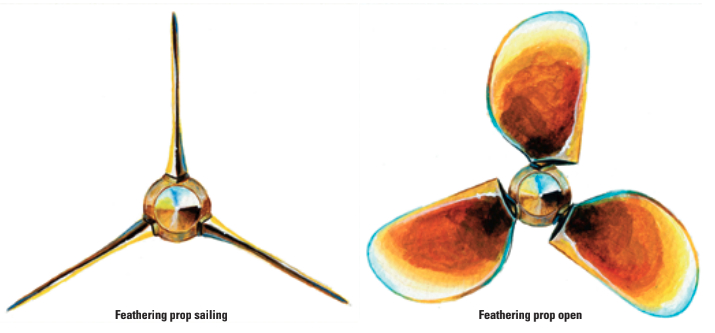
Feathering props usually have an adjustable pitch feature, although, in most cases, making adjustments to the pitch requires removal of the prop. The Autoprop design employs two or three blades that are self-pitching, allowing the prop to maintain a high level of efficiency over a wider range of speeds and loads. The Autoprop also has more thrust in reverse than comparable fixed or folding props.
Drag on both folding and feathering propellers is less than on fixed-blade models, but a feathering prop can work better in reverse than a fixed-blade prop while a folding prop will not function as well.
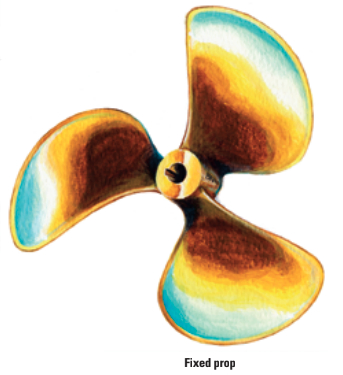
While researching the correct prop size and type for your vessel, you will also find that different shapes and styles of blade are available.
The choice between fixed-blade or folding and feathering propellers is up to the individual and his or her budget. For me and for Angel, a full-keeled cruiser which rarely races and operates in a variety of locations and weather conditions, the rugged simplicity of a fixed, three-bladed propeller was the most suitable.
Art, science, and guesswork
Sizing a prop to a particular boat and engine takes art, science, and generous amounts of educated guesswork. When I installed a 20-hp inboard diesel engine in Angel, I had to fit a new propeller. The prop distributor used a computer program to narrow the broad range of sizes and styles available. The program calculated a size based on detailed data about the boat and engine. I also sought the input of an experienced marine-diesel mechanic. Aided by the computer’s results and the mechanic’s worthy advice, I made a choice.
A propeller’s characteristics are typically stamped on the hub. The diameter is marked first, followed by the pitch size and whether it’s right- or left-handed. Angel’s new model, marked 13 x 14 RH, indicated that the prop was 13 inches in diameter and had a 14-inch pitch. Pitch is the distance that the propeller, in the absence of slip, would screw itself forward through the water in one revolution. The “RH,” meaning right-handed (or clockwise when looking at the prop from behind the boat), is the direction it will turn to move the boat forward.
After repowering, I installed the brand-new prop when Angel was still in the yard. A piece of wood wedged between the prop and the hull kept the shaft from rotating while I tightened the nuts. A soft rag between the wooden wedge and the hull protected Angel’s freshly applied bottom paint.
Opinions differ on which of the two nuts goes on first: the thick one or the thin jam nut. One do-it-yourself book suggested putting the thinner nut on first. The commercial captains and staff working in the boatyard prefer to install the thick nut first. Over the years, I noticed that either method works as long as the nuts are well tightened and the cotter pin is securely in place.
After Angel was launched, I gave the new propeller a series of sea trials. Motoring around in calm waters with a clean bottom, I could tell that the engine was slightly overloaded. The exhaust showed faint puffs of telltale black smoke and the laboring engine was unable to reach 90-percent of its rated rpm. I consulted a mechanic, who confirmed that a reduction in pitch was needed.
The shop repitched Angel’s propeller, and 13 x 13 RH was now stamped on its hub. Once again, I dove and attached this new part of Angel’s anatomy, making sure to seat the key before tightening the prop nuts against the wooden wedge, which was awkward to use under water because it wanted to float away. I kept spare cotter pins on hand in case I dropped one — I did, of course. The juvenile, freckle-faced shark returned to supervise the operation.
Perfect pitch
After this dive, a second test run showed a remarkable difference in Angel’s performance. The exhaust was clear as the diesel smoothly revved close to its rated rpm without overspeeding or overloading in a variety of sea conditions. The match was a good one.
Several years of cruising and 600 engine hours later, Angel’s propeller is still performing like a charm. Sailors do prefer to use the wind over fossil fuels, but the engine is a practical tool when we’re faced with tight schedules, crowded harbors, or narrow canals.
Given all the variables involved, I recommend you obtain professional advice in getting the most performance out of your auxiliary sailboat’s drivetrain. A properly matched prop helps to keep the engine running smoothly and to prevent needless repairs down the road. That makes it an invaluable part of a sound cruising vessel.
Rebecca Burg comes from a long line of fishermen, mariners, and coastal dwellers. An artist and writer, she singlehands and lives aboard her Bayfield 29 but never far from the Morgan Out Island singlehanded by Bill Robinson.
Thank you to Sailrite Enterprises, Inc., for providing free access to back issues of Good Old Boat through intellectual property rights. Sailrite.com