A stout bilge-keeler from across the pond
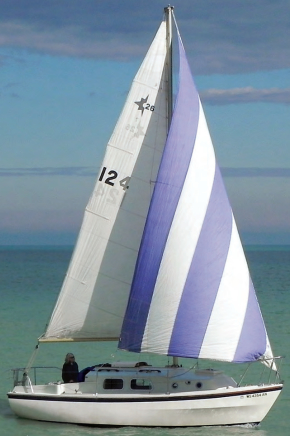
Issue 91 : Jul/Aug 2013
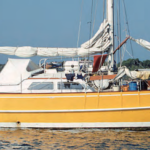
What were you doing in 1975? John Vokaty, then 48 years old, was working in corporate accounting when his wife, Helen, strongly suggested he was working too much and should take up sailing as “something to do.” And so they did. At first they sailed with others on Lake Geneva and Green Lake in Wisconsin. Later that year they acquired their first sailboat, a Pearson 28. Two years after that, they bought and sailed a Catalina 22.
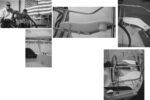
They were thinking of buying a 28-to 30-foot O’Day when John happened upon a 1969 Westerly Centaur 26 for sale in Chicago’s Burnham Harbor. John says, “It wasn’t an old boat then.” It was soon theirs. John and Helen sailed out of Burnham Harbor for a time but, for most of the 31 years since acquiring Poise in 1981, they sailed from various marinas in Racine, Wisconsin, on Lake Michigan cruises. They were not tempted to cruise farther. John says, “Lake Michigan is big enough.”
Helen and John kept a journal of their sailing outings. For some days, a simple entry included the date, who was aboard, and the weather. Other times, Helen’s beautiful handwriting tells a more compelling story of adventures with Poise. Helen passed away in 2010, but John, now 85, is still sailing Poise from a slip on the Root River at Pugh Marina in Racine. I met John last October to sail aboard Poise with his daughter Judy as crew.
History
Westerly Marine Construction, Ltd., a British firm founded in 1963 by Denys Rayner, commissioned the firm of Laurent Giles & Partners to design an affordable family cruiser to fit into their already well-established line. Laurent “Jack” Giles (1901-1969) said of this endeavor, “To be commissioned to design for Westerly Marine was indeed a challenge. With the resources of their own research department allied to a highly developed production line and a keen buying office, there seemed to be a danger of too many outside pressures working on the designers.” This turned out not to be a problem, and the designers and builders cooperated to create a “proper yacht” in a 26-foot cruiser with twin bilge keels.
The Centaur was well received at the 1969 London Boat Show and considered a hit, in part because of its generous interior dimensions. Centaurs sold well in the U.S., with many going to the Great Lakes. In all, it was so popular that 2,444 Westerly Centaurs were produced over a 12-year run that lasted until 1980.
Design
Denys Rayner was very fond of small-boat cruising, but in comfort, and that meant standing and sitting headroom. So, in common with its predecessors, the Westerly 22 and 25, the Centaur has a lot of beam and slab topsides to provide plenty of cabin space.
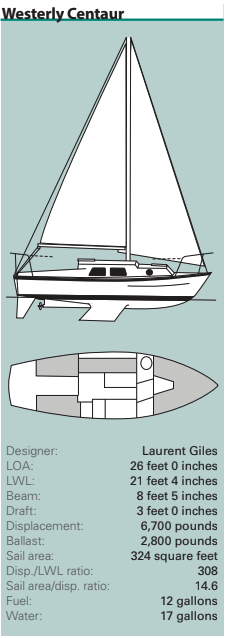
The Centaur has much nicer lines than the Westerly 22, with a spoon bow, slight aft rake to the transom, and no aft overhang. The cabin trunk is not pushed out to the rail and a step down forward of the mast reduces its visual effect. Spring in the sheerline and a chine high in the topsides forward provide an overall pleasing appearance. The aft sections are kept wide with a firm turn to the bilges. The canoe body has clean lines and the propeller turns in the clear. The rudder is a spade. Jack Giles had done research on other twin-keel yachts and vastly improved on their performance by designing the keels with high-lift foils and attaching them with 2 degrees of toe-in. This makes the Centaur very weatherly.
Construction
Westerly boats are known for sturdy fiberglass construction. John says the foredeck is a balsa sandwich with solid laminate in all other areas. While Westerly was among the first to use fiberglass interior liners, the builder did not skimp on the number of access holes needed to reach important parts of the hull. In addition, two very solid plywood bulkheads forward stiffen the hull where the most pounding takes place.
Three cabin layouts were available after 1972. In 1974, the saloon windows were modified so stress from the lower shrouds would not cause leaks. In 1976, the spade rudder was replaced with a skeg-mounted rudder to improve handling and reduce prop-wash turbulence. A transparent companionway hatchcover appeared in 1978.
Westerly offered a wide range of engine options; being overpowered appears to have been the norm. Early boats, including Poise, were given the Volvo 2-cylinder 16-horsepower MD11 diesel. Jack Giles said the 13-horsepower MD7A would push a Centaur along at about 6 knots. Due to a substantial quantity discount offered to Westerly by Volvo in 1972, the 25-horse- power Volvo MD11B appeared in many Centaurs. The smallest engine was the 10-horsepower Volvo MD1B; the largest was the Watermota 4-cylinder of up to 30-horsepower. Apparently, the cost for customers to upgrade to the larger engines was minimal, and for those who sailed in places where tidal or river currents are strong, the extra power was very welcome.
On deck
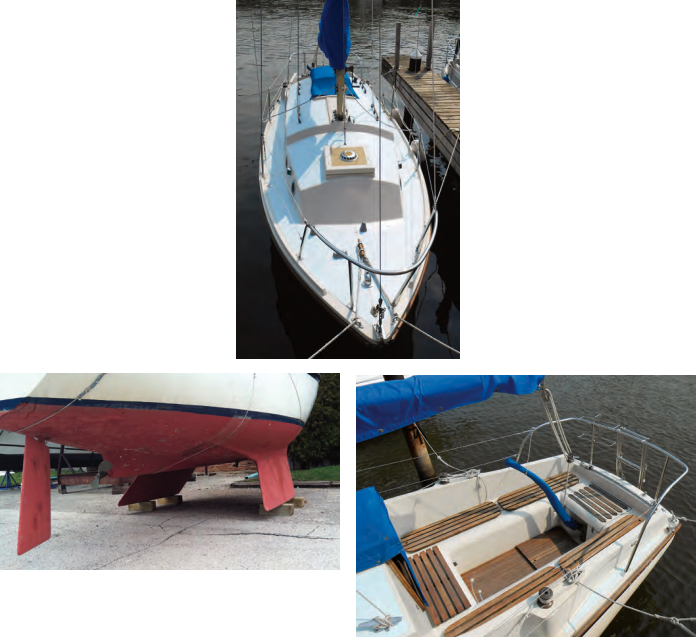
The sidedecks are fairly wide with molded toerails, double lifelines, and good handholds for going forward. The bow has reasonable space for a 26-foot boat. There is no anchor locker, just chocks for a Danforth-type anchor. The rode and chain pass down a covered hawsepipe to a bin in the forepeak.
One large translucent fiberglass hatch opens above the forward cabin and two small sturdy portholes open on either side — two in the cabin, one in the head, and one above the hanging locker. Two large fixed windows are fitted on each side of the cabin trunk. Later models had a translucent sliding companionway hatch as well, but Poise has one of solid fiberglass. A sea hood covers the sliding hatch and wooden dropboards complete the companionway closure.
Prominent features in the cockpit are a high bridge deck and a deep self-draining footwell. A lazarette provides access to equipment aft and some storage. On Poise, teak gratings cover the cockpit seats and footwell. The seats are long enough for a good nap and reasonably spaced for comfortably bracing your feet while heeled. The coamings might dig into your back, but any cushion will relieve that problem. All the hardware on the deck is of good quality.
Rig
Poise has a masthead sloop rig with a deck-stepped mast supported by a chromed-steel compression post in the cabin. It is a simple single-spreader arrangement with aft lower shrouds and a checkstay forward. Some Centaurs were built with a ketch rig, but I believe these are rare. Halyard winches are mounted on the mast. The boom is equipped for mainsail roller reefing with a geared crank at the gooseneck. (Note: This process, which has become uncommon, is illustrated in Don Launer’s 101 article in theMay 2006 issue. –Eds.) There are sheet winches and horn cleats on each cockpit coaming. The mainsheet attaches to the end of the boom (to accommodate the roller reefing) and to a traveler across the top of the arched transom.
Accommodations
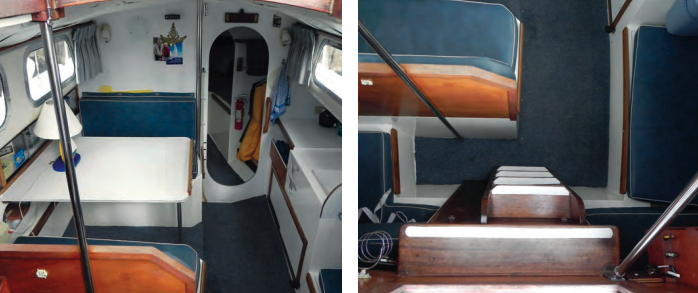
Although the companionway ladder is steep and a step to the side is needed upon reaching the cabin sole, an angled handhold provides support. Seeing the layout of the compact cabin is worth the descent, and the first impression is of a lot of light and space under 6-foot-plus headroom.
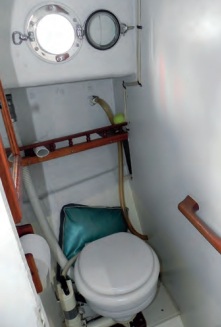
To port is a dinette that should be comfy for four adults. The table drops down to make it a double berth. No nook or cranny is overlooked forstorage, which is everywhere. To star- board is a small galley counter with a molded-in sink. Fresh water is delivered by a foot pump. Forward of the galley is a rather large hanging locker. Opposite the locker, the painted-plywood head enclosure is roomy for a 26-footer. Even without a door, the forward cabin is reasonably private, and leaving the head door open makes it more so. The wide V-berth can be used comfortably as two 6-foot 6-inch single berths or, with an insert, as a cozier double of queen-sized proportions. The aft quarter berths are equally long. On Poise, as on many boats, these become places to store bulky gear. A short settee is located to starboard, aft of the galley and forward of the quarter berth.
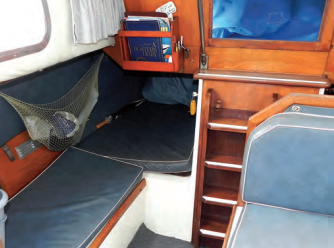
The overhead and cabin-trunk sides are covered in a white vinyl fabric, lending to the airy feel and providing reasonably good access to fasteners for deck-mounted hardware. The compression post is a good handhold as is another chrome tube on the back of the aft dinette seat. In the absence of a centerline keel, the bilges are rather shallow. The engine is easily accessed by removing the companionway ladder and a panel behind it. Poise has no electrical panel per se; switches and fuses are mounted on the side of the engine compartment. The original lighting was minimal. Poise is rigged for shorepower as she has lived most of her life in big-city marinas.
The alternative cabin arrangements offered either an L-shaped settee around the dining table or a long settee to port and a short settee to starboard. In the latter case, the galley moves into the area where the starboard quarter berth is on the standard model.
Under sail
It was a late October day but still warm enough for a brief test sail. With light winds out of the northwest, the waters of Lake Michigan were flat. John had pre-heated the engine and charged the battery before he attempted to start the cold diesel.
Motoring out was straightforward. The tiller is a rather large chunk of laminated wood and it feels very solid. To see ahead adequately, it is necessary to stand. This did not feel at all uncomfortable, and the same standing position seemed equally comfortable when we were sailing.
In the light air, Poise didn’t heel much and there was little need to touch the tiller. I felt a slight vibration in the tiller coming from propeller turbulence. John flipped the transmission into neutral and the vibration ceased. Because of the lateral area of the twin keels, I expected the boat to come about in a leisurely way, perhaps even needing help from the backwinded jib. But no, she came about smartly. While I was admiring the quick tacking and arrow-straight tracking, John said that tracking is not so straight in 2- to 3-foot seas (later versions with the skeg-hung rudder may track better in these conditions). When stronger puffs of wind hit us, the Centaur accelerated reasonably well. John says she is still a very dry boat even in more boisterous conditions.
Jack Giles once said he liked to design boats for hands-off sailing, yet they should still be responsive. He is quoted as saying that small boats require “the utmost docility and sureness of maneuvering at sea, in good weather or bad.” Lake Michigan can be a very rough place to sail at times, but I would feel very confident in the Westerly Centaur.
Twin keels do inhibit performance to a degree, owing to the added wetted surface. But John reports top speeds from 6.2 to 6.5 knots, typical of a heavy 26-foot boat. The keels allow the boat to sit level on the mud flats when the tide goes out, a not uncommon situation in the U.K. In fact, storage on land requires simply placing wooden blocks under the keels and rudder; no stands are necessary.
Twin keels could work to your detriment should you run hard aground at high tide or in an area with no changes in water level. With both keels buried, it would be very difficult to heel the boat to free it, even with a line from the masthead run off to the side. However, if you happen to run aground while heeled, the boat may well float free once the sheets are eased and it stands up.
Conclusion
Personally, I like a swing keel/centerboard or retractable keel/daggerboard for gunkholing, as these options have the least draft. Twin keels provide good stability and allow the boat to sit flat when the tide goes out, and there’s something to be said for the absence of moving parts. Boats have strengths and weaknesses. Which features are which in your boat depend on how you expect to use it. Poise has provided John with decades of good cruising. A Centaur could be your lifelong boat too, as it does many things well.
A lot of Westerly Centaurs are out there. They are all old, but depending on how well they have been maintained, they are likely a good value as their construction is sturdy. There are many choices in engines and cabin arrangements.
You will definitely find a better deal in the U.S. than in the U.K. The lowest-listed Centaur I found was $2,900, with others ranging up to $11,000. I expect good value is to be had somewhere in between those extremes.
Allen Penticoff, a Good Old Boat contributing editor, is a freelance writer, sailor, and longtime aviator. He has trailersailed on every Great Lake and on many inland waters and has had keelboat adventures on fresh and salt water. He presently owns an American 14.5, a MacGregor 26D, and a 42-foot steel cutter that he’s restoring.
Thank you to Sailrite Enterprises, Inc., for providing free access to back issues of Good Old Boat through intellectual property rights. Sailrite.com