Compound errors add up to a bump in the night
Issue 91 : Jul/Aug 2013
Accidents are supposed to be nasty moments that come out of nowhere. Yet in 1983, when I had more than 20 years’ sea time under my keel, a serious accident happened despite every step leading up to it being glaringly obvious . . . in retrospect at least. It was the climax to a string of small incidents that led to the huge one of slamming into a Turkish cliff on a black moonless night.
The first step toward potential self-destruction was when a new 10-KVA alternator proved faulty, its manufacturer denying warranty obligations by declaring that I must have tampered with it. This false accusation left me with an expensive, useless, and heavy source of magnetic attraction sitting beneath the cockpit awaiting a decision about its future.
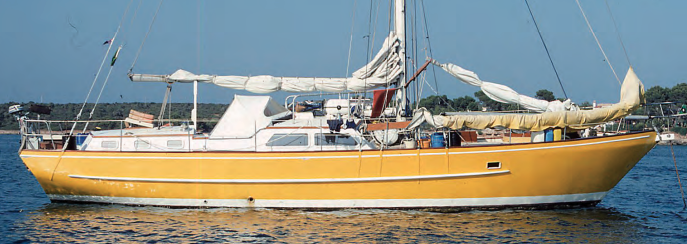
Somewhat embittered by the incident, I swung the compass of our 47-foot ferrocement cutter, Tientos, then cleared out of Australia to sail around the world with my wife, Patricia, and young son Ben. Insidious Step Number One was now in place: a deviation card showing the influence of the alternator where it was situated on departure, not where it might be in the future.
Six months later, in Larnaca Marina, Cyprus, the alternator was repaired then re-stowed just a few inches from its first position where it would again wait for installation at a later date. In the meantime, my sister Ann, 80-year-old mother, and our teenage son William flew in for a two-week Turkish cruise. Rich with the pleasure of having family aboard, and on the assumption that swinging the compass a second time would be unnecessary, we cleared for Turkey.
The city of Alanya was our first taste of Turkey after a short passage north, on which course we detected no serious magnetic anomaly. Thrilled by the sights and sounds of that exotic place, we indulged in frenetic sightseeing before setting sail west across the Alanya Gulf, at the other side of which was a line of towering cliffs needing a very wide berth. I plotted a course minus 15 degrees for a safety margin to be sure of a good offing at the end of our 70-mile track.
The calm before the . . .
As soon as we set off, the wind died and the eastern Mediterranean fell as flat as a ship’s biscuit, leaving us running on autopilot and engine power for the entire night. My two watches were late evening and again well before dawn, soon after which the gulf’s western headland should be sighted in the far distance. In the interim, William, Patricia, and Ann took their turns as lookouts.
Regrettably, in setting the watches, I failed to consider the possibility of William bumping the throttle then innocently resetting it a bit faster than before, or of my sister being in an alien environment and uncertain of what to expect at the other side of the gulf, or of Patricia not urgently shutting the throttle before jumping below to call me out. These were the tiny steps toward what could well have been disaster.
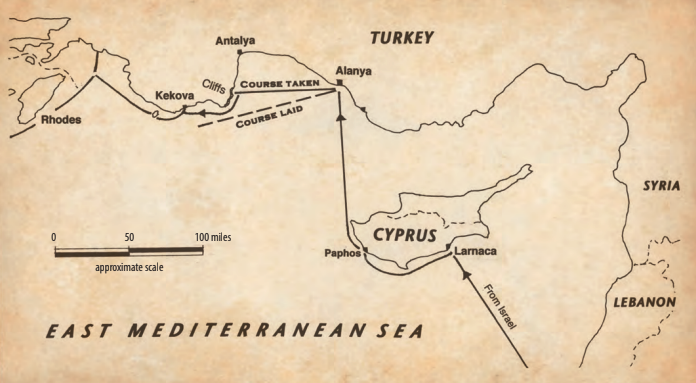
The sea being flat, I slept so soundly that I sensed, but didn’t believe, the engine revolutions had increased enough to add a full knot to our speed. Nor did I expect that my sister would be on watch in the inky-black pre-dawn hour. But that is how things stood when Ann called Patricia on deck to declare she could smell pine trees and that there seemed to be a “huge black cloud dead ahead.” Patricia sniffed the air, peered ahead, and woke me. I scrambled on deck just in time to close the throttle seconds before we rammed the huge black cloud.
The “cloud” was a sheer rock face and the smell of pine came from trees behind its edge somewhere above us. Stunned silence and disbelief hung over us like a dense fog as we automatically went into damage control, Patricia checking the bilges while a suddenly wide-awake William and I checked the foredeck and bow area. Incredibly, there was no hull damage, undoubtedly thanks to the massive steel-reinforced stem typical of ferrocement construction. The impact was softened a little by the platform-style bowsprit sliding up onto a small, sharp ledge that split it in two to hold our ship captive in scissor-like jaws.
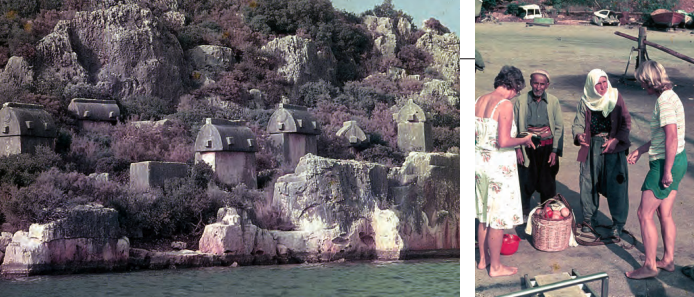
Intimidated by the thought of a sea breeze and onshore waves developing with the encroaching dawn, we abandoned caution. William stood on the rock ledge using a large lever under the bowsprit while I drove Tientos full ahead, wagging her stern with rapid turns of the rudder followed by hard astern to break the bowsprit’s tenacious grip, until she at last broke free to be moved offshore for further damage assessment. That was when my mother, quite unaware of the drama, emerged on deck to ask if we wanted a cup of tea. Soon after this we heard a plaintive voice calling from the cliff face. It was William, stranded and alone on the ledge, still clutching his lever. In the panic and confusion of the moment, followed by the relief of escape, we had all presumed he was on board.
In the growing light of dawn, we cautiously steamed back to the cliff face to retrieve him, all aghast at the scattering of off-lying rocks we’d passed earlier without foundering on any of them. This was more of a miracle than surviving the head-on collision with the cliff. With William safely on board, a thoroughly shaken family plodded south to round the headland and continue west.
Epilogue
As the skipper, the buck stops with me. I could easily blame the event on the distractive pleasure of having family members aboard, but that’s side-stepping the truth. The simple fact is, I failed to recognize how small incidents were leading to disaster. It began with my stupid assumption that, if the compass deviation proved OK when sailing north from Cyprus, then it should be OK when sailing west. Such amateurish behavior was unforgivable for one who, many years earlier, had owned a steel yacht on which moving the compass a few inches could cause it to swing as much 80 degrees.
By not working up a new deviation card in Larnaca, I had established the perfect foundation for the ultimate accident. Looking back, I estimate the deviation on the westerly course was at least 40 degrees east, enough to pull my course to the north to hit a headland that we should have cleared by at least 5 miles.
As for the failed alternator, after I mounted it properly at the end of the Mediterranean summer it still didn’t work . . . so it was unceremoniously dumped. It was a thousand-dollar dud that could have cost us our lives. Needless to add, I have not dealt with the same company since nor have I allowed small incidents to insidiously accumulate into a major one.
Alan Lucas, an Australian from New South Wales, has been cruising for more than 50 years, primarily south of the equator. He is the author of several Australian cruising guides.
Thank you to Sailrite Enterprises, Inc., for providing free access to back issues of Good Old Boat through intellectual property rights. Sailrite.com