Movable appendages went almost full circle
Issue 91 : Jul/Aug 2013
In the early history of yachting there were two distinct types of sailing craft, keelboats and centerboarders, and at the time, as the saying goes, “Never the twain shall meet!” As discussed in my piece on cutters and sloops (“What is a Cutter?” November 2012), British cutters were always deep-keel configurations while the American sloop was always a wide-beam centerboard configuration. As these national types, each with completely unrestricted sail plans, became more extreme — cutters getting narrower and deeper with greater amounts of external ballast, and sloops getting wider and shallower with all their ballast inside — tragedies were inevitable. Lives were lost when extreme examples of both types foundered.
Schooners, too, could be divided into keel or centerboard configurations — the yacht America was a typical George Steers-designed pilot schooner of the keel type. Later racing schooners, however, especially in New York Harbor, became extreme centerboard configurations. Steers himself designed yachts of both types. The keel-centerboard divide was also a regional one, with the yachts of Boston tending toward the keel types and those of New York being centerboarders.
Rule-driven changes
All this came to an end in 1884 with the adoption of the sail-area/waterline rules on both sides of the Atlantic. In North America this was the Seawanhaka Rule, and its implementation changed entirely what yachts looked like. (See Ted Brewer’s article “Rating Rules Shaped our Boats,” May 2000). While this ended the extremes of the cutter and the sloop, it would lead inevitably to unhealthy extremes of its own. The modern concept of the keel/centerboarder grew out of this rule, with Edward Burgess’ 1885 America’s Cup defender, Puritan, being the most prominent early example of this new type, but not the only one. (See “Origins of the Keel/Centerboard,” July 2012.)
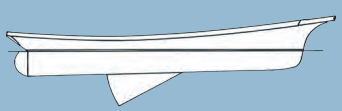
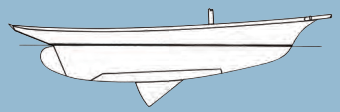
One of the most significant developments in these “compromise cutters” of the 1880s was the combination of external ballast with a pivoting centerboard rotating through a slot molded into this external ballast. All current keel/ centerboarders can trace their origins to that period. At that time, the vast majority of centerboards, when lowered, were delta-shaped below the keel. These large boards, which were rectangular in shape, were housed in centerboard boxes that often intruded well above the cabin sole and, in the original centerboard configurations of the sloops and schooners, usually extended up to the deck beams. However, the breed quickly slipped from the racing scene with the adoption of the Universal Rule in 1906 that penalized centerboards more heavily than the rule it replaced.
Arrival of the airfoil
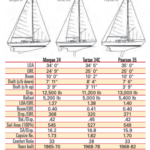
It was not until the 1950s and ’60s that the keel/centerboard made its dramatic reappearance on the racecourse with the successful Phil Rhodes’ Carina and Olin Stephens’ Finisterre. This resurgence, combined with the introduction of series construction in fiberglass, produced the models reviewed in this issue’s comparison piece on page 13.
Note, though, one important change in the nature of the centerboard. This new version of the centerboard still rotated out of a slot in the cast lead ballast but it was no longer delta- shaped. It had the shape of a high-aspect-ratio wing. This “wing type” configuration was undoubtedly influenced by modern low-speed-airfoil theory that held long narrow foils to be far more efficient (producing higher lift and lower drag) than shorter, wider foils. The wing shape was also a function of wanting to house the centerboard and its required box entirely below the cabin sole so the box would not protrude into the accommodations. What this created, however, as mentioned in the comparison article, is a highly efficient high-aspect-ratio centerboard protruding from a less efficient low-aspect-ratio keel.
Non-cooperating foils
These two foil types don’t operate in harmony. Neither is large enough by itself to generate the same lift as the equivalent full-depth ballasted keel. To generate the desired lift, the low-aspect-ratio keel requires a higher angle of attack (the leeway angle), an angle at which the high-aspect-ratio board could be in danger of stalling. In addition, any wing will suffer “tip loss” when the high-pressure fluid on the leeward side of the keel spills over to the low-pressure area on the windward side of the keel. These tip losses are common on all lifting surfaces and produce the tip vortices common to all foils. Tip vortices produce something called “induced drag,” with the amount of induced drag being directly proportional to the size of the tip vortex.
Obviously, the higher the aspect ratio of the wing and the smaller the wingtip in proportion to the area of the wing, the smaller the tip loss. And the smaller the tip vortex, the smaller the induced drag. That’s why glider or sailplane wings are so long and narrow. Therefore, the combination of the high-aspect-ratio board protruding from a low-aspect-ratio keel means the board is doing little to reduce the tip losses spilling off the keel, and the upper portion of the board might actually be operating within these tip losses. The result is that these two independent foils are not acting in unison, and the performance of the board is being compromised by the presence of the keel.
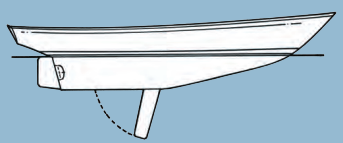
The other detriment to performance of this configuration is the turbulence that develops in the open slot in the keel when the board is lowered. Anyone who has sailed a high-performance racing dinghy upwind without flaps on the bottom of the centerboard trunk knows firsthand the amount of water sloshing around in the box and how much of that ends up in the boat. On racing dinghies, centerboard flaps are essential, but flaps are almost never installed on keel/centerboard configurations. Early delta-shaped centerboards did not suffer from this since the board, even in the lowered position, always filled the slot. High-performance development dinghies, such as the International 14, solved this problem completely by converting to daggerboards, where the foil-shaped board always completely fills the corresponding foil-shaped slot. The famous little Laser also employs the daggerboard.
Foils working in harmony
When I was at C&C, we addressed these problems by developing a centerboard configuration that acted more in unison with the keel. Our goal was to have the centerboard act more like a “keel extension” than as a separate foil. The centerboard, when lowered, was as close as we could get it to being an augmentation of the keel, so we were no longer dealing with two independent entities trying to act together, but created instead one large foil made up of two interacting components. This was a real harkening back to the early delta-shaped boards of the late 19th century, indicating that even without (or possibly in spite of) an understanding of the new science of aerodynamics, these early designers intuitively knew what was best.
This “keel-extension type” of board also did a much better job of properly filling the slot when the board is down. Indeed the board — be it an iron or bronze casting or a lead-filled fiberglass molding — always transitions from a foil shape to a rectangular cross-section that completely fills the slot when the board is fully lowered.
The configuration also contributes much more to stability than the high-aspect-ratio board. Its longer foil length results in greater actual thickness for a given foil thickness ratio (usually from 6 to 10 percent of length). This results in the board having a greater volume and a resulting higher weight, especially if it’s cast from iron or bronze. When the board is lowered, there is consequently a more noticeable lowering of the total ballast center of gravity with a commensurate increase in stability.
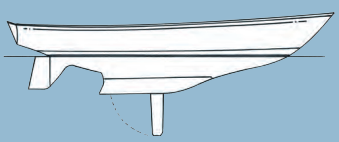
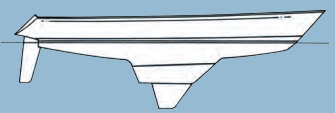
The typical keel/centerboard configuration of most production sailboats of the 1960s and ’70s is a product of the CCA era of yacht design when prevailing airfoil theory encouraged the use of higher-aspect-ratio boards protruding from lower-aspect-ratio keels. However, the better solution that emerged in the ’80s, primarily from C&C, was the use of the keel-extension type of board where the board and keel acted more in unison, the drag from the open slot was eliminated, and stability was increased with a lowering of the center of gravity. This was, on the whole, a much better solution and one surprisingly close to that employed by the originators of the keel/centerboard.
Rob Mazza is a Good Old Boat contributing editor. A sailor by passion and yacht designer by vocation, his long career around sailboats began at C&C Yachts back when now good old C&Cs were cutting-edge new.
Thank you to Sailrite Enterprises, Inc., for providing free access to back issues of Good Old Boat through intellectual property rights. Sailrite.com