How the holes in your hull can take your boat down
Issue 73 : Jul/Aug 2010
Although fiberglass, steel, and aluminum are not naturally buoyant, they can be fabricated into a shape like a boat hull that will float . . . until it’s punctured. In spite of that truth, we deliberately puncture our hulls to install raw-water intakes (for heads and engines) and discharges (for the same heads and engines plus galley sinks, cockpit drains, and more).
The legendary naval architect L. Francis Herreshoff thought putting holes in the bottom of a boat was such a bad idea that he advocated the use of a cedar bucket instead of a plumbed marine head.
Don’t bet on the bilge pump
Some small boats, such as center-console outboards, have double hulls filled with foam to make them buoyant even when swamped. But larger boats (and most sailboat hulls) will not float after the hull has been punctured unless the bilge pumps can keep up with the leak.
It would be nice to think your bilge pump could handle the task, but a 1-inch hole 2 feet below water level will allow water into the hull at a rate of 28 gallons per minute. That’s 1,680 gallons per hour — 14,000 pounds. Doubling the diameter of the hole quadruples the flow, since the area of a hole is proportional to the square of its diameter.
As weight is added to the boat it will settle lower in the water and the flooding rate will increase.
Can the average boat’s bilge pump handle this? Only if it’s very large and the battery remains charged and the automatic bilgewater-level switch works properly and the bilge pump’s switch is in the automatic position and the pump is wired directly to the battery rather than through a battery-selector switch that might be turned off.
It’s also sobering to realize that the gallons-per-hour (gph) rating of your bilge pump is not at all realistic, since that figure is determined by how many gallons it will pump with zero “head” (the distance it must raise the water). Friction in the pump’s hose adds to the head, with the result that the effective head decreases the actual rate at which the pump will operate to about 40 percent of its quoted rating.
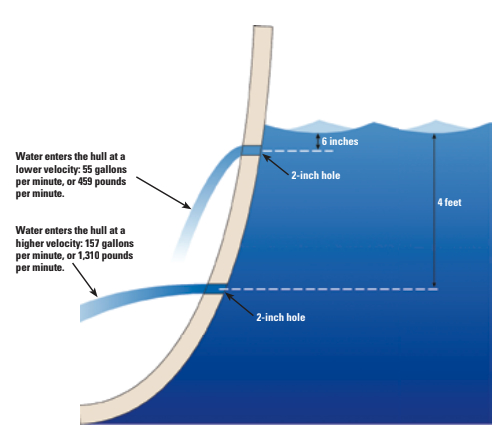
Where is the leak?
The location of the leak very often determines whether a boat can be saved or is doomed. Is it at a point in the hull that cannot be reached? At what depth below the waterline is the leak? The farther below the waterline, the faster water will come into the boat and the more difficult it will be to stem the flow. Whenever possible, any through-hull added below a boat’s waterline should be as close to the surface as is practical for the particular application.
Sinkings by the numbers
Bob Adriance, editor of the BoatU.S. publication Seaworthy, describes some of the common causes of sinking as: leaks at through-hulls and hoses (18 percent); leaks in the engine’s cooling system (12 percent); damage due to grounding (10 percent); and striking a submerged object (4 percent).
Failure to close through-hulls is a major cause of winter- related sinkings. Many of these sinkings are caused by ice lifting the hose off the through-hull. Most of these off-season sinkings could be prevented if the hoses were fastened to the through-hull fittings with two opposed all-stainless-steel hose clamps or, better yet, if the through-hull seacocks are closed.
Many boats also sink at the dock due to leaky stuffing boxes. On most sailboats, unfortunately, stuffing boxes are difficult to reach and don’t get inspected or adjusted regularly. Inspecting for deteriorated hoses and broken raw-water strainers is also often difficult. Water left in a strainer over the winter can freeze and crack the strainer’s glass and the damage can go unnoticed during spring commissioning.
Another cause of sinking is water siphoning back into a marine toilet located below the waterline and connected for direct discharge (which is only legal well offshore). Frequently, this is caused by the air-valve at the top of a vented loop becoming corroded so it cannot open and break the back-siphon. To prevent the head discharge from coming in contact with the air valve and causing corrosion, it’s a good idea to mount the air valve at the end of a short tube and screw the tube into the vent fitting on the loop.
A damage-control kit
Since the United States Coast Guard does not have any regulations concerning the equipment that should be on board to prevent flooding and sinking, it’s up to individual boatowners to create their own damage-control kits. A good starter collection for this bag should include a selection of tapered softwood plugs that can be pounded into place and a mallet with which to pound them; rubber balls in various sizes; small sheets of flexible metal, along with pieces of wood of different lengths for wedging them in place; and underwater two-part epoxy putty.
Don Launer, a Good Old Boat contributing editor, has held a USCG captain’s license for more than 33 years and has sailed the East Coast from Canada to the Caribbean. He has been a lifelong student of the history and arts of navigation and frequently gives talks on the subject.
Thank you to Sailrite Enterprises, Inc., for providing free access to back issues of Good Old Boat through intellectual property rights. Sailrite.com