. . . and two fellow CCA keel/centerboarders
Issue 91 : Jul/Aug 2013
I have to admit to having a prejudice toward keel/centerboarders — possibly due the fact that I own one — so I’m pleased to be looking at three CCA keel/centerboarders, this time from the mid- to late 1960s. In July 2012, we looked at three larger yawl-rigged interpretations of this concept from the late ’50s and early ‘60s, none of them true production boats. For this review I’ve chosen sloop-rigged boats from the early work of three very proficient and well-known high-volume production fiberglass sailboat designers and builders.
Each of these shoal-draft boats tries to improve upwind performance by the use of a high-aspect-ratio pivoting centerboard housed beneath the cabin sole. I’ve always had doubts about the efficiency of a high-aspect-ratio board protruding from a very low-aspect-ratio keel (see “Keel/Centerboard Evolution” on page 14). My own preference would be a more triangular-shaped weighted board that, when lowered, would form a more logical extension of the shoal-draft keel, although I have never seen any test or simulation data to confirm my view.
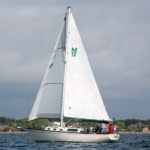
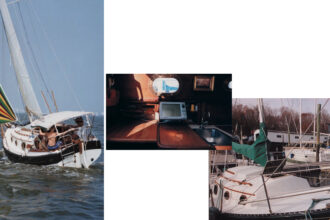
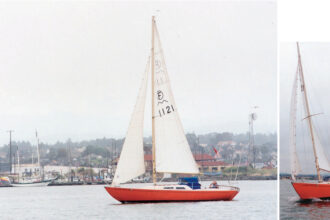
The Morgan 34 and the Pearson 35 are more closely related to the boats compared in the July 2012 issue, each having a full keel with the rudder attached. I included the Tartan 34C with these full-keel configurations to introduce the evolutionary “next generation” that brought a higher performance rig and underbody into the picture while still providing shoal draft for better cruising and shallow water applications.
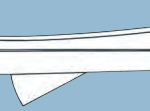
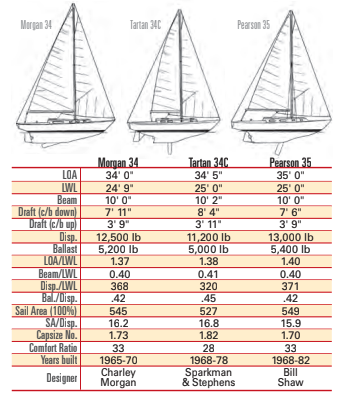
The Tartan 34C (for classic) has a separate skeg-hung rudder and a much more distinct keel, still with a centerboard housed in a slot in the lead ballast. This configuration, even with the skeg, reduces wetted surface and increases maneuverability. I can speak with some authority about how difficult these shoal-draft full-keel hulls can be to tack in high winds and a steep sea, especially during starting-line maneuvers. In addition, the weather helm generated by my own C&C Corvette on a heavy-air reach can be somewhat overpowering, even when the board is raised as shown in the Morgan 34 illustration.
It is also interesting to note the Tartan has a shorter boom and higher-aspect-ratio mainsail than the Morgan and the Pearson. This is intended to achieve higher performance as well as a lower rating. That increase in performance is also borne out in the numbers.
Note that the Tartan, even though slightly longer on the waterline than the Morgan, is 1,300 pounds lighter. It is 1,800 pounds lighter than the Pearson on the same waterline. Assuming these published displacements are accurate, the Tartan 34C displays the more competitive displacement/length ratio at 320, compared to 388 and 371 for the Morgan and the Pearson.
The Tartan’s shorter boom results in a smaller sail area, but its lighter displacement still gives it a higher sail area/displacement ratio of 16.8 in comparison to the Morgan’s 16.2 and the Pearson’s 15.9. The Tartan also has a higher ballast/displacement ratio, indicating better upwind potential, especially when combined with a slightly deeper draft.
If I were to pick a boat for performance around a racecourse, it would be the Tartan. Looking at the performance ratios discussed above, it certainly has the advantage on all points of sail. When you include the lower wetted surface and the better maneuverability achieved with the removal of the deadwood aft, there should be no doubt of the outcome, everything else being equal.
The Tartan’s lighter displacement does produce the highest capsize number, but since all are well below the threshold of 2.0, this doesn’t represent a great risk offshore. Similarly, the lighter displacement leads to a comfort ratio that’s lower, but not significantly so.
Numbers aside, I like the profile of the Morgan best of all. Each is appealing, but the Morgan has slightly more rake to her transom and I must admit an attraction to that subtle rise in the house aft to form the hint of a doghouse for increased headroom.
Rob Mazza is a Good Old Boat contributing editor. A sailor by passion and yacht designer by vocation, his long career around sailboats began at C&C Yachts back when now good old C&Cs were cutting-edge new.
Thank you to Sailrite Enterprises, Inc., for providing free access to back issues of Good Old Boat through intellectual property rights. Sailrite.com