Turbulent economic winds pruned a budding sailboat industry
Issue 94 : Jan/Feb 2014
Most owners of good old boats have a strong association with Japanese products: Yanmar diesel auxiliaries are popular throughout the world, Mercury (Tohatsu) outboards are clamped to many transoms, gasoline-powered Honda gensets are ubiquitous, and Yamaha personal watercraft are the bane of peaceful anchorages. But when it comes to actual sailboats — cruising boats, racing yachts, daysailers — where does Japan fit in?
Today, none of the shiny sailboats displayed at boat shows from Annapolis to Miami to Seattle are made in Japan, but once upon a time, and for more than 25 years, Japan did manufacture sailboats for the U.S. market. For many years, Japanese yards did a brisk business turning out several models each of Mariner, Fuji, and Yamaha sailboats for export.
As would be expected of an island nation, Japan has a long seafaring history. But not until the late 1950s, a little more than a decade after the end of World War II, did Japanese boatyards begin to build recreational sailboats for export. It began when a few enterprising Americans partnered with two Japanese yards to turn out a small number of wooden sailboats to ship back home for sale.
International Marine and Okamoto Shipyard were located in southeastern Japan, not far from Tokyo. International Marine grew out of a partnership between an American businessman and a Japanese businessman. Their enterprise turned out a small number of wooden Samurai 28s, a variation of L. Francis Herreshoff’s H-28 design. The larger Okamoto Shipyard built 35- and 40-foot ketches designed by American William Garden and commissioned by American Bill Hardin. With this handful of wooden boats and no formal dealer network abroad, the Japanese recreational boatbuilding industry got off to a slow start, but in 1958, the pace began to pick up.
After commissioning a couple of H-28s for export, American businessman Clair Oberly started his own company in Japan, Far East Yachts. During the first few years, production was slow and Far East Yachts built only a few very early wooden versions of the Mariner 31, an Alden design that Oberly modified, and the Garden-designed Mariner 40. But the recreational sailboat market grew steadily, if slowly, and all three small Japanese yards — International Marine, Okamoto Shipyard, and Far East Yachts — remained busy. Then in 1960, they all underwent major changes.
Bill Hardin effectively shut down Okamoto Shipyard when he partnered with the Taiwanese Chen family and moved his operations to three Taiwanese yards (two Chen yards and the Formosa yard). Soon afterward, Kawasaki Dockyard Company, Ltd. (later to become Kawasaki Heavy Industries) purchased both International Marine and Far East Yachts. Under Kawasaki ownership, International Marine began doing business as TOA Yachts and Far East Yachts became Far East Boats, Ltd., with Oberly remaining at the helm.
By 1964, Oberly had refined operations at Far East Boats and added two boats to his lineup: the Garden-designed Mariner 35 and Sparkman & Stephens design No. 1738, a full-keel 40-foot sloop with long overhangs. The yard was slowly and steadily turning out a supply of boats for sale on the U.S. West Coast.
Material changes
On the U.S. East Coast, cousins Clint and Everett Pearson were already pioneering a new era for yacht construction. Pearson Yachts of Bristol, Rhode Island, released their fiberglass Triton 28 at the 1959 New York National Boat Show and it was selling well. The end of wooden boatbuilding was near.
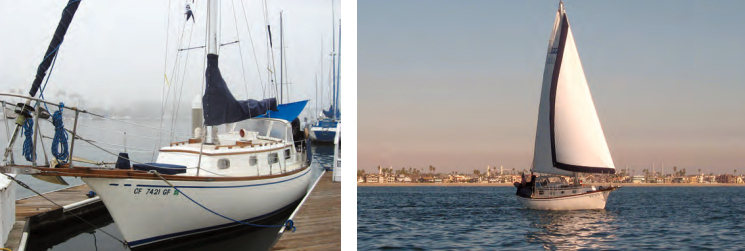
In Japan, Far East Boats was slow to adopt the new material. Only in 1967 did the company begin building hull molds for the first two models they would manufacture in fiberglass. Finally in 1968, Far East Boats turned out the last of the all-wood Mariner 35s and 40s, the yard was completely retooled, and production of the fiberglass version of the Mariner 31 was in full swing.
The transition paid off handsomely. Like Pearson (as well as many Southern California builders of the time, such as Jensen Marine, Columbia Yachts, and Coronado Yachts), Far East Boats found a strong market for its plastic boats. Because of the new material, sailboats were now affordable for the exploding U.S. middle class and builders serving that market sold everything they could produce.
Responding to the demand, in 1970 Far East Boats added the Mariner 32 (using the same hull mold as the 31 but with a wooden deck and cabin) and the Garden-designed Mariner 40 to their fiberglass models. Two years later, it added the Garden-designed Mariner 36. Ultimately, Far East Yachts delivered more than 200 units from its four-boat fiberglass lineup during the five-year period from 1968 to 1973. Then disaster struck.
Financial challenges
The Smithsonian Agreement was a byproduct of the economic turmoil of the early 1970s. It was a decision by the major nations of the world to float their currencies. Overnight, the U.S. dollar was devalued against the Japanese yen (raising the prices of Japanese goods to Americans) to the point that Kawasaki shut down both its yachtbuilding subsidiaries. Far East Boats and TOA Yachts were out of business by the end of 1971.
Clair Oberly scrambled to keep production running. He partnered with Japanese businessman Takuji Kato, negotiated for some of the Far East Boat assets, convinced about half his former employees to follow him, and reopened for business as Clair & Kato Yachts. After only a few boats were finished, this venture failed and Oberly returned to Long Beach, California, where he built a few more Mariner boats before closing shop for good. A rumored design for a Mariner 45 was never built.
The rise of Fuji Yacht Builders
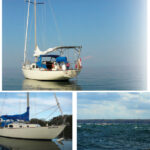
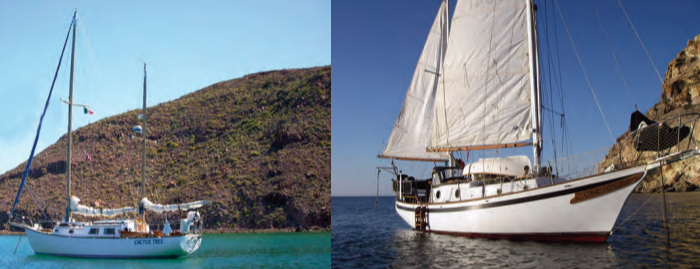
Back in Japan, a former principal of TOA Yachts and the former head carpenter of Far East Boats (Mr. Makise and Mr. Nakazaki, respectively) joined forces to start Fuji Yacht Builders in Yokosuka in the same yard where Far East Boats had turned out the Mariners. With some assets and employees of the shuttered companies, the new Fuji yard turned out a couple of one-off boats that likely used a left-behind Mariner 36 hull mold. But by 1973, with entirely new Alden designs in hand, it delivered the first Fuji 35 and began construction of the Fuji 45 model. Within a year, using the Mariner 32 hull mold as a basis and a new deck and coachroof designed by Alden, the company launched production of the Fuji 32.
While sales of the full-keel, ketch-rig lineup were initially brisk and more than 200 boats were eventually built, sales began to wane into the mid-1970s. Though the Fuji hulls were solid fiberglass and the spars aluminum, the Alden designs echoed those of the now-eclipsed wooden-boat era. In the U.S., the cruising boat market had discovered Bill Lapworth’s Cal 40 and Bob Perry’s Valiant 40. Builders and buyers alike were learning that the new material allowed for new designs and these boats were proving the speed and viability of modern underbodies with separated keels and rudders. The long-standing demand for tried-and-true traditional designs was weakening.
Five years after launching the Fuji 35, Fuji Yacht Builders responded to the market forces. In the late 1970s, it turned to Sparkman & Stephens to design, “a roomy, comfortable cruising yacht.” In short order, S&S’s Francis Kinney drafted design No. 2292 that was to become the Fuji 40, a sloop with a modern underbody — a radical departure from the full-keel Alden ketches that made up the rest of the Fuji lineup. Driven by the urgency to get with the times, the company started building the first seven Fuji 40s in late 1977 before the plans were even complete. It was probably a case of too little, too late. In the end, only about a dozen Fuji 40s were built. Less than two years later, Fuji Yacht Builders shut its doors.
As the market for recreational sailboats grew, so did the number of builders. By the time it got the Fuji 40 out the door, Fuji Yacht Builders faced increasing competition, and the disparate economies of Japan, Taiwan, and the U.S. put Fuji at an increasing disadvantage. Even in this era of fiberglass hull construction, cruising sailboats built outside Europe featured ample hardwoods above and below decks. Construction of these boats was costly in materials and skilled labor. Says Niels Helleberg, curator of the designs of the late John G. Alden, “I don’t recall what the Fuji boats were selling for, but it was not enough to keep them in business.”
Compared to Japan, material and labor costs in Taiwan came at a significant discount. Since Bill Hardin moved his operations there almost two decades earlier, boatbuilding in Taiwan had continued to accelerate. By the late 1970s, more than 100 yards — some of them very good — were turning out Tayanas, CTs, Transpacs, Masons, and more. In Southern California and Florida, the 35- to 45-foot Columbia and Morgan yachts enjoyed the competitive advantages of efficient production techniques and close proximity to market. In 1978, Catalina Yachts released its flagship 38-footer, and by the end of 1979, the Newport Beach, California, importer of Fuji yachts had stopped ordering.
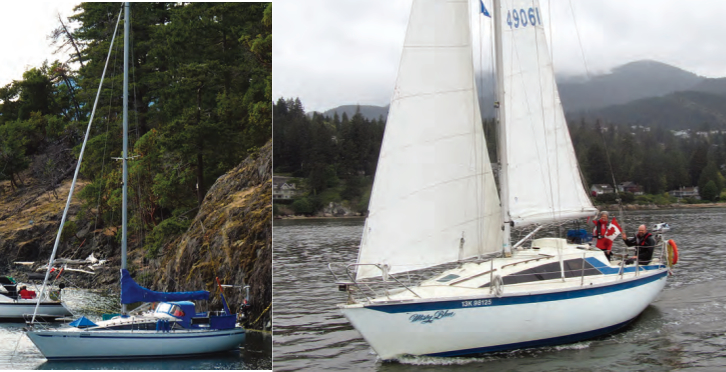
Yamaha – another approach
In 1960, at about the same time that Japanese conglomerate Kawasaki entered the production-built sailboat business through its purchase of Far East Yachts and International Marine, another Japanese conglomerate, Yamaha, got into the act. Located in Shizuoka, 75 miles from Kawasaki’s operations at the mouth of Tokyo Bay, Yamaha’s boatbuilding operation began as an offshoot of its burgeoning fiberglass operations. Accordingly, the company started on a much smaller scale, building boats under 15 feet.
Ten years later, the Yamaha model lineup had expanded to include modest-sized coastal cruisers, but in limited numbers and for sale only in its domestic market. Then, in 1975, two years after Kawasaki abandoned the production sailboat business, Yamaha made a splash on the international sailing scene. The Yamaha 29 was an ultra-modern racer/cruiser designed by France’s Jean Marie Finot. It was sold in Europe and profiled in European sailing magazines. The flush-deck, center-cockpit design showed the IOR influences of the time (such as pinched ends and modest tumblehome), but also radical elements such as an aft saloon and large transom portlights.
Within 12 months, Yamaha capitalized on its success with the launch of three additional models, the Y33, Y24, and Y25 — all of which maintained the ultra-modern design cues of the Yamaha 29. While the company employed the design input of Scandinavian designer and yachtsman Peter Norlin for this product expansion, it was also by now drawing on in-house design expertise gained over the years.
Yamaha was founded in the late 1800s by a man who, charged with repairing a musical instrument, decided he could design and build a better one. So it makes sense that, after laying a foundation based on French and Swedish design input, Yamaha decided it could do it better and formed its own in-house design team. The group spared no expense getting up to speed, taking cues from the best designers of the time.
“One afternoon, two Japanese gentlemen came to my office, dressed in dark suits,” Seattle designer Robert Perry recounted in an email. “They introduced themselves as being from the Yamaha design office. One spoke some English and asked if they could look at some of my design work. I was flattered and began to lay out drawings for them. They studied the drawings pretty much in silence. After a while one of them said, ‘Problem with American boat, not designed for human body.’ I’m six-three and as I looked at the two Japanese guys, neither of whom was over five-five, I replied, ‘Yours or mine?’”
The bold move by Yamaha to combine design and manufacture under the same roof proved to be a good one. Much like the Japanese automobile companies did in the same period, Yamaha quickly became a leader in a new technological approach to sailboat design and manufacture. Its design team was one of the first to employ computers in the design and engineering phases of production. Engineers studied hydrodynamic properties of hull models in test tanks and design enhancements followed. Carpenters built full-size mock-ups of proposed decks and interiors so that sailors could provide input before production commenced. The company taught non-sailing engineers to sail. On the manufacturing side, the company turned inward for production of much of the hardware found on Yamaha sailboats, including blocks, hatches, mast collars, latches, and chocks.
Out in the real-world test bed, Yamaha boats were on the scene proving their mettle. Magician V, designed by Yamaha’s Ichiro Yokoyama, won the 1978 Quarter-Ton World Championship. (The same designer went on to lead Yamaha’s designs for the 1992 and 1995 America’s Cup challenges.) Two years later, Linda Weber-Rettie raced her Yamaha 33, Rough & Rettie, across the finish line in the Singlehanded Transpac race from San Francisco to Hawaii. In 1983, Yamaha-built Super Witch won the Pan Am Cup yacht race. Shortly afterward, another Yamaha design won its class in the Whitbread Round the World Race.
The company’s rise to prominence was short-lived, however. Global economic cycles ultimately affected Yamaha too. By the mid-1980s, currency valuations and a softening sailboat market abroad led the company to curtail exports of recreational sailboats. But, unlike the Japanese sailboat manufacturers that preceded it, Yamaha didn’t shut its doors. Production for in-country sales continues to this day under a subsidiary named New Japan Yachts. In addition to offering a nice range of daysailers and coastal cruisers, the company continues to sell parts for the boats that last left its shores nearly 30 years ago.
Michael Robertson and his wife, Windy, bought a cruising sailboat in Mexico, sold their Washington, D.C., home, and dropped out of their high-pressure lives in 2011 to voyage with their two daughters, Eleanor (10) and Frances (7). They’re currently aboard their Fuji 40, Del Viento, heading for Mexico’s Sea of Cortez after spending more than a year cruising the North Pacific coastline from Cabo San Lucas to Alaska’s Glacier Bay. They document their journey at www.logofdelviento.blogspot.com.
The author wishes to thank Bill Kranidis and the Mariner Owners Association for historical data compiled over the years and maintained online.
Thank you to Sailrite Enterprises, Inc., for providing free access to back issues of Good Old Boat through intellectual property rights. Sailrite.com