A drop leaf makes and saves space
Issue 94 : Jan/Feb 2014
Owners of sailboats of a certain vintage face a dearth of counter space during food preparation and galley cleanup. The boat is, after all, a sailing machine and not designed to offer the equivalent of a household gourmet kitchen! Perhaps because there is so little available space to begin with, simple modifications can double or triple usable counter space without intruding on that all-important living space. Our 1978 Islander Bahama 30 was fortunate enough to leave the factory with a U-shaped galley and a reasonable amount of counter space. However, the icebox lid, range, and sink cut into that space, leaving little usable room for meal preparation.
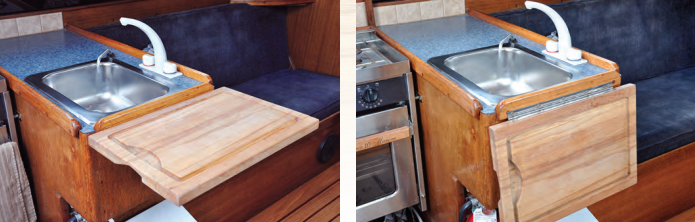
Borrowing an idea from a drop-leaf dining-room table, I came up with a convenient counter extension that can be mounted almost anywhere there’s a vertical surface. The first step was to purchase (or make) a cutting board. It proved less expensive to purchase a ready-made board at the local hardware store than to make one from scratch.
While choosing between functional and cost-effective versus decorative and expensive, I discovered a plethora of available boards. I selected one labeled “roast carving board,” as it had valleys cut along the edges of the top surface for collecting liquids. I wanted to catch the runoff when stacking wet dishes from the sink on the board. The space I had available was 17 inches on its long edge and about 12 inches wide. The board I found was a perfect fit.
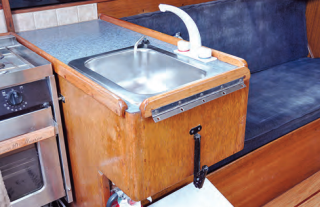
The next step was to find a support bracket that could be operated with one hand yet would be sturdy enough to take abuse. I found a simple 10-inch spring-loaded drop-leaf support made by Builder’s Hardware (Model #BH2316087) at the local hardware store for less than $15. It’s not a “marine” product but I’ve had it in place for more than eight years and it shows no sign of wear or rust.
The trick to mounting the board was to ensure that there would be sufficient space for the support between the folded board and the cabinet. The manufacturer’s mounting instructions on the back of the packaging call for a spacer at the hinge to create that room. In my case, the fiddle already on the counter provided a near perfect spacer. To add stability to the board, I attached it with a standard 3⁄4-inch stainless-steel piano hinge. Careful measurement and a steady hand had the assembly in place in no time. It’s a simple one-handed operation to raise or lower the board and it’s completely out of the way when not in use.
The added counter space is most welcome when preparing or cleaning up after meals. It also serves as a safe place for cookware hot off the stovetop, as there’s no fear of damaging the Islander’s Arborite countertop. (Not all of us old-boat owners have granite or Corian countertops.) Multiple boards could be placed in the galley if additional space is needed. This simple, inexpensive addition was well worth the effort.
Bert Vermeer and his wife, Carey, live in a sailor’s paradise. They have been sailing the coast of British Columbia for more than 30 years. Natasha is their fourth boat (following a Balboa 20, an O’Day 25, and another Islander Bahama 30). Bert tends to rebuild his boats from the keel up. Now, as a retired police officer, he also maintains and repairs boats for a number of non-resident owners.
Thank you to Sailrite Enterprises, Inc., for providing free access to back issues of Good Old Boat through intellectual property rights. Sailrite.com