An inferior anchor was a drag
Issue 94 : Jan/Feb 2014
Autumn in the northeastern part of the North American continent is a golden time of year. Gone are the summer mugginess and drab green scenery, replaced by crisp air and brightly colored shorelines. Gone too is the sailing season. Cold nights and blustery days signal winter’s rapid approach and haulout time.
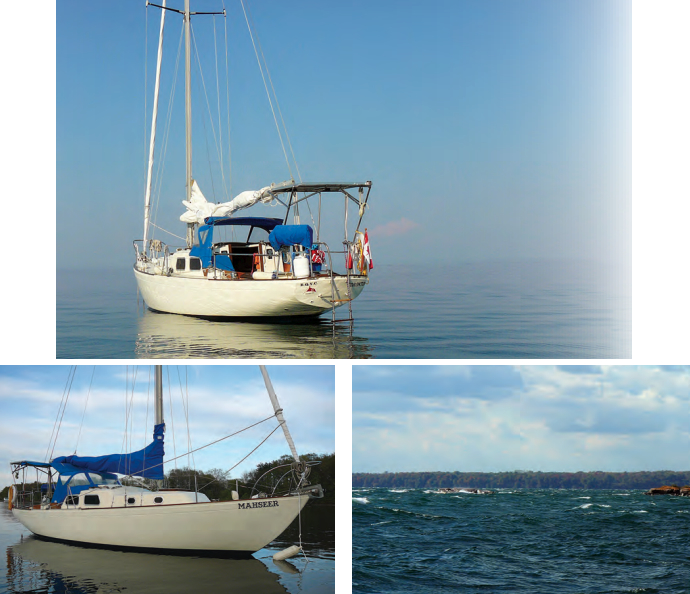
It was early October and time to bring Mahseer, our Alberg 30, from her summer mooring in Prinyer’s Cove at the eastern end of Lake Ontario to her haulout place in Iroquois, Ontario, 100 miles down the St. Lawrence River. This last journey of the season would see her travel down the North Channel between the Ontario mainland and enormous Amherst Island, across the exposed Lower Gap off the Kingston waterfront, and into the Thousand Islands to wend her way through myriad islands, rocks, and shallows.
The first day out saw us slipping quietly over steely gray water after a clammy departure from Prinyer’s under overcast skies. My unshakable shipmate, Amalia, was suffering from a cold. The forecast was for a strong westerly building to 25 knots by midday. That would push us downwind nicely. A 30-knot forecast was in it for the afternoon, but we hoped to be well clear of the exposed Kingston waterfront and into the islands by then. When we reached the Lower Gap just shy of noon, the wind piped up on cue and the following seas began to build uncomfortably as we raced past the ominous facade of the Kingston Penitentiary, making helming difficult and prompting a sail reduction to just the main with the first reef. Running down the length of Wolfe Island, we hoped for some moderation in the sea state upon reaching the immense basin to leeward of the island.
The wind lost none of its strength as we were chased down the 5-mile stretch of relatively open water toward the entrance of the so-called Canadian Middle Channel at the eastern end and thence into the heart of the Thousand Islands, with many granite islands at close quarters. Transiting the easternmost buoy in the basin known locally as the “40 acres,” we were washed into the channel by one monstrous swell in whose crest Mahseer seemed to bury her hull before starting her charge down the face.
By now the wind had apparently reached its full strength of 30 knots. As we were long past the time to take in the second reef, the boat was difficult to manage with the wind trying to bring her head up one moment and the seas kicking her stern the opposite way the next. Yet I dared not turn head to wind in those seas! Once we were in the channel, off Leek Island, the wind seemed to strengthen further and, with the seas diminished in this relatively sheltered area, Amalia held Mahseer head to wind while I scrambled onto the cabintop to wrestle down the mainsail and lash it securely to the boom. While up there, I was overawed by the raw strength of the unwavering blast. With things now under control, we continued our run under a scrap of genoa (with the engine ticking) for Mulcaster Island, a few miles downwind and a familiar anchorage we thought best under the circumstances.
Ensconced in a protected notch created by Mulcaster and some neighboring islands, we lowered the anchor, paying out the heavy chain rode with the electric windlass, and set the hook by backing the engine. This anchor is an undersized claw that came with the boat when we purchased her earlier in the season. Elated to be in safety after so many exertions, we settled in the cockpit. Hiding from Aeolus’ searching fingers under the dodger, we lit a good Jimenez cigar and downed a bottle of red wine while Otis in the background urged us to “try a little tenderness.”
Wine and a hectic day’s run make for a weary head, so at 8 p.m. we called it a day, figuring to get up for an early start on the next leg of the trip. It had been blowing continuously throughout the evening, but we felt secure nestled in Mulcaster’s bosom. I had checked our position relative to some familiar landmarks, including the brightly lit Glen Resort located on the mainland shore less than half a mile to the north and some islands in the distance to the east, and all seemed well. In fact, I had been thinking that, with the strong wind pushing her so hard, we would have a devil of a time breaking the anchor out in the morning. The air outside was positively chilly as I slipped under several layers of polar fleece blankets and buried my head in a soft pillow. What a delight to be inside our cozy little shell on such a night! Snug in my berth, I tried in vain to read Willis Metcalfe’s history of seafaring disasters on Lake Ontario. The muffled sounds of rapping halyards conspired with Mahseer’s gentle rocking to bring on slumbers.
That uneasy feeling
Just as my consciousness was about to turn the corner, I was jarred by a sudden gust eliciting a low moan from the rigging and causing Mahseer to veer on her rode, which rattled briefly against the hull. “Glad I’m snug in here,” thought I, and would have dozed off again, except for a nagging feeling that something was not quite right. With the heightened flow of wind, Mahseer resumed her former rocking attitude but now I could hear the sound of intermittent rushes of water outside the hull. “Odd,” I thought, “The wind must have shifted to the south and is now sending whitecaps into the anchorage.”
Long experience has taught me not to ignore feelings of unease. Reluctantly, I left the warmth of my berth to have a look outside. I grabbed a flashlight and sleepily slid open the companionway hatch. The sound of crashing waves was now very present as I aimed my light into the offing. My blood froze. I shall long remember that awful sight of my boat’s stern bobbing up and down in a mess of waves falling on a horrifyingly close rocky shore, less than a boat length away.
It took a while for my reeling mind to comprehend the scene. At first I thought the wind had shifted and I had paid out too much scope and we were now being pushed into the northeastern point of Mulcaster Island. But then my beam revealed a small outbuilding perched above me on the bank and I knew none existed on Mulcaster. In any event, the boat did not appear to be pounding on the bottom and perhaps disaster could still be averted. I called to Amalia, now sitting up on her bunk. “My God, we’re on a lee shore, no idea where we are. We’ve got to get her off. Bring me my pants!”
My first action was to start the engine. (God bless the Atomic 4!) Then I went forward to activate the switch on the electric windlass to bring in the chain, in the hope of drawing us toward wherever the anchor was (presumably in deeper water). The boat drew away a short distance, then suddenly stopped. Peering into the water with my flashlight, I could see a huge ball of weeds dangling on the chain. Pulling mightily, I drew the lot up to the water’s surface (a scared man’s strength, you know!), reached down, and started to tear away at the weeds in an attempt to uncover the anchor.
Meanwhile, I called out to Amalia to put the engine in forward gear and get us into deeper water (or so I hoped — I really had no idea where we were and could only assume the water would be deeper away from the island). She did so, but the boat barely moved. I ran back to the cockpit to see what the matter was and opened the throttle wide, but she still wouldn’t budge. Mahseer twisted and tugged as though she were tethered. I immediately returned to the foredeck, thinking it best to continue working on the weeds. When I finally did claw my way through the knotted mass down to the anchor I could feel something snagged there, like a cable.
A quick look with my light — By God, it was a cable! An electrical cable, probably supplying power to the island, was caught in the anchor fluke. The compound nature of this sailor’s nightmare did not escape me and I am quite certain that a few ignoble utterances passed through my lips. No sloping Titanic deck declarations of meeting fate with dignity to be passed on to posterity here . . . just sheer terror and a frantic effort to save my little ship.
With the forces acting on the boat, it was impossible to pull the wire off the anchor, and because the windlass “down” switch on the foredeck was defective, I could not lower the anchor from my position. I yelled for Amalia to toggle the cockpit switch: “Lower the frigging anchor — now!” . . .or something gracious like that. With the cable now less taut, I managed to slip it off the fluke and we were immediately released. We motored a short distance away from the island, glad to still be afloat and un-electrocuted, hearts pounding, heads dazed, and bearings lost in the darkness.
Disentangled but distraught
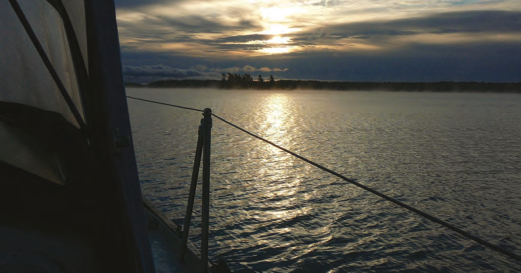
Cold and terrified, with the wind still howling, we made a few tight circles under slow power to ensure that we stayed in what appeared to be safe water until we could gather our wits. We had no way of knowing exactly where safe water might be; all we knew was that we were quite literally “between a rock and a hard place” surrounded by barely visible land masses on all sides in waters we knew to be strewn with rocks and shallows. Which of these vague outlines, we wondered, was Mulcaster, whose environs we knew well enough that we could brave going back to reset the anchor? In truth, nothing was familiar. The lights of the Glen Resort were nowhere to be seen and we could not recognize any of the near islands. We could see the occasional car lights on one of the near shores and guessed this was the mainland along which Highway 2 runs. Totally disoriented, we discussed what was best to do.
What a blessing to have a partner with sangfroid at such a time. Amalia quickly connected the depth sounder so we could at least “see” the bottom and we were relieved to find ourselves in 30 feet of water. This gave us a clue as to where we might be, but in such a vulnerable position we needed certainties, not conjectures. We decided our best course was to avoid wandering about in the dark, which would only add to our confusion and perhaps even lead us back to the fate we had just narrowly escaped.
Seeing a nearby shoreline with a few house lights to wind- ward, we cautiously approached — keeping a worried eye on the depth sounder — and deployed the anchor in 8 feet of water, the landmass ahead offering a lee from wind and seas. Then, resorting to the GPS, we were able to plot a fix and learned we were behind a point jutting from the mainland in an area of good water (with general depths of 8 to10 feet). It was just before 9 p.m., less than an hour since we had said goodnight.
Deciding to stay put for the night, I retrieved our secondary anchor from the lazarette, a Danforth type, and set off in the dinghy into the darkness ahead to deploy this anchor at a 20-degree angle to the first. I wouldn’t say that we had a restful night, but we did manage to stay put until morning. In any event, both anchors found a mud bottom this time, so we were quite secure.
The rest of the trip was rather uneventful, involving a long slog motoring downriver to Iroquois over the course of the next day, light and fluky winds, swirling cold in the exposed cockpit: the usual sailor’s routine. By the time we made harbor, Amalia’s cold had worsened and we were both a bit sore from the previous night’s exertions, but Mahseer was none the worse for wear from her adventures.
Epilogue
Tracing a line on the chart from our transposed location of that awful night back to Mulcaster, and taking the wind direction into account, it was plain that we had been blown in a straight line by that one strong gust. What remains incomprehensible to me is that we had dragged half a mile without any sensation of movement. The island on whose shore Mahseer had been cast has a depth of 10 or more feet right at its rocky edge. The other shorelines in the vicinity tend to have rocky shallows upon which Mahseer’s keel would have surely pounded. We were lucky on many scores that night and, in the course of things, some of our reactions were appropriate and others wanting.
The first consideration is our questionable claw anchor. Earlier in the season we had dragged on this very hook in the anchorage on the north side of Main Duck Island in Lake Ontario, a place I have anchored many times in various boats with different ground tackle and never a hint of trouble. The blast that hit us at Mulcaster must have been a strong one. Indeed, we later heard on the VHF radio of 30-knot gusts on that night. A skipper attends to his ground tackle, anticipating any eventuality, and I was sadly deficient in this duty.
Some readers might also question my judgement in the matter of the electric cable. In my defense, I always verify the chart for the presence of submerged cables and none were indicated as a concern for our situation. Besides, we obviously caught this cable at some distance away from our original anchorage, likely near Popham Island where we fetched up. Ironically, it was probably this very cable that prevented us from knocking into that rocky lee shore.
I believe the manner in which we dealt with our disoriented state once off the lee shore was correct. We exercised the first priority, which was to get to deeper water, made every attempt to avoid wandering too far, and then utilized the available instruments to find a relatively safe place to drop the anchor and fix our position. Going upwind toward shallow water was the best choice under the circumstances, since, once anchored, we would be swinging back toward the (safe) ground over which we had come. After ascertaining that we were in a safe place, we deployed a second anchor to hedge our bets against a repeat event.
Oh, and whatever did happen to Glen Resort’s brilliant light display? Had we interrupted its source of power? No, it had simply disappeared behind that point of land around which we had drifted.
Burton Blais is an amateur (from the Latin amator: one who loves) small boat tinkerer, adventurer, and writer who earns his funds as a food microbiologist. He has built and restored a number of boats, from sail and oar craft for camp cruising in our great northern waterways to classic plastic keelboats that enable forays toward broader horizons. When his favorite medium solidifies during the long Canadian winter, he turns to cross-country skiing to indulge his penchant for self-sufficient wandering.
Thank you to Sailrite Enterprises, Inc., for providing free access to back issues of Good Old Boat through intellectual property rights. Sailrite.com