How do boats get our attention?

Issue 75 : Nov/Dec 2010
One of these days, scientists will announce a study that shows boats excrete pheromones and that certain groups of humans are drawn irresistibly toward the sources of these invisible chemicals like bears to honey.
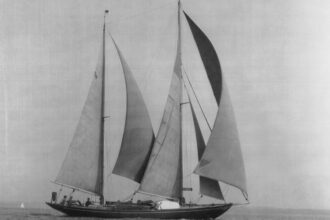
Different kinds of boats emit subtly different signals, so some of us are attracted more strongly toward wooden gaff schooners, others to ocean liners, and yet others to high-powered runabouts. Despite voicing often scathing opinions about the preferences of some of our fellow afflicted, we can sympathize with all of them.
I live in Tidewater Virginia, not on the water but on the watershed, surrounded (as I write this) by elephant-eye-high corn. So when my old sailing friend Tom called to ask if I’d like to go look at a boat with him, how could I resist?
The boat in question, an Ericson 39, was not far from my home, in one of the good old boatyards that still allow, nay, encourage, good old do-it-yourselfers. It was on the hard, surrounded by boats old and not so old in various degrees of decrepitation and resuscitation.
I wish I could report that the Ericson was in the “good” category but, after walking on squishy decks and feeling crumbling rust all over the steel keel support, I had to report that it wasn’t good enough for Tom, who was looking to sail away with the new love of his life. Not that Tom couldn’t have done most of the work needed to bring it back to life, but his house and sundry other boats he has rescued are all still works in progress. The issue wasn’t so much whether as when, and could his new friend wait?
So we moved on across the fi eld, peering at this one (its pretty steel hull looked like Belgian lace but had been recently covered by a temporary shed . . .), that one (a Cheoy Lee Pedrick 41 that I had done most of the drafting work on 30 years ago), a couple of handsome double-enders, Chesapeake deadrises (yes, powerboats, but still working!), and (hats clasped to chests) wooden wrecks one missed storage payment away from the yard’s annual bonfire. We rounded out the day with a drive down Main Street in Reedville to gaze at its wonderful old houses.
Tom happened to be towing a car on a trailer — a sports car he had built from the wheels up, a replica (somewhat modified) of a Lotus Eleven from the 1950s. From the attention it received in the boatyards we visited, it would appear that pheromone receptors have a degree of overlap.
I was grateful that Tom had dragged me away from my desk, but I came back to it full of mixed feelings: happy for the boats that were under good care, sad for those that weren’t. The nice thing about working at Good Old Boat is that most of the stories we print are happy ones about the boats whose pheromones have reached their marks.
Jeremy McGeary is Good Old Boat’s senior editor, in which position he finds a use for every aspect of a life spent messing about in and with boats — sailing, building, designing, and writing about them.
Thank you to Sailrite Enterprises, Inc., for providing free access to back issues of Good Old Boat through intellectual property rights. Sailrite.com