The cost to repair vs. the cost to replace
Issue 95 : Mar/Apr 2014
Let’s say your 30-foot good old boat needs $25,000 worth of repairs and she’s only worth $20,000. Should you make the repairs? Many dockside wags would say no. Not long ago, I noticed an article in a well-regarded sailing magazine that said if the repairs cost more than the boat is worth, you shouldn’t do it. I suppose the implication is that you should sell the boat or let it deteriorate. What’s a sailor to do? After all, we have to have boats, don’t we?
Owning a boat is not a particularly rational financial decision to begin with. It’s not going to add to your retirement fund. In fact, it will probably reduce your 401K even though it will enrich your life. But once you’ve committed to boat ownership, however irrational financially, it’s still possible to use some financial tools to guide your decisions thereafter.
One of the problems with examining whether or not to put a lot of money into an older boat is that the exercise is a lot less fun than sailing. However, spending a little time examining the best financial course can help improve your sailing experience.
This boat or that boat?
Let’s start with the proposition that, as a sailor, if you sell one boat, you’ll buy another. Therein lies the rub. Will it make more financial sense to keep your current GOB 30 and make the expensive repairs or to buy a new or newer boat, as many wags state? The answer lies in the data.
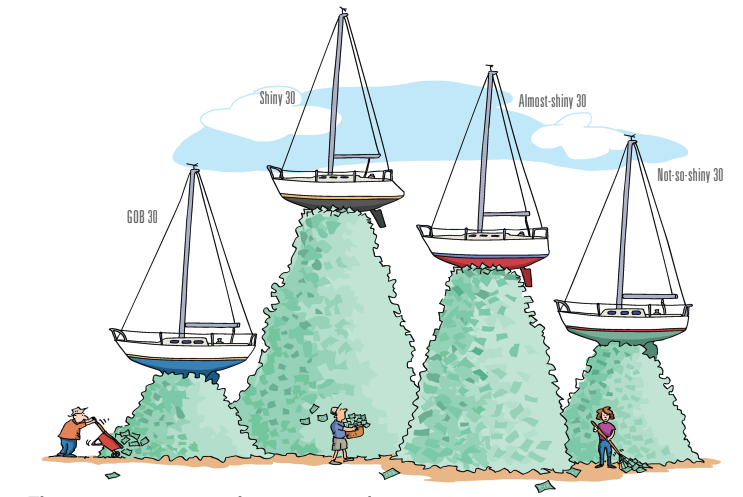
Because you’re going to own a boat, you can begin with the concept of “opportunity cost.” That’s the cost of an activity measured against the next best alternative not chosen. In the case of repairing your GOB 30, the next best alternative would be to buy a new Shiny 30 or a used Almost-shiny 30. By comparing the expense of owning another boat to that of owning and repairing your GOB 30, you can determine if it makes financial sense to make the repairs on the GOB 30.
For the purposes of this illustration, I’ll make the following assumptions:
You will keep your GOB 30, the alternative Shiny 30, or the Almost-shiny 30 for 10 years.
You will borrow money for the repairs to your GOB 30 or borrow to buy an alternative boat.
You will be able to sell your GOB 30 for $20,000 today or for $20,000 in 10 years.
A Shiny 30 or Almost-shiny 30 will depreciate at a rate of 5 percent per year.
You have good credit and can borrow at a rate of 4 percent.
Maintenance and upgrades on your GOB 30 will be $3,500 per year.
Maintenance and upgrades on a Shiny 30 will be $2,000 per year.
Maintenance and upgrades on an Almost-shiny 30 will be $3,000 per year.
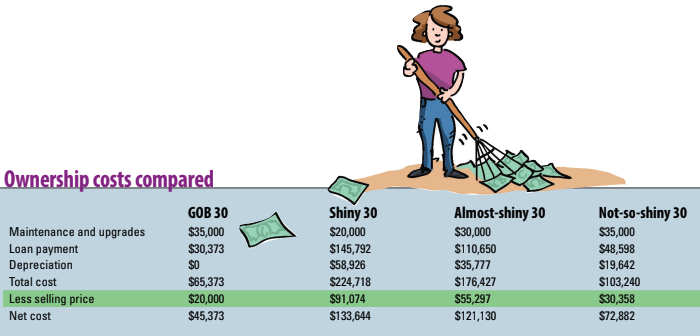
Using this information, you can determine whether it makes financial sense to hang on to your GOB 30, buy a new Shiny 30, or look instead for a 10-year-old Almost-shiny 30. I also included in the calculations a 20-year-old Not-so-shiny 30 in case your pockets are not deep enough to handle the more expensive boats.
Good old inexpensive
As you can see from the table, the most financially responsible choice is to repair and keep your GOB 30. (I could have imagined a different outcome that would favor a new or newer boat by changing some of the assumptions and data. But I didn’t, because then there wouldn’t have been an article.)
Note that the table doesn’t include the total cost of boat ownership. Its focus is only on major differences in expenses. Many of the costs, such as moorage, will be the same for all options. Besides, including the total cost of boat ownership might cause you to experience some depression and perhaps lead to increased consumption of spirits.
The outcome of your analysis will depend on your situation. Don’t automatically assume that keeping your GOB 30, no matter how emotionally satisfying, is the most financially appropriate option. Use the data as a guide and make it specific to your particular circumstances. Fortunately, calculators and computer programs make it easy to crunch the numbers. You don’t have to know the specific equations or do the math yourself, unless you are so inclined. After all, some people like to varnish teak.
The upgrade analogy
The same analysis can help with other aspects of boat ownership. To use a personal example, some years ago we thought it would be nice to have an aft cabin. We tend to have guests aboard for a week or two each year. We felt it would be more comfortable for all involved if each couple had a private cabin. We couldn’t retrofit our good old boat to make this possible.
I calculated the cost of an aft cabin, based on the prices of different boats with the characteristics we wanted. I determined that an aft cabin would cost us between $50,000 and $100,000. For this price, we determined that we could happily continue converting the main saloon settee to a double berth. If we needed more privacy and we were sailing in an area with hotels, it would be much cheaper to rent a hotel room. If we were in the wilderness and really needed more privacy, someone could sleep on the beach. Even chartering a boat for a week or two a year would be a better financial option.
Emotion sometimes wins
On the other hand (a well-worn economics term), you have to keep in mind that there is an emotional aspect to boat ownership. I once had a boat neighbor who owned a Hinckley Bermuda 40. He put three times as much money into that boat as he would ever get out of it. He loved that boat and so did I.
As this example illustrates, financial calculations do not have to be the determining factor in your whether-to-sell-or-maintain decision-making process. After all, at $200,000 a pop, how many of us would choose to have children if we based our decision solely on the cost of raising them?
Instead, the finances should be only one aspect, albeit a grounding one, for your decisions. Emotion can and does sometimes trump the bottom line. I’m guilty of succumbing. Now that I’ve moved into my seventh decade, we’re thinking about replacing our good old boat with one that’s easier to sail and has more creature comforts. The cost of this change is going to be nearly as expensive as putting our kids through college . . . but the ability to sail for another 10 to 15 years? Priceless.
Carl Hunt is a semi-retired economist living in Colorado. He has sailed for more than 30 years and has cruised his boats from British Columbia to Mexico. He has also chartered and cruised other people’s boats throughout the eastern United States and the Gulf of Mexico, the Caribbean, the Mediterranean, and other parts of the world.
Thank you to Sailrite Enterprises, Inc., for providing free access to back issues of Good Old Boat through intellectual property rights. Sailrite.com