On burying a sailor you’ve never met
Issue 95 : Mar/Apr 2014
“For the truth is that I already know as much about my fate as I need to know. The day will come when I will die. So the only matter of consequence before me is what I will do with my allotted time. I can remain on shore paralyzed with fear. Or I can raise my sails and dip and soar in the breeze.”
–Richard Bode
When we finally pulled into Santa Barbara Harbor, we still had the ashes. We’d never committed them to the Pacific. We hadn’t let them swirl in the cold sea winds. Neither my friend Jacob Ells nor I ever found out exactly how the 74-year-old died. We’d never actually met him. The rumor around Oakland’s 5th Avenue Marina was that, while serving in the Vietnam War as a pilot, Jurgen Arnsdorff had been in a fiery crash and breathed fumes that had damaged his lungs. It was believed that they eventually caved in on him.
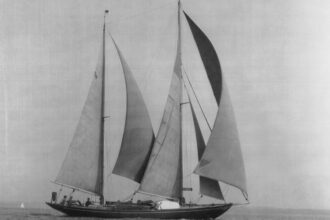
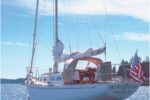
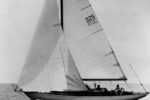
Not long after Jurgen’s death, Jacob bought Jurgen’s 1967 Pearson Invicta II, La Flaneur, from his long-time girlfriend. Though it had been sitting for a year, it wasn’t hard to tell Jurgen had loved the classic fiberglass racer. From the halyards to the fuel filters, he’d hand-painted hundreds of parts his favorite color — green. He’d customized the inside of the roomy cabin and refitted the deck. Other than the engine, the 38-foot yawl was set to cross oceans.
As Jacob explored his new vessel, he found the lockers and lazarettes filled with a treasure trove of spare parts and pieces, and the girlfriend called often with more useful bits she’d found among the boxes and bins of her Bay Area condo. It was during one of these calls she asked us to take Jurgen’s ashes to sea. In a breeze, we accepted.
Jurgen joins the crew
At the time it seemed natural, just another ripple in the hurricane of preparations for our first offshore voyage, something every new boat owner did. In our mid-20s, we hadn’t buried many people. Our understanding of a funeral was a circle of crying friends and relatives dressed in black, a hole in a grassy cemetery, and a rock with a name and dates carved into it. We knew that choosing someone’s grave must be done with reverence and respect. But really, we thought we’d just dump the old guy overboard and be done with it.
Upon our visit, the girlfriend, also very much along in years, hesitantly sent us off with the remains in a heart- shaped urn along with two small food barrels and a panel for our windvane. No instructions for burial. No recommendation for a final resting place. When we got back to the boat, Jurgen went on a shelf with other necessary cruising supplies: a crossbow, a trumpet, a bean plant, and a pair of duck eggs we had high hopes of incubating.
The next few months were spent outfitting. The crusty tinkerers who hang around 5th Avenue’s wobbling docks knew Jurgen. As Jacob tweaked his new engine, they told him about Jurgen’s cruise to Europe and through the Panama Canal on the same boat. They talked of his craftiness and his playboy nature. They pointed to the well-designed galley with a Force 10 stove and lines of spice-jar holders as evidence of Jurgen’s culinary prowess.
As we got to know the boat, we got to know her previous owner. In the V-berth, we found a picture of a naked woman, just a torso with arms raised. In one of the lockers, we found scuba gear. In the head, we discovered tiny platforms fit exclusively to his toiletries. From Sailing the Farm to The Riddle of the Dinosaur, we read his books. Jacob even donned Jurgen’s bright red foul weather gear on occasion.
It became common to include our cremated crewmate in conversation. We’d tell people how we’d been asked to spread the ashes and they’d ask who this man was. We always told them what we knew. Our parents and relations became familiar with the story and they often offered unique ways to dispose of him.
“Maybe you should sprinkle him into the paint and varnish, so he’ll become part of the boat,” my mom had suggested. She’s an artist.
Jacob’s dad often forgot the old man’s name and called him “Yurdigan.” He’s an engineer. Nonetheless, they were both friendly to him.
A vague plan
With small savings put aside, both Jacob and I had quit our jobs to embark. We figured we would go where the wind took us when it took us. Our intended direction from San Francisco was south, but we had little set in stone after Southern California. Maybe we’d take the trades over to Hawaii then on to the Line Islands, Fiji, and the tropics. We’d find work in New Zealand for a few months and just keep going. That was just one of our many ideas.
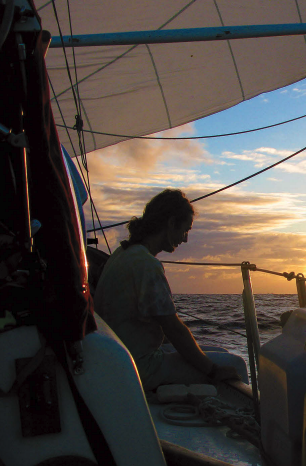
We started down the California coast. Jurgen now had a special place on the shelf, surrounded by many of his former belongings. A fresh breeze and clear sky gently delivered us to Half Moon Bay. We thanked Jurgen. When the engine died just around Point Conception, we cursed him. The chain of calamities and small successes led us to Santa Barbara.
There were a few occasions when we could have scattered the ashes, but at no point did it really seem right to make Jurgen walk the plank and sail off without him in his own boat. For the time being, we decided we’d keep him on board. It seemed to us that’s where most mariners prefer to be. We would keep looking for a suitable place and waiting for the appropriate time. It might be a little odd to wander around the world with the remains of a man we’ve never met. But, I suppose, stranger things have happened at sea.
Dylan Silver is a freelance writer and photographer based in California. When he’s not sailing, he’s wandering the mountains and coast, always on the lookout for stories and adventure.
Note: Dylan wrote to tell us he and Jacob ended up burying Jurgen when they were exactly halfway between California and Hawaii –Eds.
Thank you to Sailrite Enterprises, Inc., for providing free access to back issues of Good Old Boat through intellectual property rights. Sailrite.com