Sporty covers for cherished Sport-a-Seats
Issue 95 : Mar/Apr 2014
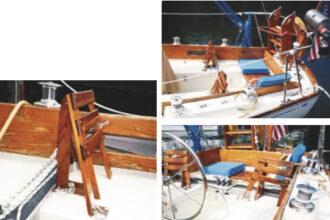
In early 2006, this magazine published a photo of the founding editor taking her morning leisure, her feet up and her body reclined in a way totally foreign to every sailboat I have shipped aboard. The agent of her apparent comfort was a legless, multi-position recliner called a Sport-a-Seat. The accompanying text heaped praise on this must-have sailboat accessory.
It so happened that Olga and I had just sailed up to Puerto Rico from Grenada. This is important because shipping to most of the islands in the Caribbean is complicated and/or expensive, but Puerto Rico is a U.S. territory, which usually means standard shipping from the mainland is available and affordable. Indeed, Sport-a-Seat did (and does) ship to Puerto Rico so, based on such a glowing recommendation, we ordered a pair.
The immediate impact of these seats was such that, right away, we could not imagine ever being without them again. We became protective, stashing them up under the dodger to keep them dry when not in use. Keeping them clean was more of a challenge, particularly as they instantly became our seats of choice for eating alfresco, which more often than not we do thrice a day. The excellent Sunbrella upholstery cleans easily enough, but frequent cleaning surely shortens the life of the fabric, just the opposite of our aim.
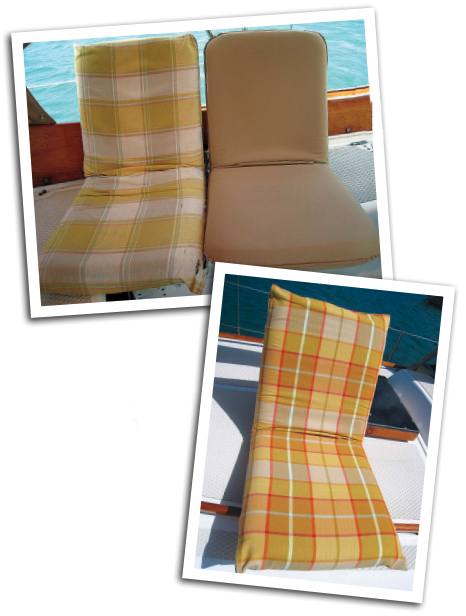
In our linen locker we found a pair of new king-sized pillowcases that had come with a sheet set we modified to fit our V-berth. They proved to be a good fit, except they were about four inches too short. Still, they instantly provided 90-percent coverage. They also gave us the model for the longer covers that we determined to sew as soon as we found a suitable fabric.
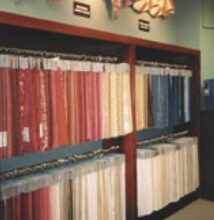
Our quest was short. We had often admired the colorful madras fabrics in Martinique, and in a few short weeks we were there. Madras is most often a plaid cotton or cotton and silk fabric used for comfortable clothing, but in Le Marin, Mme. Ozier-Lafontaine offered a generous selection of heavier madras decorator fabrics. We bought enough to make two longer pillow cases with overlapping end-flaps.
In addition to protecting the original upholstery, bright slipcovers provide an attractive contrast to bland cockpit colors. Madras does fade over time, but we found the evolution pleasing. We remove and wash these covers at least once a season. The photo of two seats shows how “new” the protected original Sunbrella fabric has remained, even though these chairs are more than five years old and have seen full-time daily use for around three of those.
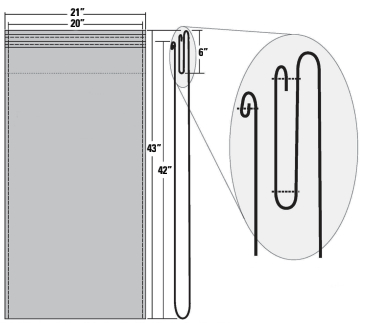
The cut width is 21 inches. The cut length is 43 + 42 + 1⁄2 + 1⁄2 + 6 + 6 + 1⁄2 = 98 1⁄2 inches
Stitch the hems in both ends of the blank before sewing the side seams.
One-piece slip-on cover
The project detailed here is the replacement of our five-year-old madras covers with fresh ones. To avoid an under-leg seam at the front, we make the cover from a single piece of fabric that wraps over the bottom end to form both the front and back. It also wraps over the top to form a retaining flap. The decorator fabric we chose came in a 2.8-meter width (a little over 9 feet), making its width about 10 inches longer than the length we needed for the cut size. For narrower fabric, the blank would be cut lengthwise, but if the pattern or the economics require it, you can certainly make this cover in two pieces seamed together at the bottom.
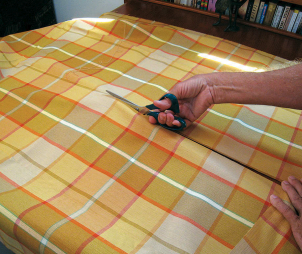
A one-piece cover starts as a long narrow rectangle of fabric, rendered dead easy to cut accurately with our plaid pattern. Sew a 1⁄2-inch double hem on one end. On the other end sew a 6-inch hem with the raw edge turned under 1⁄2 inch. This becomes the overlapping flap end. The double-thickness here helps it hold its shape.
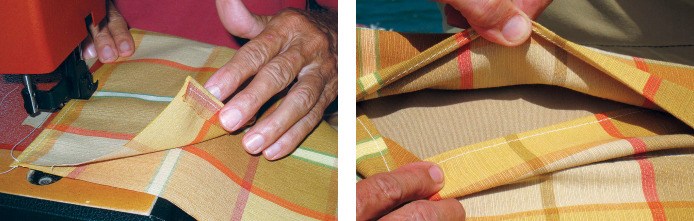
Completing the cover is nothing more than seaming the two sides. Binding these seams is not essential, but it does make the job neater and cuts down on loose threads when removing the covers to wash them. Reverse the finished cover, leaving the flap turned inside out, and slide it over the straight Sport-a-Seat, starting at the bottom. When the seat is fully inside the cover, reverse the flap to lock the cover in place.
These covers encase the seat’s carrying straps, which we never use. If you want a carrying strap, it would be easy enough to fabricate one and capture its ends in one of the cover’s side seams.
Our finished covers turned out slightly tighter than planned because the fabric seller was less generous than I had anticipated with the cut length. The measurements I provided here create a slightly looser cover, a feature you’ll appreciate when installing and removing it. You can also alter the measurements to make this cover fit a different folding seat, but judging by the alternative seats I have seen, the better course is to not prolong their brief lives but to save your money to buy the real deal.
It is not possible to overstate the improvement in comfort, at anchor and under way, that our two Sport-a-Seats have provided. Our other cockpit cushions are now just in the way — except when we have guests aboard. Our solution to that has to wait until we sail again up to 18° N.
Don Casey became the authority on boat fix-it projects with This Old Boat and is the author of several other books about maintaining, repairing, and restoring good old boats. He and his wife, Olga, have been cruising aboard their 1969 Allied Seawind since 2002.
Thank you to Sailrite Enterprises, Inc., for providing free access to back issues of Good Old Boat through intellectual property rights. Sailrite.com