Taking a leaf out of Good Old Boat
Issue 95 : Mar/Apr 2014
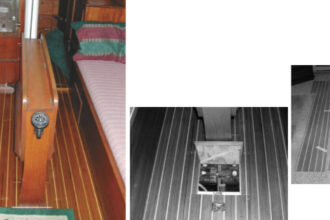
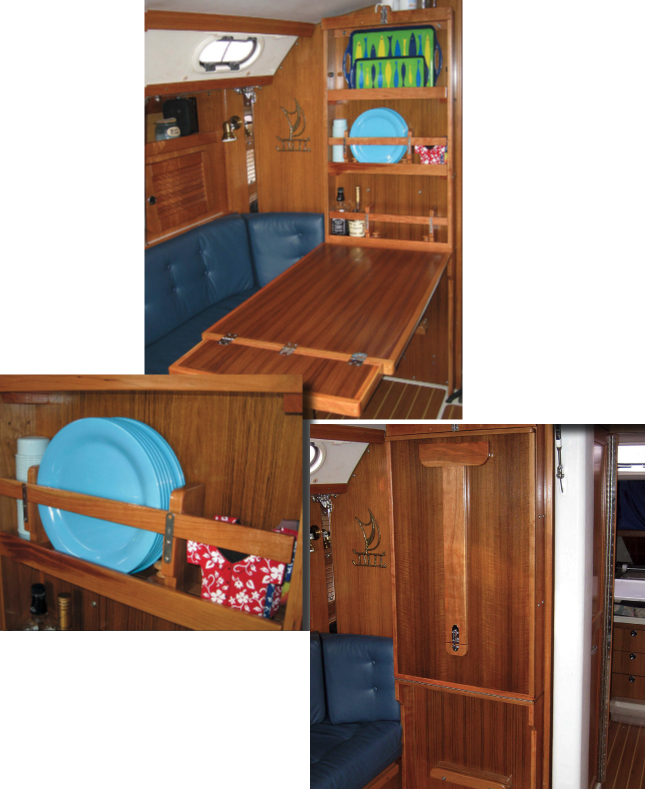
I was intrigued by an article by John Lively in the May 2009 issue of Good Old Boat, “The Case for Books.” John replaced the factory bulkhead-mounted table on his Catalina 36 with a much more convenient and useful bookcase and fold-down table. John’s article inspired me to make a similar modification to our Catalina 36. If not for John’s article, I’d still be in the pondering stage. I’m pleased with the result, which follows his concept with a few variations in the details.
My first priority was to ensure I could set up the table with ease. Storage would be a secondary feature. I don’t need to store lots of books, but I could use the space to relieve storage in the galley and other areas. I also wanted to keep the cabinet shallow; mine is only about 5 inches deep.
A big difference between my approach and John’s was that I wanted to be able to convert the dinette area to a small double sleeping berth, mainly to handle grandkid weekends. I left the area under the cabinet open to let me set a couple of plywood panels in place to support the cushions for the double berth. This part of the project is still a work in progress. I’m planning a small removable table about 8 inches deep to rest at settee level under the cabinet. This is on my list of winter projects.
I departed again from John’s design by making my shelves adjustable in height. (That’s not likely to happen, but I wanted to keep the option.) That meant my fiddles had to move with the shelves while also allowing me to reposition the bookends that I patterned after John’s system. The result was my “floating fiddles” that basically rest on each pair of bookends to hold stuff in place. Time will tell if this works out, but so far so good. (I am building the fiddle for the top shelf this winter — I ran out of wood.)
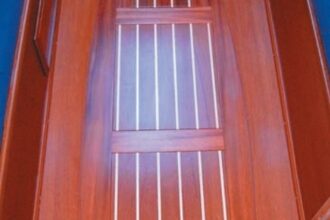
I used cherry for the solid wood parts and teak plywood for the tabletop. Cherry was about half the cost of teak and I figured (hoped) the finished product would blend with the teak the builder used throughout the cabin. This worked out nicely when I applied a natural unstained finish to all of the new surfaces.
Chuck Rushing is a self-taught sailor. He began at age 12 in an 8-foot pram he and his father built from a Sears kit and is still learning 55 years later. Chuck and his wife, Judy, now happily sail their Catalina 36, Anabel, out of Solomons, Maryland, cruising Chesapeake Bay and adjacent waters.
Thank you to Sailrite Enterprises, Inc., for providing free access to back issues of Good Old Boat through intellectual property rights. Sailrite.com