The elusive measure of comfort at sea
Issue 97 : Jul/Aug 2014
The subject of seakindliness comes up any time the conversation turns to long-range cruising. Someone who asks about a particular boat, “How seakindly is she?” wants to know how the boat responds to severe weather. Does she handle wind and wave without the helmsman having to fight the helm to hold course? Will she heave-to and remain steady? Does she provide a shorthanded crew with some level of comfort and security? In other words, is the crew dry, reasonably comfortable, and unlikely to succumb to seasickness because of the motion?
The prerequisites for a seakindly boat are usually perceived to be heavy displacement, a full-length keel, moderate draft, relatively narrow beam, slack bilges, and a moderate amount of overhang forward and aft. Another attribute that’s considered beneficial, particularly with regard to upwind sailing, is good freeboard forward with enough flare to deflect spray and prevent the bow from burying in an oncoming sea.
The type of boat described above was popular after World War II. Designed under the CCA Rule, it usually had a full keel but, especially after the success of the Phil Rhodes-designed Carina and the S&S-designed Finisterre, might have been a keel/centerboarder, although these designs often had wider beam. Among the underwater configurations most often mentioned in regard to being seakindly are those of the Rhodes-designed Bounty II and Reliant and the Atkins/Crealock-designed Westsail 32.
These older hull forms from a previous design philosophy are seldom if ever offered by production builders today. By modern standards of performance they are slow and not very nimble. They may well be exceptionally good looking in a traditional aesthetic, but they lack speed and responsiveness. My own C&C Corvette falls into that latter definition, as some of my guest helmsmen have let me know in no uncertain terms!
The question is, what is the price we have to pay in performance to achieve seakindliness? Are the two mutually exclusive? To answer that, we must look at the characteristics believed to convey seakindliness compared with those required to achieve performance.
Displacement
In The Proper Yacht, published in 1966, Arthur Beiser states that the recommended displacement of the ideal cruising boat would be (0.8LWL + 4)3. For a 30-foot LWL, that results in a displacement of 22,000 pounds or a displacement/length ratio of 364, which is moderately heavy. Not surprisingly, the majority of boats profiled in his book are of the full-keel or keel/ centerboard configurations. Just as the book was published, however, the Cal 40 entered the picture, winning the SORC and the Bermuda Race in 1966.
High displacement dampens motion by increasing momentum and inertia. Momentum is important — it helps maintain speed in a seaway so each wave encountered does not have as much of an adverse effect on the forward speed of the boat. Increased inertia causes a heavy boat to take longer to accelerate to speed but also prevents the boat from responding quickly to the vertical acceleration of waves. Since the boat reacts more slowly, the motion is more gentle.
When it comes to pitching, however, things are more complicated. Weight in the ends of the boat can lead to excessive pitching or hobbyhorsing. As the bow rises to a wave, the rotational momentum maintains the upward motion excessively until the bow drops again, when the momentum then maintains the downward motion until it’s damped by the impact with the sea. That’s why on all racing or performance-oriented boats, no matter what their displacement, the goal is to concentrate weight amidships to avoid excessive wave-induced pitching.
Lighter ends react more quickly than heavy ends but travel through shorter arcs. The result is higher frequency but lower amplitude of motion. Which is more comfortable? Some argue that higher frequency of motion is more uncomfortable than greater amplitude, or more pronounced motion at a slower speed is more comfortable than less motion at higher speed. The general consensus is that heavier boats are more comfortable at sea than lighter boats, no matter the weight distribution.
Complementary characteristics
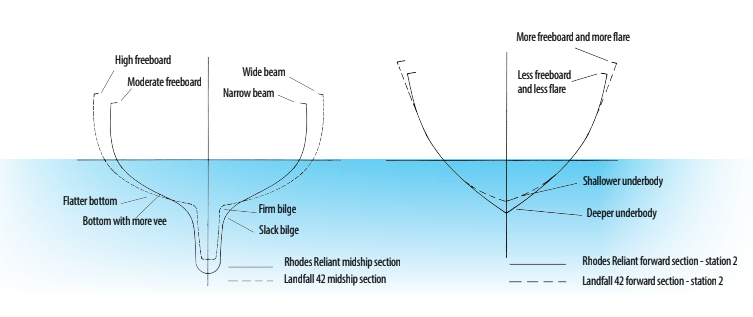
Boats that are described as seakindly are relatively narrow of beam and have the slack bilges reminiscent of the Metre boats (the 12 Metre and 6 Metre classes, for example) of the International Rule and the early R-boats of the Universal Rule. In both keel and keel/centerboard designs with this configuration, the transition between the hull canoe body and the fin keel is not distinct — one morphs into the other with very generous fillets between the keel and hull.
As designs changed over time, the keel became more distinct and welldefined and the rudder became separate from the keel, remaining well aft as the trailing edge of the keel moved forward. Displacements became lower (primarily to improve off-wind boat speed), bilges became firmer, bottoms became flatter, forward sections more U-shaped, and beam increased, especially aft. The trend in modern production boats has certainly been in the direction of characteristics that improve performance rather than those that impart an easy motion.
It should also be said that lighter displacement generally results in lower costs. Boats, like a lot of commodities, can be priced by the pound. Of course, when taken to an extreme where lighter displacement is achieved with more expensive materials and processes, price does go up. Wider beam also allows more generous and roomy accommodation plans and greater cabin sole area. Extending that beam aft permits sumptuous aft cabins and generous cockpit space. So those changes that tend to have performance benefits also permit more spacious interiors and cockpits.
Narrower beam reduces torsional rolling movement or “corkscrewing” of a hull in a confused sea. The greater the beam, the more tendency the boat has to roll in any sort of cross or quartering waves. It is for that reason that some people consider catamarans uncomfortable in those conditions.
In the March 2014 issue (see “The Once and Future Bow”), we saw how bow shapes have changed with overhangs and flare forward giving way to plumb stems. If bow overhangs and flare “cushion” the impact of waves and throw spray away from the hull, then it follows that any design eliminating these features would compromise seakindliness. Aft overhangs are often mentioned as being important in maintaining seakindliness — the pitching motion is reduced or damped by the stern overhang becoming immersed as the bow overhang rises to the wave. Just as increased beam allows for larger interiors, longer waterlines and shorter overhangs allow more usable space forward and aft.
The middle ground
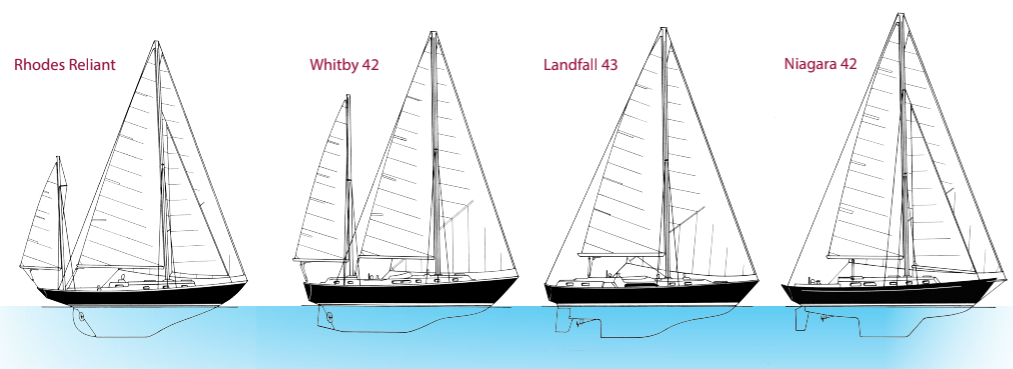
Do you have to give up performance and maneuverability to achieve a seakindly boat? It’s one thing to be comfortable and quite another to be the last boat on the ocean. In preparation for the New Age of Sail exhibit at the Marine Museum of the Great Lakes at Kingston, Ontario, we have been documenting the large number of Canadian boatbuilders operating in the 1960s and ’70s (see “Resources,” page 19). The huge growth in sailing in this time period was brought on by the combination of the postwar economy and the introduction of fiberglass boatbuilding. Three 42-footers that emerged during this time period provide an insight into how three prominent Canadian builders accommodated the growing demand for cruising designs.
One of the first boats that showed this change in direction was the Ted Brewer-designed Whitby 42 built by Kurt Hansen of Whitby Boatworks in 1971. It is a center cockpit cruising boat with a traditional full keel, and one of the first designs to depart from the dual-purpose racer/cruiser philosophy of the time. It ended up being even more traditional than Ted himself envisioned. While Ted wanted to introduce the now famous Brewer Bite between the keel and rudder to reduce wetted surface, Kurt Hansen would have none of it, wanting a more conventional underbody. As a result, the Whitby 42 is the most conservative design in our group, being the earliest and most traditional.
The second Canadian builder to tackle the cruising boat concept was C&C Yachts with its Landfall series. During my 15 years designing for C&C, the principal goal was usually performance. Seakindliness did not come up for discussion very often because C&C and its competitors were designing dual-purpose racer/cruisers, not world-girdling cruisers. At C&C, that changed with the introduction of the Landfall line of pure cruising boats and with the design and building of the 67-foot offshore cruising schooner Archangel. New Zealander Sir Peter Blake later acquired Archangel and appreciated her comfort and performance when sailing offshore.
Neither the Landfalls nor Archangel had traditional full-length keels. Their rudders were mounted on long skegs linked to the keel to provide directional stability. Although certainly not light-displacement boats, neither were they obscenely heavy. Beams were moderately wide and drafts were shallow but without centerboards. Bilges were not as slack as the postwar boats, keels were more distinct but with generous keel radii, hull configurations were sharper forward than the typical IOR shapes of the racing boats, and they had more freeboard and fuller sections forward.
The first of the series, the Landfall 38, was a rework of the C&C 38. The 42 was the first true dedicated cruising design, but C&C didn’t reach its stride with this series until the Landfall 39, 43, and 48.
When I joined Mark Ellis Design in the mid-’80s, this racing/cruising conflict did not exist. Mark’s very successful Hinterhoeller-built Niagara and Nonsuch lines and his Aloha 32 were aimed squarely at the cruising market and eagerly embraced by it. Even the magnificent custom Mark Bruckmann-built Rangely and Andy Wiggers-built Bonaventure were pure cruising boats.
Mark’s philosophy was always to create a traditional cruising design aesthetic above a modern “performance” underbody. Right from the beginning, he abandoned the full-length keel in favor of a distinct keel and rudder configuration and even eliminated the rudder skeg in favor of a low-aspect-ratio all-movable cantilevered spade rudder. His hull shapes had some slack in the bilge and were sharp forward with moderate bow overhang and flare. They had generous freeboard, moderate rather than light displacement, and moderately wide beam.
Quantifying comfort
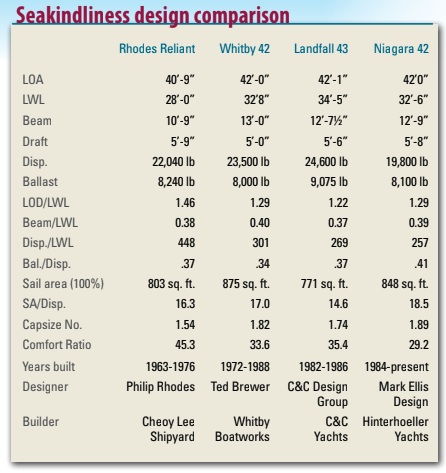
Ted Brewer attempted to address seakindliness in his much quoted Comfort Ratio. While I may quibble that Ted’s ratio is not “non-dimensional,” it does illustrate how sailing comfort diminishes as displacement decreases and beam increases. Note that all the boats discussed here are in the conservative range. The Rhodes Reliant has a Comfort Ratio of about 45 while the more modern boats average around the low 30 range. However, even Ted admits that his Comfort Ratio is only a guide and cannot possibly take into account all the factors that affect comfort at sea, which can vary from person to person, depending on their resistance to motion sickness and fatigue. However, as a first cut, the Comfort Ratio does give an indication of seakindliness and, when taken in context with the other performance parameters, gives a valuable indication of the trade-off between comfort and performance.
We can see in this comparison the evolution from the cruising-hull shape of the 1940s and ’50s, that was renowned for seakindliness, to the more modern configurations that improved performance and livability while still maintaining a higher degree of sailing comfort than their more extreme racing brethren. This direction was also reinforced in the work of other postwar cruising boat designers in the new era of fiberglass. Bill Crealock and Bob Perry are just two examples, and both of them designed classic “modern” cruisers like the Pacific Seacraft 37 and the Valiant 40 based on sacrificing a little bit of seakindliness for increased creature comfort and improved sailing performance.
Rob Mazza is a Good Old Boat contributing editor. A lifelong sailor, he writes about good old boats from the vantage point of having been involved in the design of a good many of them.
Thank you to Sailrite Enterprises, Inc., for providing free access to back issues of Good Old Boat through intellectual property rights. Sailrite.com