A ubiquitous trailerable cruising sailboat
Issue 107 : Mar/Apr 2016
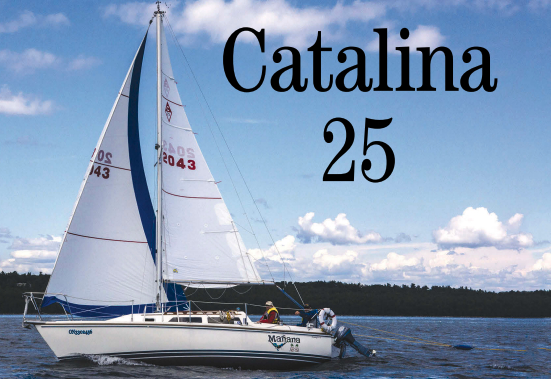
Catalina Yachts of Woodland Hills, California, produced the Catalina 25 from 1978 to 1990 from a design by the company’s founder and president, Frank Butler, and chief designer, Gerry Douglas. More than 5,000 of the boats were made, backing up the builder’s reputation for offering well-designed boats at a reasonable price. Catalina has a good reputation for customer service, even for discontinued models. (For a history of Catalina Yachts see “Catalina Yachts: One Big Family,” in the January 2001 issue, and for insights into trailerable boats, see “Trailer-Sailer Choices,” January 2014.)
The first Catalina 25 I inspected for this review was Bill Bennett’s 1989 model, Mañana, but winds were so light our test sail was not very helpful. I was later able to get aboard and sail a number of different boats, and those boats and their owners are mentioned in the “Under Sail” section of this article.
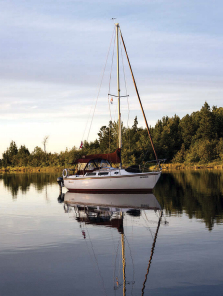
Design
Over the years, the Catalina 25 underwent several design changes. The first boats had a cast-iron swing keel. That was followed by cast-iron and cast-lead fixed fin keels and eventually a wing keel. The 25 was also offered in standard- and tall-rig versions.
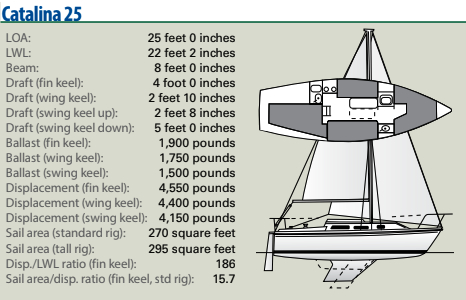
As with most Catalinas, the 25 is intended to be a decent, uncomplicated, all-around family boat that behaves well. Even the tall-rig version has a sail area/displacement ratio of just 17, which is fairly tame. The displacement/ LWL ratio is somewhat light at 186, so the boat will not be a dog.
The flat sheer, while not classic in style, helps maximize interior space within the given length, as does the vertical transom. The raked bow is typical of the design era. A feature common to Catalinas is the sloped aft cabin face that makes it more comfortable to sit in the cockpit with your back against the bulkhead.
The swing-keel Catalina 25 weighs 4,150 pounds, the fin-keel version weighs 4,550 pounds, and the wing-keel version weighs 4,400 pounds. If you add around 1,500 pounds for a trailer and items stored on the boat, you end up towing at least 6,000 pounds, although one owner I interviewed weighed his boat and trailer at 7,800 pounds, including outboard motor, gear, and some provisions. Owners I spoke to said the boat tows nicely with a 1⁄2-ton pickup or a large SUV, such as a Chevrolet Suburban.
Construction
Catalina used heavy, hand-laminated, single-skin roving-and-mat hulls with fiberglass liners. The hull liner incorporates the berth flats and other furniture and, bonded to the hull, helps distribute loads. As a result, the bulkheads do not bear chainplate loads. An overhead deck liner has a smooth, easy-to-clean surface. The deck has a plywood core. The shoebox-type hull-to-deck joint is fastened with self-tapping screws.
Most owners commented that their boats have held up well, but with a few problem areas. Several said the old aluminum-frame windows eventually leak. Some fixed the leaks with sealant and others obtained replacement kits from Catalina. A few mentioned hull blisters and gelcoat cracks and others mentioned replacing the original glassed-in through-hulls. The turnbuckles and spreader brackets on older models reportedly were prone to corrosion and should be replaced. Some of the wiring was buried under fiberglass and difficult to troubleshoot.
Owners who reported these problems also noted that, between Catalina Yachts’ service department and an active owners association, they were able to find solutions and replacement parts as well as encouragement.
On deck
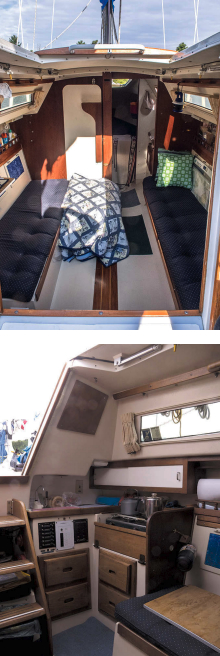
The Catalina 25’s cockpit is nearly 8 feet long, so it will comfortably seat four people under sail. Six can fit, but any more than that and someone would be in the way of the tiller.
The sidedecks are 7 inches wide, one of the compromises made between on-deck convenience and interior space. They work for careful movement from cockpit to foredeck, although some owners found them to be a bit too narrow for comfort. If the dodger is much wider than the companionway, it is a bit tricky to get around. Running halyards back to the cockpit helps.
he anchor well in the bow is too small to hold anything but a Danforth-type anchor. Some owners have added mounts on the bow pulpit for alternative anchors.
Belowdecks
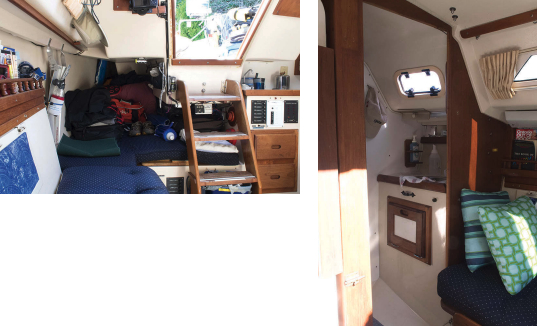
The full fiberglass hull liner makes it easy to keep the interior clean, but it can get in the way when owners want to make repairs or modifications. The boat was offered with two layouts, one with a dinette in the saloon and the other with two settees. The boat was extensively redesigned in 1987 with an updated deck and less teak inside.
A pop-top was an option up to 1987 and standard thereafter. With the pop-top down, headroom is limited to 5 feet 6 inches. With it up, standing headroom in the main cabin area is 6 feet 4 inches and, with a canvas skirt, it can be left up while at anchor, a nice plus for cruising. The pop-top is heavy, however, and several owners said they never raised it for that reason.
The main cabin can seat four comfortably for dining. A small galley is located at the aft end of the cabin. It has a small sink and an area for a small cooktop, but not much prep space. I’ve cooked a few times on this boat and found it necessary to use the table as a prep area. I also noted in a 1988 model that the cabintop slopes down enough over the galley that I could bump my head if I wasn’t careful. Some owners said the icebox did not hold ice very long until they added more insulation. Catalina reportedly improved the insulation in models built after 1983. Some owners said they use a large freestanding ice chest to supplement the built-in icebox.
Opinions on the V-berth range from “cramped” to “tight but usable.” I suspect these comments are related to owner width and height. A few said they filled in the space between the saloon settees with plywood to create a single large berth. Several owners said the quarter berth was only really usable for a child.
The head compartment, located at the forward end of the cabin aft of the V-berth, provides reasonable privacy when closed off from the saloon.
The amount of storage space is good for a boat of this size, especially if the quarter berth is used. Several owners use plastic baskets to organize their quarter berth storage. Those who sleep on the settees are able to take advantage of the V-berth for additional storage. Space under the settees on some boats is taken up with holding tanks and freshwater tanks.
Under sail
With a PHRF rating of 228 for the standard rig and 222 for the tall rig, the Catalina 25 is not especially fast for its size, but it is more than adequate for cruising. For comparison, the aging Cal 25 and Pearson 26 outboard models also rate 222 seconds per mile, while a J/24 rates 171 in many fleets.
Motoring speed with a 6-horsepower outboard is about 5.5 knots. Upgrading to an 8- to 10-horsepower outboard will increase speed to about 6 knots. Most of the Catalina 25s I have seen use a long-shaft outboard to reduce prop cavitation in rough water.
Several owners commented that handling the outboard is much easier if the controls are brought inboard. Otherwise, one has to reach through the transom and down to grasp them. Some owners have yoked the outboard motor to the rudder to provide a single steering control via the tiller. I’ve watched Catalina 25s rigged this way back down to anchor near shore and the combination of inboard controls and yoked outboard makes it look like a piece of cake to perform this otherwise awkward maneuver.
The mainsheet traveler on the stern does not have a lot of range. Some owners said it is adequate in combination with a good boom vang. A few have moved the sheet to mid-boom for more off-the-wind control.
I had test sails on Ripples III, a 1984 swing-keel model with the tall mast owned by John Reuteman of Ohio; Taranui, a 1987 wing-keel model owned by John Clement of Ontario; and Belladona, a 1985 wing-keel model owned by Mike Forbes of Indiana.
Our sail on Belladona was in flat water and very light air ranging from 0 to 5 knots. Even in the light air, Belladona tacked nicely, albeit slowly, under full mainsail and a 110 percent jib. Upwind, we ghosted along at 1 to 3 knots on a close reach, accelerating in the puffs. In this light air, Belladona sailed very flat.
Our sail on Taranui was just ahead of an approaching thunderstorm. Under a headsail rolled in to about 100 percent and full main, we zoomed to windward at around 6 knots in 10 knots or more of wind, sailing relatively flat in lumpy water. In those conditions, pointing about 50 degrees off the wind, Taranui tacked quickly and easily. As the wind built, gusts caused us to heel to around 15 degrees. With the sky rapidly turning black, we dropped sails and headed to the nearest anchorage. Taranui held her nose nicely into the wind while we dropped sails. After we dropped anchor, Taranui backed down with no noticeable prop walk.
Our sail on Ripples III was the most exciting, as we had 8 to 15 knots of wind on all points of sail with a 150 percent genoa and full mainsail. My notes showed we sailed close-hauled at 3.6 knots with an apparent wind of 8 knots, accelerating nicely in the puffs. At 10 knots apparent wind, we reached 4.7 to 5 knots and were heeled over at about 30 degrees. John said he has heeled as much as 40 degrees in a stiff breeze when he hasn’t hanked on a smaller jib. On a beam reach in around 6 to 7 knots apparent wind, we sailed fairly flat at 3.5 knots. Sailing in 5 knots apparent wind on a broad reach, we hit about 5 knots speed over the ground. Dead downwind in 1.4 knots apparent wind, we reached about 3.4 knots SOG. Ripples III tacked and jibed smartly on all points of sail.
With the engine controls brought inboard, Ripples III backed nicely out of her slip. In the slip with the swing keel up, she was very tender, but she was more stable with the keel down. Both wing-keel models were less tender at anchor or in a slip. Lowering the swing keel was relatively easy. However, raising it took considerably more effort, even with the mechanical advantage provided by the hand crank.
Setting up and launching
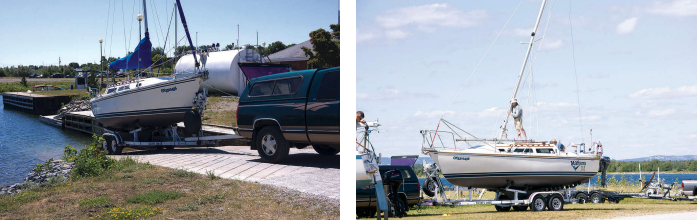
At most boat ramps, because of its draft, the fin-keel version generally requires a trailer tongue extension in order to get the boat far enough into the water to float free. Owners with swing-keel boats can usually launch without the need for an extension.
The mast is tall and heavy enough that mechanical advantage is recommended to raise it. A-frame rigs attached to the toerails are frequently employed to raise and lower the mast, along with bridles for side-to-side support. The A-frame is attached to a masthead halyard and to a 4:1 block and tackle at the bow that is led back to a cockpit winch. It’s easiest to raise or lower the mast if one person is in the cockpit cranking while another watches for snags and keeps the jib and furler in line with the mast. Once the mast is all the way up, the stays can be reattached.
Setting-up time will depend on how much of the rigging has been detached for trailering. Including the time taken to install the outboard and load cruising supplies, it can take a couple of hours, so it’s unlikely that one would daysail this boat from the trailer. On a cruise, a few hours for setup and takedown is not very much.
Conclusion
Prices on the Catalina 25 range from around $5,000 to $10,000 depending on age, condition, and equipment. Prospective buyers should check the hull for blistering, the keel bolts, the swing-keel’s cable and winch, and the rudder connections They should also look for turnbuckle cracks, and any evidence of window or hatch leaks.
One owner summed this boat up well by saying that it is reasonable in every significant regard: reasonably spacious, reasonably well-built, sails reasonably well, and is reasonably priced.
Mike Nelson is a retired engineering psychologist and the past president of the Trailer/Sailors Association. He and his wife, Diana, sail Eventide, a Pacific Seacraft Flicka.
Thank you to Sailrite Enterprises, Inc., for providing free access to back issues of Good Old Boat through intellectual property rights. Sailrite.com