Don’t be shocked by aging insulation
Issue 110 : Sept/Oct 2016
When we were in Patagonia a few years back, we tied up at a marina in Puerto Montt for several weeks. We dug out our power cables and the appropriate connectors and adapters and connected to shorepower at the nearest power box. All was good for a while, but every few hours the ground fault circuit interrupter (GFCI) tripped and Nine of Cups, as well as three other boats connected to the circuit, lost power. This was annoying. The marina manager called an electrician to investigate. We were embarrassed to learn that the cause of the problem was our 5-year-old power cable.
Insulation starts to deteriorate as soon as it’s manufactured. Ultraviolet rays from the sun, harsh temperatures, and the marine environment’s salt water hasten the process. Ultimately, deterioration can allow current to leak from the power conductors to the ground wire or, worse, to the surface of the insulation — a potentially dangerous situation.
A GFCI device detects leakage and interrupts the circuit, before anyone gets hurt (we hope). The insulation in our 5-year-old cable had apparently degraded to the point that the leakage current was right at the threshold required to trip the breaker.
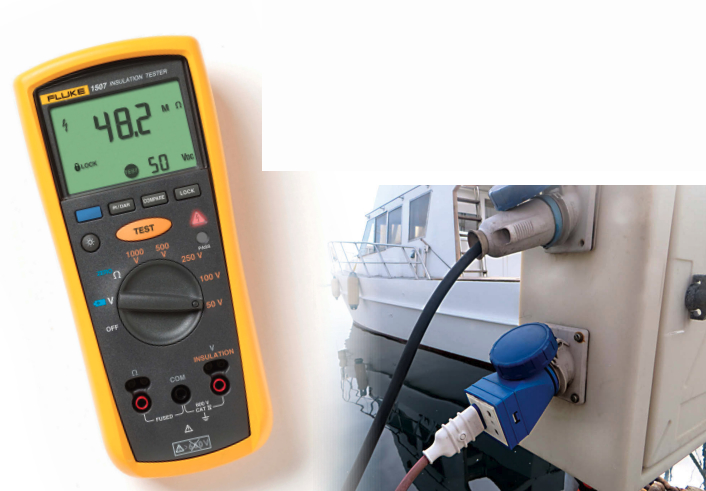
Unless the insulation has completely broken down, the insulation resistance of a power cable cannot be checked with an ordinary multimeter. Most multimeters check resistance by applying only a few volts and a much higher voltage is necessary to see any measurable leakage. The instrument needed to measure the quality of the insulation in a cable is a megohmmeter.
A typical megohmmeter differs from a multimeter in the ohmmeter mode in three ways. First, a megohmmeter applies a much higher voltage — typically 500 to 1,000 DC volts (VDC). Second, a megohmmeter can typically measure resistance up to 2,000 megohms, whereas a multimeter measures up to about 1 megohm. Third, the output of the megohmmeter has a high internal resistance, making it less hazardous to use despite the high voltages present.
Not long ago, a megohmmeter was the size of toolbox and cost several hundred dollars. Today, a basic tester for checking insulation is the size of a handheld multimeter and can be purchased for less than $75. If the budget will allow, it is a handy device to have aboard.
Testing a power cable
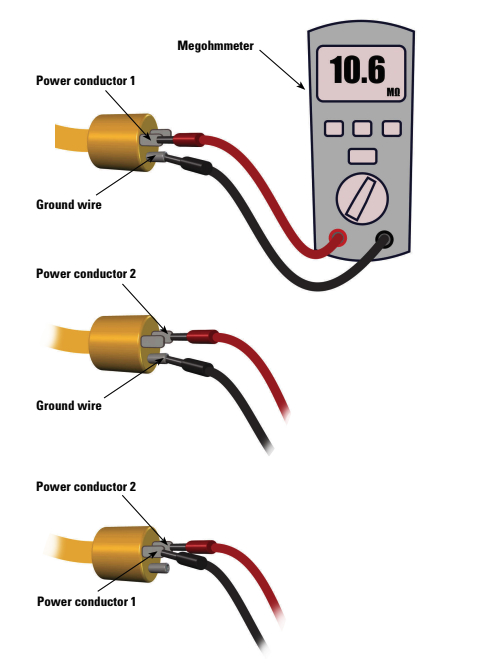
The simplest way to check the insulation of a marine power cable is to conduct what is called a Proof Test.
- Disconnect both ends of the cable to be tested.
- Connect the black test lead between the common terminal on the meter and the ground wire of the cable.
- Connect the red test lead between the Volts/Ohms terminal on the meter and one of the power conductors.
- Select the 1,000-volt setting.
- Press and hold the test button for several seconds. (It may take a second or two for the resistance reading to stabilize.)
- Repeat the test between the second power conductor and ground and again between the two power conductors.
In all testing configurations, the resistance between any two conductors should be higher than 1 megohm. Older or more sophisticated megohmmeters may use a different procedure for checking cable insulation; refer to the owner’s manual.
Tools and motors
Getting a little tingling feeling when using your power grinder? You might want to check its insulation before using it while standing in a puddle of water. Connect the megohmmeter between each power conductor and the ground conductor. The resistance between either of the power conductors and the ground should be at least 1 megohm. For double-insulated tools, which have only two prongs on the power cord plug, connect the tester between each of the power conductors and any exposed metal on the tool. Again, the resistance should be at least 1 megohm. (Note: the resistance between the two power conductors will be low — a few hundred ohms or less — which is normal).
The megohmmeter can also be used to check the insulation of the winding of motors and alternators. For an alternator or brushless DC motor, the stator windings should be disconnected from each other and the resistance checked between windings and between the windings and ground. For brush-type DC motors or generators, the brushes should be removed and the resistance checked between the coils separately. For a 12-volt motor or alternator, all resistances should be a minimum of 100,000 ohms.
Transformers
Some boats incorporate transformers on the incoming AC shorepower circuit, either to provide isolation from shorepower or as a step-up or stepdown transformer to convert 220 volts AC (VAC) to 120 VAC or vice versa. We have a 1-kilovolt-amp (kVA) step-down transformer aboard Nine of Cups. The megohmmeter can be used to check the insulation of the windings.
The transformer should be disconnected from shorepower and onboard circuits, and the resistance of each winding checked against the other and to ground. For a typical 120 VAC isolation transformer, all resistances should be greater than 350 megohms. For a step-down, step-up, or 220 VAC isolation transformer, the resistance should be greater than 650 megohms.
While a megohmmeter may not be an essential tool to have aboard, it is certainly a useful one. Now that they are reasonably priced, it may make sense to buy one.
David Lynn and his wife, Marcie, have been living aboard Nine of Cups, their 1986 Liberty 458 cutter, since purchasing her in Kemah, Texas, in 2000. In those 16 years, they have sailed her nearly 90,000 nautical miles and visited some of the more remote places in the world in their ever-so-slow circumnavigation. Nine of Cups and crew returned to U.S. waters in April of this year, making landfall in Culebra, Puerto Rico, before heading to St. Augustine, Florida. The Lynns are currently cruising the Chesapeake Bay. Find them on their website at www.nineofcups.com or their blog at www.justalittlefurther.com.
Thank you to Sailrite Enterprises, Inc., for providing free access to back issues of Good Old Boat through intellectual property rights. Sailrite.com