A dry suit is put to the test on the Gumby immersion course
Issue 110 : Sept/Oct 2016
Most sailors who venture upon cold water have given considerable thought to the consequences of having to abandon ship, and some carry immersion suits against that rare but real possibility. I carry aboard a dry suit that I wear when kayaking and also as foul weather gear when sailing in cold and wet conditions, and I wondered if it was a practical alternative to an immersion suit.
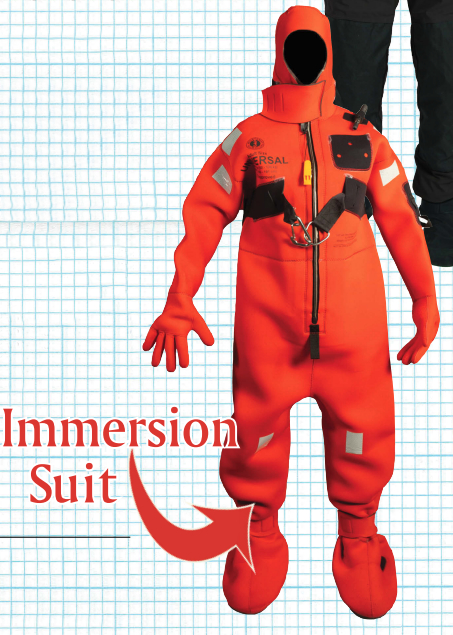
Just the thought of abandoning ship is scary. The likely outcome of jumping into in icy waters is even more scary. Survival times are short. Some will go into shock on contact, gulping water, and the best will remain functional for only 15 minutes and perish within 1 to 2 hours, even when wearing a life jacket and foul weather gear. For this reason, commercial vessels that work cold waters (defined as 59°F or colder) are required to carry immersion suits (also called survival suits and, colloquially, Gumbys).
Although minimum function standards for immersion suits require a wearer be able to walk and swim, it’s impossible to work a boat in one. These ungainly one-size-fits-most creations give the wearer the grace — and the look — of a B movie creature. They are carried as a last resort, to be donned only when the boat is heading
down, which is perhaps too late if the sinking is sudden.
A dry suit, in contrast, is a multi- purpose garment, useful to the sailor for a variety of tasks. It can serve as foul weather gear in severe conditions, be worn when kayaking, or be donned prior to diving to inspect for underwater damage or to untangle a line.
Dry suits have long been the gear of choice for frostbite dinghy sailors, allowing them to compete safely and in relative comfort while being drenched by cold water. They have also become standard issue for sailors who race in the southern oceans where they must endure long shifts on decks swept by freezing water.
A dry suit can also be helpful when someone has to go into the water to assist in recovering a man overboard (MOB). And if that MOB happened to be wearing a dry suit because conditions were cold and wild that day, his prospects for survival would be that much greater.
In other words, a dry suit is versatile gear that every cold-water sailor might want to own and use. Furthermore, the cold-water protection seems comparable to that of an immersion suit — perhaps infinitely better because you are more likely to be wearing it.
Before sending anyone out to buy a dry suit, I decided to test my theory by comparing characteristics of dry suits line by line with the U.S. Coast Guard construction and function requirements for immersion suits as laid out in Title 46 of the Code of Federal Regulations, Part 160, Subpart 160.171 – Immersion Suits (67 CFR 160.171). Although I didn’t have a bright orange, tricked-out ocean racing suit available to test, my very rugged Ocean Rodeo Soul was designed to withstand the rigors of windsurfing.
Testing protocol
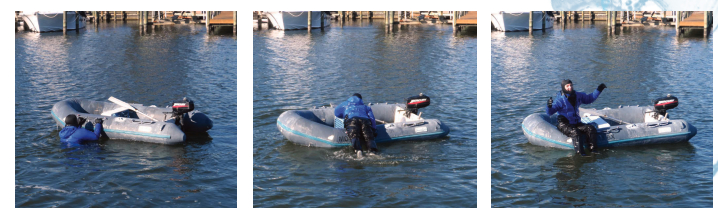
When comparing how my dry suit is constructed against the specifications for immersion suits, it seems clear that some requirements deserve allowance. For example, immersion suits are intended for use by anyone who needs to grab one. An adult immersion suit must fit any fully clothed person from 110 pounds to 330 pounds in weight and 4 feet 11 inches to 6 feet 2 inches in height. Any sailor can purchase a dry suit of the appropriate type, size, and fit.
I skipped certain tests that were not applicable, such as resistance to fire and diesel fuel, but I added one of my own. On one occasion, I intentionally opened a zipper a few inches and flooded my suit in 50°F water just to see the effect. While quite unpleasant, it was certainly better than foul weather gear and more like a wet suit; the water was warmed within a few minutes. Swimming was more difficult, as the suit became progressively heavier and provided no place for water to exit. However, unless the neck seal fails, air is still retained in the upper portions of the suit and provides buoyancy.
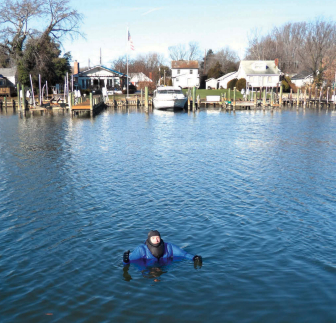
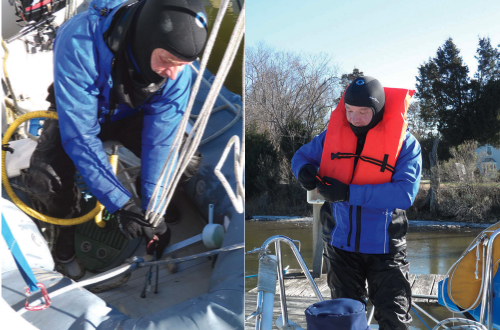
For the tests that involved agility and in-water activities I added a 5/7-mm Neoprene dry suit hood and 5-mm Neoprene gloves, essential accessories for diving or cold-water survival. A lovely 35°F day with thin ice on the water provided the required test conditions, while my crew took refuge in the heated cabin.
Dry suit redux
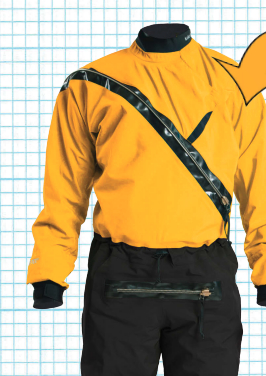
Dry suits are made for a variety of users, from military special forces to divers to windsurfers, and are made from materials best suited to their purpose. Many diving suits, for example, are made of Neoprene. Dry suits for sailors and paddlers who spend most of their time out of the water are made from waterproof breathable materials (Gore-Tex is one) akin to those used for high-end foul weather gear.
Dry suits block all water entry by means of tight seals around the neck and wrists. These are always too tight, by design, but are designed so they can be trimmed (per the manufacturers’ instructions) for a comfortable but watertight fit. While the neck seal may be slightly uncomfortable, there is zero chance of a cold dribble down the neck.
Most dry suits have attached waterproof socks over which you can wear wet-suit shoes, deck shoes (they need to be one size larger than street shoes), or Neoprene dinghy boots — eliminating the need for bulky seaboots when the suit is worn as foul weather gear. (You can also wear socks inside the suit for warmth.)
In a suit designed for sailing, internal suspenders keep everything in place. The suit is entered by means of a special waterproof zipper, which might be over the shoulders or across the chest.
Immersion suit construction standards
General
The regulation requires immersion suits to be made of closed-cell foam to provide insulation and flotation.
Impact resistance
A wearer must be able to jump into the water from 4.5 meters without injury and the immersion suit must not dislodge or suffer damage.
Seams
Stitched seams must meet a federal standard and glued seams must have a strength of at least 50 pounds.
Closures and seals
In the jump test, there should be no undue ingress of water.
Hardware and metal parts
Hardware must be easy to operate by the wearer and metals used must be galvanically compatible.
Suit exterior
The primary color must be a specific “vivid reddish orange” and reflective panels are required. The exterior surface must pass a tearing and abrasion test.
Buoyant materials
An immersion suit’s buoyancy must not depend on inflated compartments.
Hand and arm construction
Immersion suits are required to have gloves integral with the sleeves.
Leg construction
Immersion suits must be designed to minimize air being trapped in the legs when the wearer enters the water headfirst (to prevent inversion).
Foot construction
The immersion suit must have integral (attached) feet with non-slip soles.
Size
An adult immersion suit must fit any fully clothed person from 110 pounds to 330 pounds in weight and 4 feet 11 inches to 6 feet 2 inches in height.
Immersion suit performance standards
Buoyancy
The regulation requires an immersion suit to have 22 pounds of buoyancy.
Righting
An immersion suit must self-right from a face-down position in 5 seconds.
Thermal protection
An immersion suit must not allow the body temperature to drop more than 3.6°F in 6 hours. Moderate activity with a pulse rate of up to 140 beats per minute (BPM) is permitted for the first hour, and a maximum of 120 BPM thereafter.
Water penetration
An immersion suit must not leak more than 100 mililiters during the first 2 minutes and 500 mililiters in an hour.
Donning time
An immersion suit must be capable of being donned within 2 minutes.
Swimming and water egress
A person wearing an immersion suit must be able to swim 25 meters and climb into a life raft.
Field of vision
Immersion suit standards allow for some restriction of vision.
Hand dexterity
A person wearing an immersion suit must be able to pick up and write with a pencil after 1 hour in 41°F water.
Walking and climbing
The walking and climbing tests are designed for shipboard use.
Dry suit construction standards
General
My dry suit does not meet the flotation requirements because it lacks foam, but wearing a life jacket would supplement the flotation.
Impact resistance
I jumped from 3 meters three times wearing my dry suit. I observed no significant shifting of the suit and the suit and I survived unharmed.
Seams
I did not pull seams apart, but I did do a pull test equivalent to the standard without damaging the suit. I have been kayaking and sailing in this suit for two years during which time it has proven pretty rugged.
Closures and seals
My dry suit closures all remained intact.
Hardware and metal parts
My dry suit is made for windsurfing. I lube the zipper periodically to ensure it works smoothly and to help keep it watertight.
Suit exterior
My dry suit was available in red, but I bought a blue floor model on discount at a boat show (so I really should add reflective panels!). Dry suits are made of tough fabric but are vulnerable to catastrophic failure if torn. A dry suit would be a little cold if flooded — as would an immersion suit. However, the suit will still hold the water in place where it can be warmed by the wearer’s body, providing some level of insulation.
Buoyant materials
Most dry suits do not provide buoyancy other than the air that is trapped inside. I was very comfortable wearing a life jacket over my suit.
Hand and arm construction
A sailor who intends to use a dry suit as a survival suit will need to buy separate warm gloves. I use 5-mm Neoprene gloves in the coldest weather.
Leg construction
Air does not become trapped in the legs of a well-fitting dry suit.
Foot construction
Dry suits are made with a variety of foot treatments according to their intended use. My suit has attached feet and during this test I wore two pair of fleece socks under it — nice and warm.
Size
Dry suits are made in many types and sizes, so any sailor can buy one that fits, and it’s normal to wear clothing inside for warmth.
Dry suit performance standards
Buoyancy
I grabbed steel dumbbells off my boat’s transom one at a time until I was floating as if in a swimsuit: water at my chin with my head tilted head back. I needed 40 pounds of weights if I made no special effort to burp air from the suit. Although this easily exceeded the standard for buoyancy, I could lose it all if the suit suffered a leak. I needed a life jacket anyway to match the requirements for head support and self-righting.
Righting
My dry suit would not self-right because the air moves around inside it, making me stable in any position. A life jacket of the right type quickly righted me.
Thermal protection
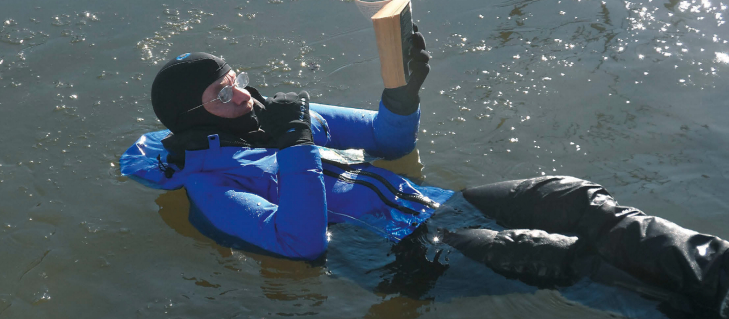
I spent a portion of my time in the water performing swimming and boarding tests, a portion enjoying a swim around the harbor, and a portion toward the end as quiet time, reading a book.
I eventually ended the test at 2 hours on account of boredom. By this time, my core body temperature had actually risen 0.4°F. My little fingers did get slightly cold, but were still warmer than the standard requirement of 50°F. They warmed up if I swam a few strokes to redistribute warm air (my palms read 65 to 70°F). My feet stayed comfortably warm (62°F at the toes, 80°F at the arch), and my legs and torso were very comfortable as long as I rolled over every 5 to 10 minutes to redistribute warm air within the suit (I managed to do this while reading my book and kept it dry!).
Under the suit, I was wearing long underwear, fleece top and bottom, and two pair of fleece socks — the clothes I typically wear in freezing conditions. To make the dry suit more like a survival suit, I also wore a 5/7-mm Neoprene diver’s hood and 5-mm gloves during the test (these could be carried in a pocket while working on deck and donned in the water if suddenly needed in an overboard situation).
Water penetration
Reasoning that my clothes would absorb any water that leaked into my dry suit, I weighed them before and after my series of tests. The weight gain after 2 hours was .25 pounds, well below the 1.1-pound weight of the 500 mililiter limit for 1 hour, and this included the jump test, which would ordinarily be conducted separately. I believe that all of the gain was from perspiration and inadvertent drips while removing the dry suit. I was quite dry and not at all clammy.
Donning time
While it takes a little practice to put on a dry suit, anyone who does it regularly can probably do it in close to 2 minutes. I usually wear my suit as foul weather gear and for warmth as soon as the weather gets wild, so being able to don it quickly isn’t such a big consideration.
Swimming and water egress
While the regulation allows these tests to be performed in a warm pool, I performed them in a 33°F harbor as part of the thermal protection test. I anchored the inflatable dinghy the required distance from the boat (25 meters) and easily performed the swimming test and boarded the dinghy in the required time (30 seconds).
Field of vision
Vision from a dry suit is restricted only by the hood, which can be lowered or removed (its only purpose in the water is to provide warmth).
Hand dexterity
My 5-mm Neoprene gloves easily pass the test for warmth and dexterity; I was able to turn the pages of a book, clip carabiners, operate plastic buckles, and untie knots after 2 hours in 33°F water. Depending on the suit, Neoprene gloves could be carried in a pocket.
Walking and climbing
A dry suit allows mobility by design, and typically does so better than most foul weather gear. Often after I’ve been kayaking I forget I have it on and continue to go about my business.
Strengths and weaknesses
Strengths
Immersion suit
- More robust
- No accessories required
- One size fits all
- Easy to don
- Less expensive ($300-$800)
Dry suit
- No water ingress
- Wearer’s agility is much better
- Can be worn in all situations where
high risk of MOB exists - Can be worn as foul weather gear
in cool or cold weather - Very practical in situations that
involve a life raft - Sailor will be practiced in its use
- Multiple additional uses
Weaknesses
Immersion suit
- More potential for water leakage
(no seal at the neck) - Wearer cannot function as well
when sailing or swimming - Not helpful in the event of an
unpremeditated MOB - Time needed to locate and don
during rapid sinking or capsize
Dry suit
- Failure due to tear is possible
- Must wear separate shoes, gloves,
and hood - Must wear life jacket to ensure full
buoyancy and righting - Must be fitted to individual
- Additional donning time required
(should be worn in situations with
a high risk of immersion) - More expensive ($650-$1600)
Personal experience
My Ocean Rodeo Soul dry suit has a feature of special value to sailors: because the suit includes a built-in jacket and hood, and because the closure is by a zipper across the shoulders, it is practical to work in what Ocean Rodeo calls standby mode, with good ventilation through the shoulders and neck while maintaining the same protection as standard foul weather gear.
When I use my dry suit for hull cleaning or other diving under the boat, I use fins to help me get down and a weight belt to achieve neutral buoyancy. Because the entry zipper on the Ocean Rodeo Soul is across the back of the shoulders, the best way to minimize retained air in the suit is to descend the boarding ladder to mid-chest before pulling the zipper the last 1⁄4 inch. For deck wear, and when thinking about survival in the water, I simply squat before pulling the zipper closed. This prevents the awkwardness caused by over-inflation while still providing considerable buoyancy.
I like a Neoprene beanie (made by Ocean Rodeo and others) when kayaking or sailing in the rain. It keeps my hair dry, like a swim cap, and will not blow off. For diving and severe cold-water protection, I switch to a 5/7mm dive hood. This is unpleasant on deck, but it keeps the critical neck area warm. It could be kept in a pocket.
A face mask adds considerable warmth by keeping the top half of the face warm, leaving only a small area around the lips exposed. It also gives a better view in spray and would be a survival asset in cold, stormy waters. I always take a mask when going in the water in sub-55°F temperatures, if only just in a parking position around my neck. A snorkel wouldn’t hurt. There are good reasons Navy rescue swimmers wear these.
Conclusion
It is not my intent to persuade anyone that a dry suit can replace an immersion suit in all situations. However, after my immersion experiment, I feel that a good dry suit with the proper accessories comes very close to meeting all the requirements of an immersion suit while offering dramatic advantages in wearability and utility.
If the probable risks are sudden sinking, rollover, capsize, or MOB, a dry suit is the more practical choice. If you are sailing in cold waters, you really should have at least one dry suit on board anyway, if only for its usefulness in underwater maintenance and emergency repairs or MOB recovery. In my case, as a year-round sailor and frequent singlehander, a dry suit provides safety no other garment can. The real questions are whether you need something for every member of the crew and whether that something is a dry suit or an immersion suit.
A conventional immersion suit offers more robust protection and flotation in a commercial setting, where one-size-fits-all makes sense, where user familiarity may be less, and where a boat sinking over some time period is the greater risk. I just don’t feel that is the real world of sailors, whether cruising or racing. I like my dry suit.
Drew Frye cruises Chesapeake Bay and the mid-Atlantic coast aboard his 34-foot catamaran Shoal Survivor, searching for out-of-the-way corners known only by locals. A chemical engineer by training, 40-year climber and 30-year sailor by inclination, he brings a mix of experiences to solving and writing about boating problems.
Thank you to Sailrite Enterprises, Inc., for providing free access to back issues of Good Old Boat through intellectual property rights. Sailrite.com