A latecomer to rowing dips in her oar
Issue 113: March/April 2017
The title of Richard Bode’s wildly popular little book says it all: First You Have to Row a Little Boat. I don’t know how many copies of this book have sold since its publication in 1993, but I have personally purchased (and subsequently given away) three.
I missed the rowing step in my boating career, and for that my nautical education has been incomplete. I grew up in central Indiana, far from any large bodies of water. My family waterskied and we towed our ski boat to many lakes and reservoirs, launched it, skied for an afternoon, and then towed it home to await the next outing. There was no rowboat in the picture, and no lazy days on the water learning its ways.
As a college student, I was a camp counselor one glorious summer in Minnesota. I learned a little bit about sailboats that summer and saw the best northern lights display ever. There were no rowboats, though, nor lazy hours to idle away with one.
I met Jerry somewhat late in life. He was racing a Flying Scot three times a week in a very competitive one-design fleet on Lake Minnetonka, west of Minneapolis. We had a good time sailing, but there were no rowboats for me there either.
We married, bought our C&C 30, and put a kayak aboard as our dinghy. I have always loved the time spent on that kayak as much as I have loved our sailing experiences. But you do not row a kayak. The skill of rowing continued to elude me.
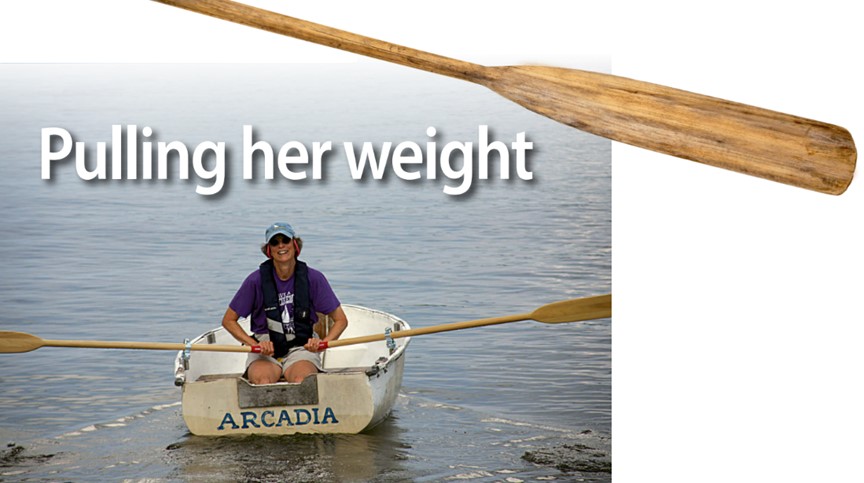
During the past summer I began to make amends. A couple of sailors in our marina offered their dinghies for my rowing pleasure. Jerry bought me a pair of oars and off I went on short trips outside the marina whenever time allowed and a dinghy was available.
At first I was frustrated. My arms didn’t work in unison. I would typically dig deeper with one oar than with the other and have to compensate with an extra stroke every so often. I frequently dragged an oar or skipped it in the water, causing an unplanned braking or steering maneuver.
I read and reread a couple of Good Old Boat articles by the late Don Launer about the gentle art of rowing (May 2003 and September 2015). Don was a believer in feathering the oars. I clearly wasn’t ready for that lesson just yet.
I missed the kayak, in which one faces the bow and can make fine steering adjustments while paddling forward. What’s more, many kayaks have rudders! Sitting facing backward in a dinghy, I cannot ignore the sight of my snaking wake mocking me. Trying to row in a straight line away from something is not as easy as I thought it would be. Maneuvering in close quarters in the marina more clearly demonstrated my inadequacy. Sometimes I used an oar like a canoe or kayak paddle. Sometimes I used an oar to fend off pilings and other boats.
Jerry suggested I try rowing facing forward. I moved the oarlocks to the other position, turned around, and tried again. There’s a lot to be said for that, but you can’t row as vigorously in that position. You can’t, as they say, “put your back into it.” I don’t suppose you can get as much exercise or go as fast. It uses a different set of muscles. I learned that much.
By the end of the summer, after five or six outings in a small rowboat, I was beginning to get the hang of going straight in one direction or making other maneuvers that were planned before execution (as opposed to those that might have looked good from the shore but were not actually what I’d intended). I’m not ready to row to a mooring as some sailors do regularly. But I am getting the feel for rowing. And, although sitting so that I can row facing forward has some charm, I think if he saw me, Richard Bode would amend the title of his book to: First You Have to Row a Little Boat . . . Backward. I’m working on it.
Thank you to Sailrite Enterprises, Inc., for providing free access to back issues of Good Old Boat through intellectual property rights. Sailrite.com