Here are the terms that define the wind
Issue 55 : Jul/Aug 2007
Knowledge of the wind is vital for sailors. So is knowledge of the vocabulary of the wind. To understand and talk about the wind, some important terms must be defined.
Wind direction – The direction of a wind is described as the direction from which it blows.
Windward – The windward side of an object is the side facing the direction from which the wind is blowing.
Leeward – (pronounced LOO-word). The opposite side of that object, the side away from the wind, or downwind.
Lee shore – The sailboat in the illustration below is on the windward side of the island. The island presents a lee shore, since it is to leeward of the boat. This is a sailor’s worst nightmare in a storm, since if the boat can’t claw to windward or maintain its position, it will be driven onto that lee shore.
Veering – When a wind veers, it shifts direction clockwise. A wind shifting from northerly to northeasterly is a veering wind.
Backing – The opposite of veering. When a wind backs, it shifts direction in a counterclockwise direction, such as when it changes from west to southwest.
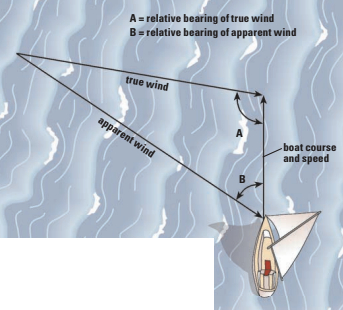
True wind – The true wind is the wind speed and direction as observed from a stationary position, such as a boat at anchor or on land.
Apparent wind and relative wind – These terms have the same meaning. They refer to the wind you sense on a moving boat. It is the combination of true wind and the wind made by the motion of the boat. In the vector diagram, the length of a line represents velocity and the angle of the line represents direction. Knowing the boat’s vector and the true wind’s vector allows us to determine the apparent wind by completing the triangle with the third line.
Although the true wind is nearly beam-on to the boat’s course in the illustration above, the apparent wind, due to the boat’s forward motion, requires that the sails be trimmed in a close-hauled position. Remember, the true wind direction is always aft of the relative wind direction.
Wind gradient – Friction slows wind down at the surface of the land or water. In average conditions, if the wind velocity is 10 knots at 100 feet above the water, it might be 8 knots at 33 feet and 7 knots at 12 feet. This gradient, combined with the motion of the boat, makes the relative wind at various heights change in velocity and direction. The direction of the upper relative wind always lies farther aft than the lower relative wind. This is one of the reasons for inducing twist in the upper part of a sail.
Wind pressure – The pressure the wind creates is proportional to the square of the wind’s velocity. If you double the wind speed, the pressure is four times as great. Thus the wind pressure on sails, boats, or buildings is four times as great when the wind increases from 15 to 30 knots.
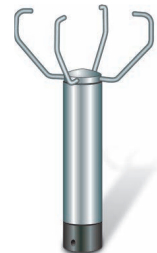
Anemometer – An anemometer (from the Greek anemos, meaning wind, plus meter, a measure) is used to indicate wind speed. You can gauge wind speed with a piece of string tied to a shroud, a windsock, or mechanical rotating cups. Professional meteorologists use radar systems and balloons, but these methods are not available to the average sailor.
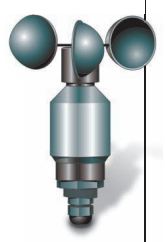
Recently, an anemometer has come on the market that replaces the rotating cups with a non-mechanical sensor. This sensor is ultrasonic and has no moving parts. It gives wind speed and direction. It is becoming competitively priced, compared with top-of-the-line cups-and-vane mechanical systems, and provides data in icing conditions when the rotating cups-and-vane systems are disabled.
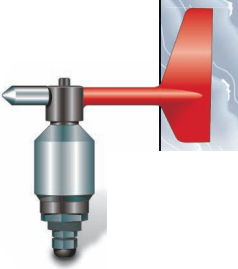
Windvane, or weather vane – This is a means of determining wind direction. The windvane points into the wind, and the wind direction is mea- sured either in points of the compass or azimuth degrees. When an anemometer and windvane are combined into one unit, the instrument is known as an aerovane.
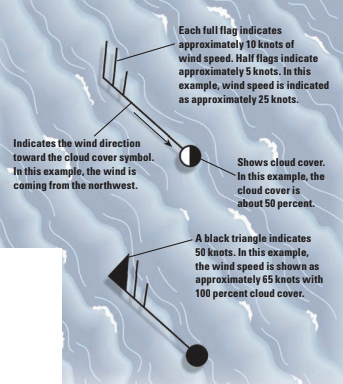
Weather map symbols – Weather maps have symbols to indicate wind conditions. These symbols, which look like notes on musical scores, indicate the wind speed and direction, as well as the cloud cover for various locations (see Good Old Boat, November 2005).
The symbol consists of a circle, which indicates cloud cover, and an arm that points to the circle. This arm indicates the wind direction and is known as the wind barb, or arrow. Think of these arrows as flying with the wind to remember what wind direction they are indicating. The flags, or feathers, at the end of the arrow indicate wind speed. A long feather represents 10 knots of wind (within 2 knots); a short feather represents approximately 5 knots of wind.
The first illustration above shows that the sky has about 50 percent cloud cover and the wind is from the northwest at a speed of 25 knots (10+10+5).
When winds are at or over 50 knots, one or more black triangles are used to indicate each 50-knot wind increment. In the second illustration above, the weather map shows completely overcast skies, with the wind from the northwest at 65 knots (50+10+5).
Thank you to Sailrite Enterprises, Inc., for providing free access to back issues of Good Old Boat through intellectual property rights. Sailrite.com