But it’s just the latest in a long series of loves
Issue 55 : Jul/Aug 2007
Nobody’s questioning the moral and ethical fiber of Warren Milberg. He’s a good man. As a boatowner, however, he does have one minor character flaw. It’s quite possible that he shares this flaw with a significant number of fellow sailors. You may catch a glimpse of yourself, gentle reader, in the description of Warren that follows.
It’s not that he’s been disloyal, exactly. It’s just that there are so many boats. Each type has strengths and weaknesses. And all are so beautiful. I would argue only that Warren has been guilty of being fickle. In one year, for example, he owned three boats, but that’s an extreme example in extreme circumstances. Still, it makes my point. Allow me to develop my case.
It started innocently enough with an ad he spotted in The Washington Post sports section: “Learn to sail. Two 4- hour sessions. $200. And a phone number.” Warren had just returned from a tour in Vietnam. He was ready for something new. Something peaceful. His sailing teacher had a 20-foot twin-keeler and a short fuse.
“The wind was blowing a bit,” Warren recalls. “He started yelling at me in a language I didn’t understand [sailing jargon]. I was in a sweat, and he was in a dither. When we got back to the dock, he said, ‘I don’t think you’re ever going to be a sailor.’ He recommended some books for me to read, told me to read them first and call for a second lesson later.”
The instructor no doubt expected that he’d seen the last of Warren Milberg. But Warren, who had $200 invested in those two lessons, did read the books, and he went back for his second lesson in spite of his unpromising beginning. The next time it was “a wonderful day,” he recalls. “I said to myself, ‘Gee, now I know how to sail.’ I bought a 15 1⁄2-foot Snipe one-design racer.”
Sage advice
At the marina where he launched his new boat, the previous owner offered this sage advice, “It may not look like it, but this is a lot of boat. You really have to know how to sail it. If you get into trouble, let everything go.” No problem. Off Warren went. The weather cooperated for the first two outings. He didn’t get into trouble. Things went well. “As a result, I gained too much confidence,” Warren recalls. “But the third time, the wind was really blowing. The boat was overpowered. Water was coming over the gunwale. The advice to ‘let everything go’ came back to me. I let everything go. I took down the main and sailed back on jib alone, thoroughly chastened.”
After that, Warren learned to watch the weather carefully, a habit he has never dropped. He refers to himself as a “closet wind junkie.” Even when dressed in a suit and tie and not headed east to the marina, Warren is evaluating the wind moving each flag he sees for direction and strength. “Am I missing a good sailing day?” he wonders.
He joined the Snipe fleet and began racing. “I learned a lot about sailing at that time,” Warren says. “I took the Annapolis Sailing School cruising course in a 24-foot Rainbow. I chartered larger boats on the Chesapeake, as well as in the Bahamas and the U.S. Virgin Islands.”
Was he grateful to the Snipe for the lessons it taught him? He never gave that boat a name and sold it one day for a 22-foot Hurley and a life focused more on cruising and less on racing. “This one had a fin keel,” he notes, “although some are twin-keelers. The Dockrell is essentially the same boat.”
Warren doesn’t give the Hurley more than that passing footnote while recounting his sailing history. Did it have a name? What lessons did this boat teach him? Those stories go untold. That boat obviously was a one-night stand. He did not fall in love with that boat, but he did fall in love with cruising.
Epiphany
“Then I bought a Columbia 28 with an Atomic 4,” he says. “It was my first inboard. It was a terrific boat with a terrible, cranky engine.” The boat’s name was Marisa (the name of the previous owner’s girlfriend). This boat offered him his first experience with long-range cruising on the Chesapeake Bay: “I circumnavigated the Delmarva Peninsula. It was spectacular. This was an epiphany. I said, ‘This is what I want to be doing!’”
Many years would pass before that dream became reality. There was a divorce. The boat was sold. Warren was boatless and left to charter from time to time or sail on other people’s boats.
Time moved on. He fell in love once more — an unusual love story in itself — started a family and remained boatless. Jackie Hess is the woman who captured his heart permanently. Their son, Evan, has just completed high school. Both are good sailors who enjoy daysailing with their captain.
“Jackie and I went for a Sunday drive to the Chesapeake Bay,” Warren says. “We found a beautiful place off the beaten path. It faces the Thomas Point Lighthouse and the Bay Bridge, West River, Rhode River, South River, Annapolis. It was a panorama. There were so many sailboats there . . . and I didn’t own a sailboat!” The time, clearly, had come. Warren was about to become a sailor once more, albeit a fickle one. “We went to a boatyard. There was a 23-foot Alberg-designed, C. E. Ryder-built Sea Sprite. It looked like a miniature Alberg 30. We’d chartered a 30 before and really liked the design.” Warren believes that Carl Alberg didn’t know how to design an ugly boat.
Warren continues, “Jackie said, ‘Why don’t you buy it?’ I made an offer. This was a spectacular little sailer. I fell in love with her.” Her name was Economy (the previous owner was a fan of Henry David Thoreau). Both Thoreau’s and Warren’s ”economy” was about living life to its fullest.
No Bimini room
“The only flaw was its boom placement,” he continues. “It was too low. There was no room for a Bimini beneath it. We baked in the July and August sun. I wanted a larger Sea Sprite . . . something in the 27- to 28-foot range. I didn’t want a project boat.
“I talked to a broker. After some time he called with this suggestion, ‘It’s not your kind of boat, but go see this little C&C Niagara 24. It’s clean, a nice boat.’ I wasn’t interested,” Warren says. “This was a beamy mid-1970s light-displacement, fin-keel, high-aspect ratio, outboard rudder sailboat . . . nothing related to Alberg’s classic narrow beam, full-keel-with-attached-rudder designs. But I took the drive down there anyway. It really was well-kept. The gelcoat was shiny. The teak had been maintained. There wasn’t as much teak as in an Alberg. It had good canvas. I did a mini-survey and made an offer. Two hours later that boat was mine.”
Sometime in 1995, just before buying the C&C, Warren realized that each time he commuted into Washington, D.C., from Annandale, Virginia, he was driving in the wrong direction. Those commutes took him farther from his boat. He’d been working as a defense contractor but decided it was time to spend more time sailing and writing about sailing. He takes his retirement seriously, however. “Somebody has to patrol the bay,” he says. “It might as well be me.”
Aptly named
Warren sailed his new baby, named Flexible Flyer by the previous owner, home to Herrington Harbour North, in Deale, Maryland. The year was “It was a good boat. Flexible Flyer was aptly named: she flew! C&C gave real meaning to the term ‘racer/cruiser.’ This was my toy. There was more interior and storage space than in most 28-footers. I could sail it all over the place . . . and did,” Warren says fondly. His love for that boat was obvious in an article he published in Good Old Boat in July 2002 about the joys of sailing a smaller boat. He advised readers not to think they needed to buy ever-larger boats to be happy. You would think, wouldn’t you, that Warren had found the perfect boat? “Perhaps it was just the right boat for the right time,” he hypothesizes.
“Seven years later I wanted an inboard, as I hoped to do more overnight, longer-distance cruising with my family. Budget was a factor. Size was a factor. I didn’t want a 1960s or ’70s boat. I wanted an ’80s boat, one that was big enough for a small family to cruise on but able to be singlehanded.” He discovered a Catalina 27 that met his criteria. It had wheel steering and an inboard diesel. It looked well-kept. I had it surveyed, did a sea trial, and sailed it home. More than 6,600 have been sold,” he notes. “People love them.” Unfortunately, that was in mid-July 2003. Hurricane Isabel was due to arrive in September.
“I liked sailing the Catalina 27,” he says. “It was fast and fun to sail. Then seven weeks later the hurricane hit. I had been sailing the Chesapeake Bay since the mid-1970s. I thought I knew how to deal with hurricane preparations. I went for a sail on a beautiful fall day a few days before the hurricane was predicted to hit the bay area. I had a wonderful sail. Then I took all the sails off and tied up the boat with 15 docklines and eight fenders. I took the anchor off. I figured, ‘The boat will take care of itself,’ but I was wrong. In the end, it was the docks that failed, as they just couldn’t withstand the hundreds of thousands of pounds of pressure exerted by all the surging boats tied to them.”
Almost renamed
He pauses a moment. That boat almost got renamed. This would have been the first time that Warren was to deviate from the previous owners’ tastes in names. This was to be the boat. He would name it Slot Machine, based on its fine sailing characteristics. “I hadn’t ordered the new name graphic yet,” he says. He figures the sea gods were angry with him for even considering the new name. “I won’t make that mistake again,” he concludes.
“Three things happened the night the hurricane went through. Wind was from the east. The other two happened almost simultaneously: high tide and the hurricane surge were within an hour of each other. The harbors and marinas facing east were really hurt. Herrington Harbour faces east,” he pauses once more, lost in thought. “It was mayhem the day after. The first four docks were destroyed. I couldn’t get to my boat. The water was still 8 to 10 feet above the docks. But it was floating on its lines.”
Memories wash over him: “I had it hauled the next day. The bow pulpit was bent 90 degrees. The stern ladder was bent. The rubrail was destroyed on both sides. There were scratches all over in the gelcoat. I figured it was going to be at least $3,000 to $4,000 in insurance claims. BoatU.S. was magnificent. Its catastrophe team of surveyors and adjusters arrived quickly. One of them guessed that the claims would be closer to $5,000. A week later they informed me that the rudder and post were bent and would probably have to be replaced, a major undertaking. They said they wanted to total the boat.”
Warren realized that it would take 18 months to get everything repaired. Since so much damage had been done to so many boats in the area, all repair facilities would be overloaded. “BoatU.S. said it would send me a check for the full insured value of $14,000, and if I wanted, I could buy it back for $8,500 and fix it myself. I just took the check. I didn’t want to wait for 18 months.”
Wrote article
Full of regret over his loss, Warren wrote an article for the Chesapeake regional sailing magazine, SpinSheet. “Then two months later I got an email message from a guy who had read the article and said, ‘I think I bought your boat.’” Indeed, he had picked it up at a BoatU.S. auction and was repairing the damage. Warren was able to give him some of the engine parts and manuals that belonged with the boat.
But Warren was boatless once more (and about to acquire his third boat that year). “By this time,” he recalls, “I had become something of a believer in fin keels, spade rudders, relatively wide beams . . . all the things that the Albergs are not.” Warren realized that he was not going to be sailing offshore. “I sail once or twice a week, a daysail of 30 miles or so, occasional weekends, once in a while a longer distance overnight at anchor. The C&C taught me that fin-keel boats are perfect for that. Knowing where and how you sail are the most important things to understand when buying a boat.”
He saw an ad for a 1986 Hunter 28.5 for sale on the Chesapeake about 100 miles from his home port. The broker had sold this boat twice already, taking it back in trade each time. He knew it well. “It had a 1986 Yanmar in it. The engine looked brand-new,” Warren says. “I bought it in Havre de Grace in late fall of 2003. It was stored up there over the winter for me for free.”
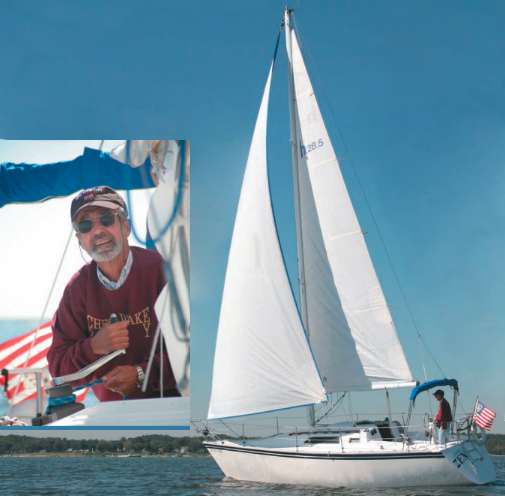
This boat’s name was (and remains) CrewZen. “Fortunately,” Warren says, “the boat names I’ve inherited have been boat names that I’ve liked.” This is a good thing because Warren Milberg is not about to consider changing any more boat names. He’s not one to risk inciting another hurricane. Is he about to change boats anytime soon? I certainly hope not, although while Jerry Powlas and I were in Annapolis last fall for the boat show and writing this article, we learned about an Alberg 30 that might make a nice boat for someone. When he heard this, Warren’s ears twitched. I told you he’s fickle. But for now, he’s contented with CrewZen.
Decent boat
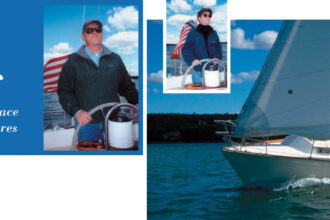
“This is not a Sabre, Caliber, or Hinckley. I think Hunter made a decent boat and it’s a great value on the used-boat market,” he says. “It wasn’t meant for offshore; it’s a coastal cruiser.” His model of the 28.5 has the 4-foot keel, he notes, but there is also a 5-foot 2-inch keel meant for places where the water is not as shallow as the Chesapeake. His boat displaces 7,000 pounds. The mast is stepped on deck.
Other owners on Steve Prusinski’s very active webpage, dedicated to the owners of Hunter 28.5s, < http://www. huntertwentyeightfive.com/> have provided Warren with loads of valuable information about his boat. They complained, for example, about the cast-iron keel. Because of this, Warren stripped the keel to bare metal and put a product called POR-15 on it. He says it’s like a thin tar that creates a chemical bond with the metal. The iron keel has not been a problem since.
Warren learned that the PHRF rating for this boat in the Chesapeake area is 183 to 186. But he says, “A fellow with the deep-keel model and rigged for racing voluntarily dropped his PHRF to 174, and he’s still winning. The boat is actively raced in a number of fleets around the country and seems to do well.” Warren continues counting off the features: “Sail area is 400 square feet with a 100-percent foretriangle and 500 square feet with a 150 jib. It has the classic Hunter B&R rig.”
Sailing characteristics
Jerry, who spent time at the helm of CrewZen, made these observations: “I’ve had a chance to sail and motor two Hunter 28.5s. Both were agile under power and backed with precision and authority because of their spade rudders. Both were good sailers. Despite its shallow-draft keel, Warren’s boat pointed well and didn’t seem to need much wind to move along under the 150-percent genoa. The shoal-draft keel did seem to make the boat feel tender in gusts, but after the initial heeling, she steadied up and got stiff.
“I found the helmsman’s position cramped,” Jerry continues, “but the split backstay made standing up straight possible even in this tight space. The T-shaped cockpit does, however, make getting around the wheel a bit easier than with conventional cockpit designs.
“The unusual B&R rig, named after Swedish designers Lars Bergstrom and Sven Ridder, is popular with Hunter Marine,” Jerry says. “The version on the 28.5 is a mast-head rig with a backstay. The spreaders are highly swept, an essential characteristic of this rig and also its main disadvantage. The two pair of swept spreaders do not allow for easing the boom off on a run without laying the mainsail on the rigging. In practice this disadvantage only shows up on very broad reaches where the skipper can either lay the sail on the rigging or tack downwind.”
Jerry adds, “Since the boat is a coastal cruiser, not a bluewater sailer, I’d freely ease the boom when the notion struck me and watch for signs of chafe. If I discovered problems, I’d probably give up the practice or reinforce the wear points if there were not too many. A caution here, however: put a stopper knot in the mainsheet so the boom can never hit the shrouds in a flying jibe. That could cost you the mast on any boat. The main advantages of this type of rig are: it allows for a lighter cross-section in the mast and it permits the shrouds to be far inboard, a factor that produces wide and uncluttered sidedecks. It should also improve headsail sheeting angles. Later-model Hunters were rigged without any backstay at all.
Looked easy
“Warren made singlehanding the boat look easy, which I would judge was partly because of his skill and experience and partly because the boat’s size and layout work well enough with a crew of one,” Jerry continues.
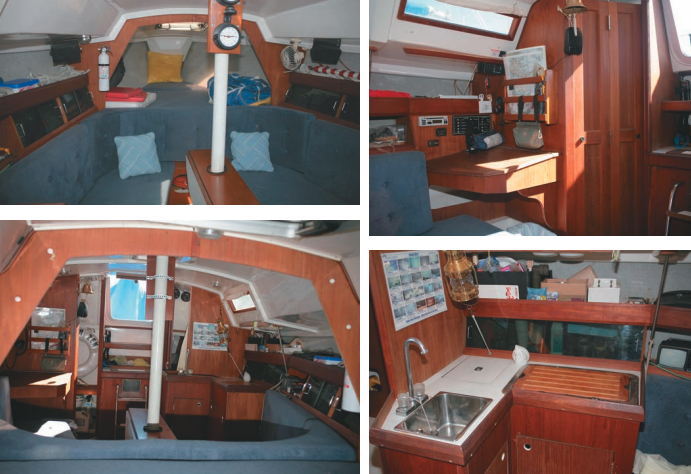
“The interior of the 28.5 is very innovative. The lack of a major bulkhead near the chainplates makes the interior feel very open. The layout has the head next to the companionway to starboard, which is a nice feature, but some owners complain that the head is a bit too small. I admit to thinking the same thing.
“In summary,” Jerry says, “the 28.5 sails and motors well and offers a good value and a good platform for singlehanding. I can see why Warren likes his boat.”
Remaining leg
So, in the spring of 2004, the first sailing opportunity following his three-boat year, Warren brought his baby home to his favorite marina in Deale, Maryland, which had been rebuilt from the ravages of the hurricane and was protected by an additional stone jetty in the approach channel. His original plans for this 100-mile maiden voyage called for a friend to join him on what was to be a two-day trip at the end of April. But his friend got called away on business at the last moment. Warren was lucky to find another friend and sailor to join him on the trip.
The marina where he bought CrewZen provided a van to pick Warren and his crew up at his marina in Deale and drive them to the boat in Havre de Grace, avoiding the awkward car shuffle that boat movements like this often entail. The voyage began in mid-afternoon and ended that evening at a quiet anchorage some 25 miles south. It had all been accomplished with the help of the engine, as the wind and waves were right on the nose.
The morning of the second day dawned gray and gloomy, so the two donned their foul weather gear for the remaining leg. Although Warren hoped to raise the sails on his newest boat, it wasn’t to be; the wind and waves continued to come from the south. Late that evening they pulled into his marina, tired but delighted with how well the boat did under power. The next few days would provide ample opportunity to get some sails up and to experience the fun and exhilaration that sailing this boat can provide.
With the Hunter 28.5, we’re absolutely, positively certain (well, sort of sure anyway) that Warren has found the boat that’s just right for him (for now). It wasn’t an easy path. He had to learn more about his own sailing habits and understand the realities of his sailing location. And he had to experiment with several types of sailboats (in an attempt to understand all the different options out there, of course). Each boat is a collection of compromises, as we all know.
Warren Milberg has tried most and settled down with a Hunter 28.5 . . . at least for now.
Thank you to Sailrite Enterprises, Inc., for providing free access to back issues of Good Old Boat through intellectual property rights. Sailrite.com