This one, he swears, is the final vessel
Issue 74 : Sept/Oct 2010
There comes a time in the life of every sailor when he must contemplate his final vessel. The one (figuratively, at least) that will carry him to Valhalla . . . the boat that will epitomize who he has become. For my wife, Terrel, and me, this means a small ocean-capable cruiser of traditional design. No matter that it may never cross an ocean, the ability to do so should be enough to sustain the dream. For us, this last boat would be trailerable, at least within the context of being transported great distances but not necessarily on a frequent basis.
Several boats we’ve known fell within this general category. Among them was the Nor’Sea 27, which I have always considered the gold standard for a transportable, ocean-girdling, sailboat. Pacifi c Seacraft’s 25 was another contender.
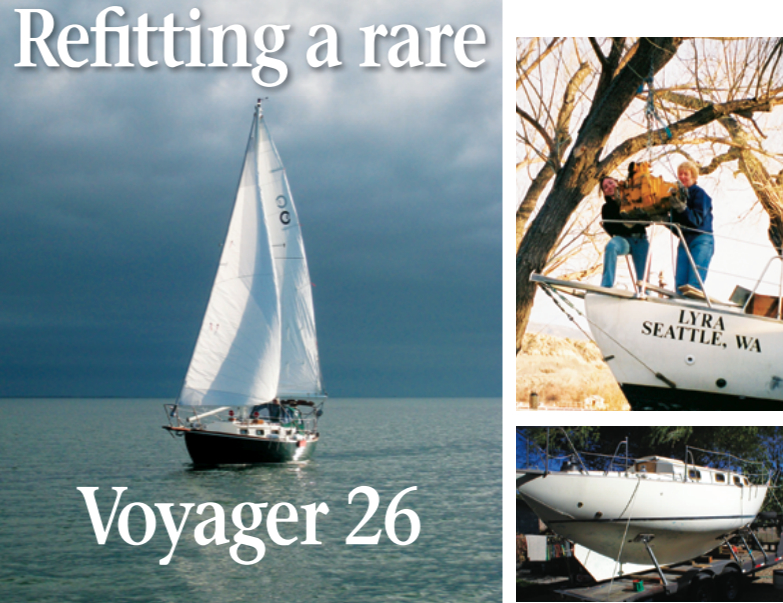
But one boat has stuck in our minds over the past 20 years of boat browsing, a boat that incorporated many of the best features of the previous two: the little-known Ocean Voyager 26, a Florida-built, offshore double-ender designed by Dan Avoures in 1975 and built through the 1980s.
Brooks Atherton, one of the owners of the Ocean Voyager Corp., recently said it was one of the sweetest sailing boats he had ever handled. He went on to remember famed circumnavigator Tristan Jones praising it at the Houston boat show.
A countrywide search
The search for our own Voyager was a long process, ending with a four-month sabbatical that led us from Colorado to Miami to look at first one (that proved beyond practical repair) and then to Tampa where a second candidate sold 24 hours before our arrival. (It had been on the market two years and I, in my infinite wisdom, felt there was no hurry.)
Seldom are two of these boats on the market at the same time. But, as luck would have it, we found our next target (a third one) on the Internet. It was in Seattle, Washington. We stopped by our home in Colorado on the way to Seattle and exchanged the motor home for the pickup truck and gooseneck trailer, on which I had previously installed a set of jack-pads with screw adjusters.
At Shilshole Marina in Seattle we at last beheld our new ship . . . and a sad, sad sight she was: mossy decked and down by the bow, her cataract-like plastic portlights staring sightlessly into the morning mist. We looked at one another with dismay. But we were there; we had little choice but to soldier on. We immediately noticed an ankle- deep mix of bilge water and diesel fuel. Things got worse as we sorted through piles of heavy, moldy, gear stuffed in the forepeak (this explained why she was down at the bow).
Neglected but sound
I surveyed the engine with a jaundiced eye, knowing it would never go chug-chug-chug again. The mate, not easily intimidated, manned the bilge pump and instructed me to begin tapping the deck for soft spots. I was sure there would be many. But, as it turned out, there were none and, upon closer inspection, we found the boat to be structurally very sound and obviously little used . . . just badly neglected by a young and struggling owner. A fairly recent survey we found aboard stated that the bottom was in fine condition with no blistering of any consequence. All in all, things were looking up.
My philosophy in restoring older boats is this: I much prefer a badly neglected example in sound original condition to one that has been “upgraded” by previous owners. The terms “upgraded” or “good used condition” are meaningless phrases to the anal-retentive restoration guy. I would rather buy reasonably to begin with and figure on replacing everything — because in the end, I will anyway. The sailor who follows this plan is more likely to be a happier camper (though a bone-weary one) at the finish.
Few are aware that many of the later Voyager hulls and decks were built on contract by Island Packet. These had a very high-quality hand layup (the schedule being comparable to both the Nor’Sea and Pacific Seacraft). The standard deck core on these boats is 1/2 -inch, high-quality marine plywood, just as Pacific Seacraft used. Even better, the core does not extend to the border-mounted stanchion-bases, cleats, and so on. They are bedded through solid glass, which is impervious to rot. So, unless a lot of “stuff” has been haphazardly added to the cored area, these decks are not prone to soft spots. (Months later, when we pulled the headliners on our boat, the clear glass overlay revealed plywood core as beautifully sound as the day it was laid).
Happily, the trailer fit, and we arrived back in Colorado (several snowstorms later) with our dubious prize in tow. A new dream was born.
A restoration begins
Fortunately, I was in a position to devote myself full time to the project, now parked in front of our shop. This is a huge advantage, by the way, and another plus for a transportable boat. I spent the first few months gutting the boat. Everything we could take off or out without using a cutting torch or saber saw we removed and stored for later refurbishment. We scrapped all the wiring, electrical panels, plumbing (including the head), and the engine (with its associated mechanicals).
I packed more than 60 pounds of cat litter into the bilges to soak up the last vestiges of diesel fuel. Weeks later, I removed it with a Shop Vac and replaced it with five gallons of Simple Green mixed with an equal amount of hot water. We then took the boat for a little 20-mile drive on hilly, curvy roads, employing the old “washing machine effect” to emulsify any residual diesel. This is yet another unsung advantage of a trailerable boat. It still took several flushes of hot soapy water and nearly another year spent “airing out” in western Colorado’s high, dry climate to effect a complete cure.
True to the survey, the bottom condition exceeded my expectations, with only a scattering of pinhead-sized blisters and perhaps a half-dozen or so the size of a nickel. There was no evidence of previous repair . . . not bad for a boat that had spent most of the last 28 years in the water. It did carry six or seven coats of very hard bottom paint that would have to be ground down to gelcoat to facilitate fairing and applying barrier coats. Our friends Rich and Sara Cardwell volunteered to help with this project. They clearly had no idea of what they were letting themselves in for. I jumped at the offer and, amazingly, they remain our good friends to this day.
We let the bottom cook in the sun for many weeks and then applied four heavy coats of industrial-strength epoxy barrier coat. Later in the restoration, we went back inside and coated every square inch of exposed fi berglass in the interior — lockers, overheads, bilges, engine compartment — with two coats of Interprotect barrier coat by Interlux. The laminate was thus protected from moisture inside and out.
Electrical and mechanical
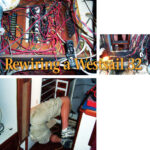
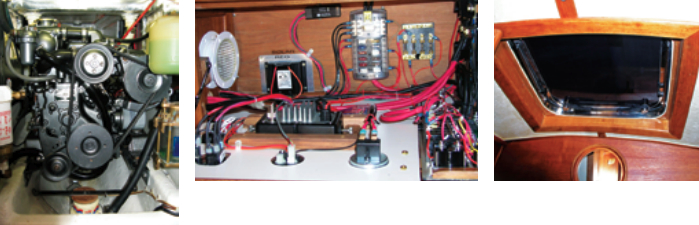
This was the proper time to begin the job of rewiring: before the interior went back in. If I have a forte (and this is widely debated), it is wiring. I spent an inordinate amount of time installing circuitry for control panels, switches, fans, outlets, pumps, radios, solar regulator, GPS, various sailing instruments (including two separate autopilot circuits), and spare runs for future items not yet invented. All wiring runs were item-specific, individually fused, and with all circuitry terminating in a single-hinged-front cabinet for easy access. I chewed up about $600 in oversized Anchor-brand tinned wire in the process and the better part of an additional two weeks of restoration time. I was still shooting for a 16-month splash date and felt I was running only a little behind. Silly me.
As for diesels, all Voyagers had one. The first boats generally came with a single-cylinder Farymann or BMW, both raw-water-cooled and rated somewhere around 12 hp. While these were considered adequate in their day, their design has become a bit long in the tooth for most. We opted for a Yanmar 2GM20F we found on eBay.
Although it was a “good used engine,” I elected, for peace of mind, to rebuild it completely. I’ve been spinning wrenches and building engines since high school and, for me, these little precision diesels are a joy to work on (out of the boat, of course). The fact that this particular engine had been coupled to a saildrive in its previous life left me no option but to purchase an expensive brand-new conventional transmission.
The Yanmar fit nicely in the old Farymann’s space with only minor modifications to the bed. It later proved smooth and dependable.
The prop shaft on this boat is rather long, making it especially important to get a proper alignment on our new shaft and Cutless bearing. A Drivesaver coupling device was a good investment, in our opinion. Another nice feature of this engine bed is that it allows a nearly horizontal shaft run, which translates to more efficiency at the prop. We found that a 13 x 12 RH 3-bladed prop was just about spot-on for this setup.
Interior amenities
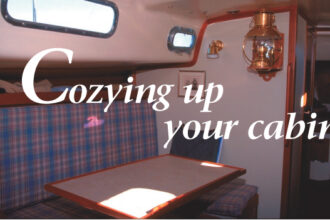
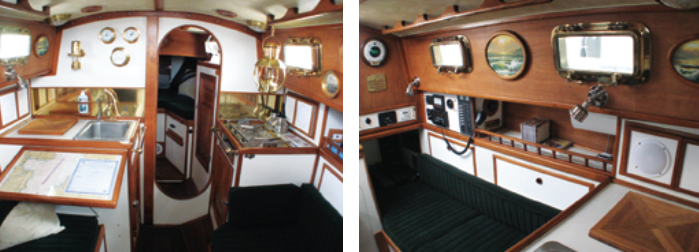
The Voyager enjoys a bright and airy Herreshoff-style interior and, while there were two versions, our traditional center-galley model made the most sense for us. Though the forepeak is a bit cramped, it does provide privacy for the V-berth and, surprisingly, a larger head area than the layout version with the aft head.
We installed a modern holding system with an integrated, oversized manual pump, which expedites things in a more dependable fashion. Waste goes first into the tank, leaving us with the option of sending it to the deck pumpout port or — with the help of a three-way valve (that’s always locked) — to the through-hull below the waterline. This is a system design I have never had questioned by harbor authorities anywhere we’ve sailed.
The portlights were one of the few places the original buyer had skimped on his order form. While these plastic ports had (amazingly) remained virtually leak-free for 28 years, they were nearly opaque and a bit brittle. A call to New Found Metals in Port Townsend, Washington, confirmed the availability of our favorite style of traditional bronze ports and — happy day! — they were on sale. Still, buying eight of them was a budget-blowing experience. This is one of the few upgrades likely to return dividends at sale time.
While instructions for installing these are straightforward, I still spent about one day per port removing the old one and installing the new. However, they are now a strong structural part of the boat and will probably have to be chain-sawed out someday (but not by me). As a side note, while the screens that came with these ports are beautifully made, it’s nearly impossible to install them and have the ports remain leak-free. Other owners hope NFM will address this issue.
At this juncture, I should also confess that I use only one type of sealant/caulk on our boats: 3M 5200. Yes, it’s forever; that’s what I like about it. Some folks may be unaware of the new spray-on release agent for this product, which should negate any lingering objections.
Our boat had no permanent stove installed. I couldn’t justify the space for and weight of an oven model but we did find a wonderful little brass-and-stainless-steel gimbaled propane cooktop we could build in. We ran the new impervious-to-everything line aft and through the stern deck to a rail-mounted aluminum tank. These are tall slim tanks about the size of scuba tanks. Terrel, my better half, has provided them with insulated green covers to enhance that illusion. There is, by the way, a feeder line to the small rail-mounted Force 10 barbecue. The system does, of course, include the obligatory Xintex Fireboy 2 safety control panel connected to a tank solenoid and additional sensors, one in the bilge and one in the bottom of the stove compartment. This system is pretty much the standard in the marine industry. Over the years, we’ve become satisfied that it’s safer than most when properly installed.
Crowning achievement
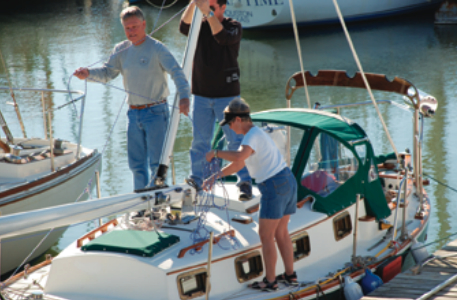
Terrel, a skilled seamstress, did all the interior upholstery, then went on to build Sunbrella sailcovers, lee cloths, tiller covers, and sunshades. Her crowning achievement was an honest-to-gosh offshore dodger of a quality you’d be hard-pressed to find commercially. Though she has often crafted elaborate wedding and graduation dresses, she admits this was the toughest sewing project she has ever undertaken. She built and rebuilt it over the course of six months until she was satisfied that it was exactly right for the boat. I have not seen a better one. Before you ask, she says she will never do another.
We were able to do all the work on this boat ourselves, save for the Awlgrip paint on the topsides and spars. It’s a very tricky material to apply properly in our climate. Professional sprayers of Awlgrip are few and far between in western Colorado but, after casting about, I did find a local airplane painter, Jim Partsch, who was familiar with Awlgrip and not afraid to give it a shot. I’m happy with the results and he did it at a reasonable price, considering the materials alone ran $1,600. Voyager Marine invested heavily in teak for these boats, inside and out.
They used only the best old growth from what used to be Burma and, though our boat’s outside trim was badly weathered, it was also very dense and quite thick. I had first thought some of it might have to be replaced, but it was amazingly solid and sanded out nicely, leaving plenty of wood on the toerails and coamings. We had always thought the bowsprit on these boats (consisting of one heavy narrow plank) was less than adequate for serious bow work in any kind of weather. Again eBay came to the rescue with a heavily built sprit from an expensive trawler. It was just the thing, vastly improving safety and the boat’s appearance.
Finishing touches
At this point, I could no longer abide the heavy, fiberglass “cargo hatch” on the foredeck. While it was a popular design in its time, it did nothing for the general lines of the boat and I have never seen one that didn’t leak . . . copiously. You guessed it: a brand-new all-stainless-steel, low-profile hatch appeared like magic on eBay. It fit with a minimum amount of surgery and melded well with the traditional lines of the cabintop. I was thus encouraged to add teak Dorade boxes with stainless-steel vents. These, along with the eight opening ports, made this the best-ventilated boat we’ve owned. Did I mention the day/night Nicro vent installed over the chain locker to exhaust wet-rode odors?
After nearly three years, we were coming to the end of this project. Then we decided the finishing touch would be a classic boom gallows. I’m talking about a real boom gallows with hefty bronze side brackets and oversize stanchions, something a sailor could hang on to in the dark and stormies. It would also provide support for a zip-on Bimini. There are innumerable reasons for a boom gallows (see Good Old Boat, July 2005).
After pricing bronze side brackets from the few people who still make them, I was beginning to have second thoughts but, once again, eBay came to the rescue! Sure, they were off a Westsail 32 and weighed roughly 12 pounds each, but they were priced right and I figured they could be worked down to a more reasonable size and weight.
After only six days with a hand grinder, they were down to 6 pounds each and my backyard looked like a golden fairyland. Polishing them out to a high luster took an additional two days. The cross plank of solid black walnut demanded another couple of days to fit, sand, and varnish. Inch-and-a-half polished stainless-steel pipe made up the stanchions, and we were good to go. In the end it was worth it. (That’s what I keep telling myself.)
Better sailer
We have sailed both the Nor’Sea 27 and the PS 25 extensively in the past and, in the final analysis, thought the Voyager 26 to be the better sailer in most conditions. She is a tad beamier — at 8 feet 3 inches — than the other two and will accommodate more stores. She is surprisingly fast in light air, perhaps due to her sharp entry and knife-edge keel carried all the way to the stern. Her very shallow draft, only 3 feet 4 inches, reduces wetted area as well, I suppose, though I’m no design authority. Like the other two boats, the Voyager will pretty much steer herself when properly balanced. And at a designed displacement of 7,200 pounds, she is quite seakindly for a boat this size.
On the downside, she does make some leeway, as do all her ilk, and I would not expect to get any closer to the wind than 40 degrees. These are the trade-offs one must expect in a vessel with such shoal draft, trade-offs we happily concede. The ability to explore skinny water has always been a priority for us. Oh, and take care backing this boat out of a slip in a crosswind; she’ll certainly entertain you.
We named our boat Envy — one of the seven deadly sins and the reason for her being. We have attempted to recreate in her the craftsmanship and virtues of boats well beyond our grasp at a price we could afford.
In terms of expense, we are into her about half what a comparable off-the-rack boat of this caliber would cost (disregarding three years of intensive labor, of course).
We like this boat. We truly expect her to be our last.
Ron and Terrel Chappell have been restoring and sailing small cruisers for the last 20 years and, last winter, tried out Envy in the Abaco Islands. Ron maintains he has gained much of his expertise through articles in Good Old Boat — he has been on board since the magazine’s inception and archives every issue.
Thank you to Sailrite Enterprises, Inc., for providing free access to back issues of Good Old Boat through intellectual property rights. Sailrite.com