Examining what lies beneath and behind
Issue 73 : Jul/Aug 2010
If you go through the various texts on yacht design, you will find the section on rudders to be relatively anemic. Rudder design is tricky and full of all the trade-offs and more that go along with keel design.
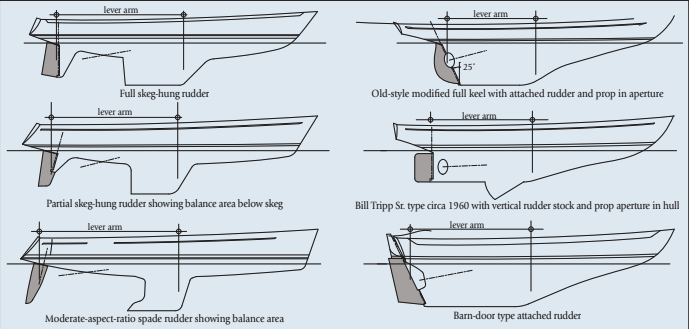
Rudders fall into three basic types. Most older designs with full or modified full keels will have the rudder attached to the trailing edge of the keel. Then there is the rudder hung off a skeg, separate from the keel, that extends the full depth of the rudder. The third type of rudder is the spade style that is independent of the keel and has no skeg. We could extend this range with outboard rudders that are hung off the transom or sternpost but an outboard rudder could be any one of the other three basic types.
The majority of production boats built today, and all raceboats, have spade rudders, so I think we have to agree that if you are after efficiency, the spade rudder is the answer. Cost is a factor too: it’s just cheaper to build a spade rudder for a modern hull with a short-chord fin keel.
Regardless of the style of rudder, its design will largely depend on the vessel’s draft. With a deep draft, the designer will have a free hand in determining the shape of the rudder. If draft is restricted, the over-ruling factor will be reducing the span, or draft, of the rudder while maintaining control.
Attached rudders
With the keel-hung attached rudder, the leading edge of the rudder is tucked behind the trailing edge of the keel and, in most cases, is a fair extension of the tapering keel shape. It is not unusual for this type of rudder to have flat sides, and you can look at it as being essentially a trim tab on a very-low-aspect-ratio foil that is the keel and rudder combined. This is not efficient but it does work.
In order to reduce wetted surface and have the tiller head exit the deck in a convenient spot, the rudder post was generally strongly raked, sometimes as much as 45 degrees. The more you rake the rudder the less effective it is for a given blade area because, as well as creating less turning moment, the rudder is imposing a downward force on the boat’s stern, which just means more drag.
Attached rudders also often have a large hole in the middle for the prop, the prop aperture. I have found boats like this to be the most challenging to handle under power in reverse. The center of pressure of a hull with a full or modified full keel shifts dramatically aft in reverse, thus greatly reducing the turning moment. Combine this with directional flow off the prop in the aperture and control in reverse can be minimal, especially at low speeds.
To many sailors, the fact that the attached rudder is hidden behind the mass of the keel means that it is protected. That can be a big advantage in some areas where you may on occasion bump the bottom or leave the boat sitting on the mud. And with the rudder heel gudgeon at the bottom of the rudder post, the rudder can be strongly supported.
Skeg-hung rudders
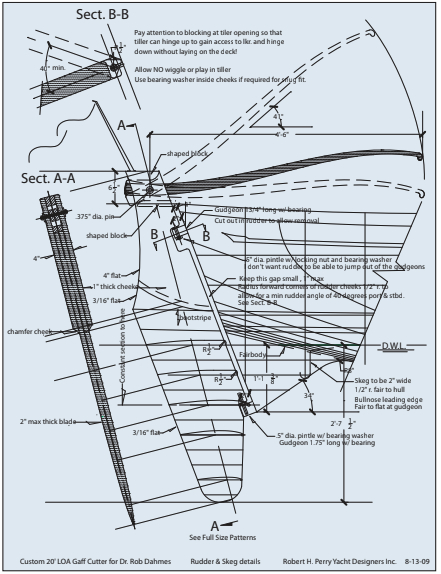
The additional area of a skeg aft can help a boat track straight. A skeg-hung rudder will have a higher stall angle than a spade rudder. Given that the leading edge of the skeg is fixed, it sees a far lower angle of attack than the leading edge of a spade rudder. However, pragmatic building concerns generally mean that the thickness at the rudder stock will remain constant to avoid what is called (and seldom seen today) the “golf tee” rudder. This need to hold the rudder thickness constant at the stock forces the foil to be altered as the skeg tapers, so the maximum thickness of the foil will move forward dramatically, and the thickness ratio of the foil will increase as you get down to the rudder tip. This can be good, as the rudder will stall at the tip first, in most cases, and a thicker foil at the tip will help reduce the stalling tendency.
Skegs can also help protect a rudder blade, but the deep taper of a full skeg makes a tough place to laminate fiberglass and I have seen some skegs that I thought were held on by the rudder, rather than the other way around.
For me, the biggest drawback to a skeg-hung rudder, especially for boats over 40 feet long, is that you cannot add rudder- blade “balance” with a skeg. There is no rudder area forward of the stock axis and you will feel every ounce of pressure on the rudder through the helm. This is not a big deal on small boats but on larger boats, if the boat has a tendency to weather helm, it can result in uncomfortable loads on the tiller or wheel for the helmsman. My current solution to this has been to use a “partial skeg” that extends for about half the depth of the rudder. This allows a portion of the rudder blade to extend forward of the pivot axis and create the balance area to move the center of pressure forward and reduce helm loads. You get the advantage of a lower rudder bearing and some protection.
Spade rudders
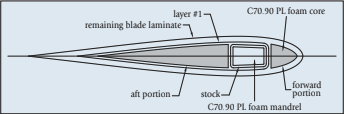
The best rudder for almost any modern boat, if you are after performance, is the spade type. With a clean spade blade, the designer can treat the rudder shape like a true foil. Cruisers often shy away from spade rudders because they feel they are vulnerable to failure. There is no lower bearing, so all the loads are taken at the intersection with the hull, and the rudder stock is supported with a bearing at the hull and another bearing up in the boat, usually under the deck. The spade rudder sees both twisting and bending loads, while supported rudders see only twisting loads. This means the rudder stock for a spade-type rudder has to be much larger and stronger than for a similar-sized rudder hung on a skeg.
The best thing for a designer designing a spade rudder is that the rudder can be considered a pure foil. Because a rudder can see quite high angles of attack, especially when a boat is hard pressed, the foil used has a fatter or rounder leading edge that makes it harder to stall. It will have its maximum thickness at 30 percent of the chord, as compared to 40 percent for a keel foil.
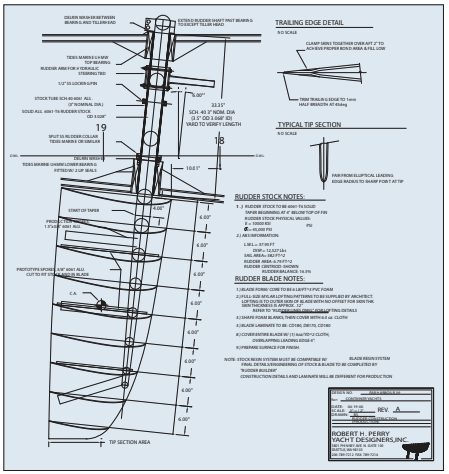
My favorite rudder foil is NACA section 0012 with a 12 percent thickness ratio. If you want less drag, you can reduce this thickness ratio to as low as 10 percent, but that produces a rudder that will stall early and has a very narrow “groove” for the helmsman. A racing boat with a very skilled driver can get by with a very thin rudder. There is also less drag from a rudder with a high aspect ratio.
In many cases, the thickness ratio for the length of the rudder blade will vary as the designer tries to wrap a blade around a given rudder-stock diameter requirement. This can be avoided to a large degree with a carbon stock that can be shaped to fit snugly within the blade.
With a spade rudder, the designer has the option of adding “balance” to the rudder blade, that is, blade area forward of the rudder stock. The right amount of balance can reduce helm pressure. Too much balance can result in a rudder that has a mind of its own, making it very difficult to drive the boat. In the old days, 10 percent balance was considered the maximum, but today we see big spade rudders with up to 17 percent balance area. I usually use around 15 percent on boats over 45 feet.
Don’t confuse helm pressure with weather helm. You want between 2 and 4 degrees of weather helm for optimal performance upwind. If you need above 8 degrees of rudder to keep the boat going straight upwind or reaching, you have too much weather helm. Rudder balance won’t help correct the angle but it will reduce the load felt on the helm.
Rudder location
I like to put my rudders as far aft as practically possible, but this is often affected by cockpit design or the height available under an aft double berth. For a given rudder area, the greater the turning moment the farther aft it is.
In a boat with an aft cockpit, I like to see the rudder tucked under the counter just enough that the top of the rudder blade can be closed off by the hull, preventing to some degree the high-pressure flow from crossing over to the low-pressure side. The trick is to keep the water flowing over the rudder blade in line with the foil. If you move the rudder aft, you increase the possibility of rudder ventilation and this can be very serious on today’s modern fat-sterned boats. Notice how many of the ultra-wide-sterned boats today are coming out with twin rudders. The leeward rudder is always immersed. If you move the rudder forward, you keep it immersed better but you reduce the turning arm. If you want the rudder as far aft as possible, one way to do it is with an outboard rudder. You see these on old Colin Archer types, Atkin-type cutters, Bristol Channel Cutters, and just about every dinghy ever built.
I have a transom-hung outboard rudder on my own boat. The biggest problem with the transom-hung rudder is that the foil pierces the waterplane and this allows the water flow to escape, producing zero lift at the root. In extreme conditions, air can be sucked down the low-pressure side of the rudder causing the blade to lose its grip on the water and the rudder to stall. This is often called “ventilating.” This problem can be offset by just adding more rudder span. When the rudder stalls, you lose control.
Outboard rudders may not be the most efficient but they just look right to my eye and they are easy to install and inspect. If draft is a consideration, the outboard rudder can be retractable.
Opinions from the experts
As I mentioned in my introduction, rudders receive little attention in published texts, but I had an idea. Why not contact some other designers whose work I respect and impose on them to contribute ideas on rudder design? So I sent three friends the same questionnaire and asked them to submit illustrations for the article.
Yves-Marie Tanton and I go back 35 years to when we once worked together for Dick Carter. Yves-Marie was my boss. His work spans the range from very traditional to very radical.
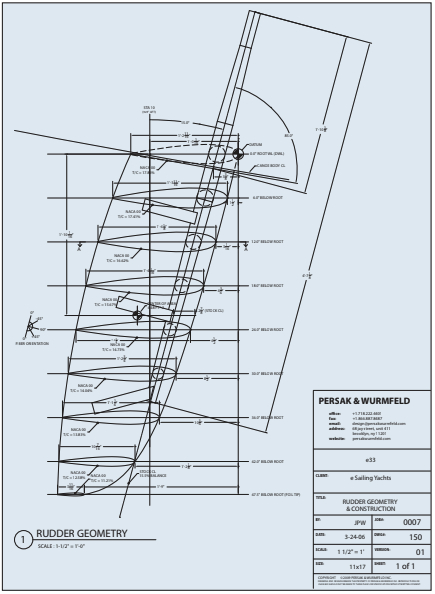
Jeremy Wurmfeld, designer of the e Sailing Yachts series is 34 years old and works with Carl Persak at Persak & Wurmfeld in Marblehead. Jeremy has some clever and innovative design ideas and I thought we should have some young blood on the panel.
Greg Stewart has been with Nelson/Marek for 24 years and his work is generally on the high-tech side of design, with experience in America’s Cup boats and many grand prix-type racing boats. Greg is a quiet guy, a college-educated naval architect who thoroughly knows yacht design.
I asked the experts to avoid answers that start with “It all depends.” Yes, it does — but I asked for short, concise answers.
How do you calculate the required area of a rudder?
Yves-Marie says he starts with 1.4 percent of the sail area using 100 percent of the main and foretriangle.
Jeremy says he also bases rudder size on rig size and follows with a lift/drag analysis.
Greg’s answer is a little different. I like it because it starts by stressing experience with other rudder designs. “First we look at our rudder database that includes the principal yacht and rudder parameters for NMYD racing rudder designs from 25-foot yachts up through IACC yachts and another database for lower-performance cruiser/racers and megayachts. This gives a good first cut at the required rudder area.”
What is the benefit of a full skeg?
Yves-Marie says, “The appearance of strength, I suppose.” He also cites an increase in the stall angle.
Jeremy says the only advantage of a skeg is structural if the owner intends to beach the boat.
Greg says NMYD has never designed a boat with a skeg but he believes the primary advantage to a skeg is directional stability.
What thickness ratio do you prefer?
Yves-Marie says he uses a 12 percent foil and varies it as required to fit the stock diameter.
Jeremy says he uses between 10 and 18 percent thickness ratio. That covers a lot of ground.
Greg says he uses a thickness ratio of 10 to 12 percent, going as high as 12 to 16 percent for cruiser/racer types. Greg also says that to accommodate the diameter of the rudder stock where it enters the hull, they often go as high as 14 to 18 percent.
How many degrees of rudder angle are required?
Yves-Marie says 35 to 40 degrees.
Jeremy says the same.
Greg says 40 degrees each side.
What are the benefits of a high-aspect-ratio blade?
Yves-Marie says short-chord, long-span rudders can stall quickly but have less drag.
Jeremy says he likes the ability to reduce wetted surface with a high-aspect-ratio blade but reminds us that this type is not appropriate for boats with draft restrictions.
Greg says he likes the high-aspect-ratio rudder because it “can provide more lift and unload the keel some and result in a biplane effect with the keel.”
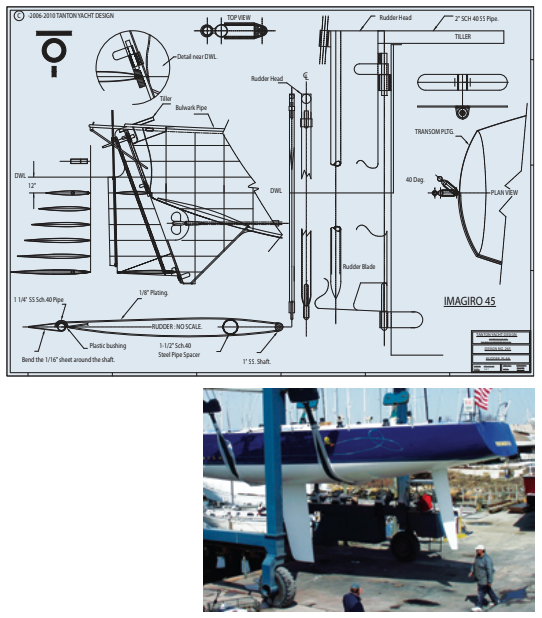
I also asked each expert to add a few words of wisdom covering the design of rudders.
Yves-Marie says, “In a setup with a few questions, it is hard to oversee all aspects of the problem of rudder design. I have slanted my answers toward cruising sailboats. The rudder design for a racing machine is almost simpler. It seems that a spade rudder hung below the hull is superior for both lift and drag. And therefore the answer is: spade rudder, high aspect ratio, thin chord, exotic building material, and oven curing for manufacturing.
“I spend a lot of time on rudder design.”
Jeremy says, “As one of the most direct conduits of feedback to the skipper, the helm (and therefore the rudder) provides a good portion (though not all) of the ‘feel’ that most experienced sailors rely upon to effectively drive a boat through the water through the intentional manipulation of rudder angle (along with sail trim and crew/ballast position). Therefore, it is important to match the rudder foil design to the intended use of the vessel and to the typical driver’s skill level.”
Greg says, “Advances in carbon-fiber materials and construction methods have allowed much lighter rudders to be built in the last 15 years.”
We have looked at a wide range of rudder types and evaluated them. Maybe with this information, the next time your boat is hauled out you can inspect its rudder and see what can be done to it to improve efficiency. Or maybe you can just look at your rudder and say, “So that’s how it works,” and go sailing.
Robert Perry is a Good Old Boat contributing editor. He has designed a lot of rudders in the course of a long career as one of the world’s leading designers of sailboats.
Thank you to Sailrite Enterprises, Inc., for providing free access to back issues of Good Old Boat through intellectual property rights. Sailrite.com