Wooden boats can be a good choice for cost, comfort, and old-fashioned seaworthiness
Issue 12 : May/Jun 2000

We’re not alone in being unable to afford a new offshore cruising boat, or even a recently built one. We are a bit unusual, however, because the older boat we’ve chosen for our ocean voyaging is built of wood. That can be explained, in part, by the appeal of wooden boats generally and by ours, in particular; she’s a pretty, graceful boat, and a terrific sailer. But there are other elements to our decision as well, such as the seakeeping qualities, purchase price, repairability, and livability of many wooden boats. If you are partial to older boats and are looking for something different, a classic woodie might just be the answer.
Wooden boats can be very long-lived — a life span of 75 years or more is not uncommon. In our Pacific cruising, the oldest boat we’ve seen sailing was a beautiful 104-year-old gaff cutter. She not only looked good but was a capable and fast cruising boat as well. It’s rare to find boats that old, though. “Youngsters,” 30 to 60 years old, are more common. They’ll likely be in need of a significant refit or repairs, but there is no reason a wooden boat of that age cannot be a strong, sound cruising boat.
While today’s racing craft are unlikely to find favor with many cruisers, between 1930 and the early 1960s ocean racers and cruisers had a lot in common. Designs were, by and large, conservative, avoiding extremes in any respect; they were and still are excellent sea boats. They’re usually heavier than modern designs of equivalent length, and their extra weight, in combination with a V or wineglass hull form, generally makes them more comfortable at sea than a modern, relatively flat-bottomed hull.
Safe sea boat
Older designs will typically have low freeboard and moderate beam, attributes that translate into reduced initial stability and limited interior volume. On the other hand, these features make for a safe sea boat. Disasters such as the 1979 Fastnet Race have led to a concerted effort to understand the mechanics of capsize and survival in storm conditions. The research indicates that “traditional” hull forms have a much greater range of positive stability than do beamy, high-sided, and flat-floored hulls, making them both more resistant to capsize in the first instance, and less likely to remain inverted should capsize occur.
Heavy, comfortable, and safe: if this sounds like a recipe for a slow boat, think again. Nomad, our 35-foot Cheoy Lee Lion, was built in 1964 to a design by the late Arthur Robb. She’s a mere 25 feet on the waterline, and, with a loaded displacement of about 16,000 pounds, her displacement/length ratio is a whopping 450. Conventional wisdom has it that such a D/L ratio produces a boat that won’t move out of its own way. Yet she sails like a witch, doing 7 knots and more to windward in sheltered waters, and covering at least 120 miles per day on most ocean passages, achieving less only when winds are very light.
Why? Much of the answer lies with Nomad’s slippery wineglass hull and cutaway keel. These result in a surprisingly small amount of underwater wetted surface, making her easily driven in light air. As the wind increases and she heels, her narrow hull remains well balanced, which minimizes drag.
Many other traditional designs will share some or all of these qualities. Although probably lacking the flat-water top speed or downwind surfing ability of a more modern design, these older boats will give an excellent account of themselves where and when it counts most: sailing at sea with a small crew.
How much?
So wooden boats can sail well, and some may be survivors out at sea. But what of the bottom line: what do they cost? And, once bought, what does it take to repair and maintain them? Let me relate our experience with our own boat. One of the reasons we bought Nomad was her low price: we paid $18,500 in 1993. This was in Honolulu, and prices for similar boats in other parts of the country may have varied somewhat. But in our area we would have been hard pressed to buy a boat of similar sailing abilities, but built of fiberglass or steel, for that amount.
But she did need upgrading. Some of the work was typical for any older boat. She’d been rerigged; her wooden mast and boom had been replaced by a tapered alloy spar. Both her standing and running rigging needed replacement, however, and we chose to do this with reusable Sta-Lok fittings rather than swages. The spars also needed painting and rewiring. Other fairly routine projects included repainting and applying new non-skid to her deck and cabintop, replacing the head and related plumbing, and replumbing several bilge pumps. The engine was in fine running condition, but we replaced the prop shaft, coupling, and a few engine accessories.
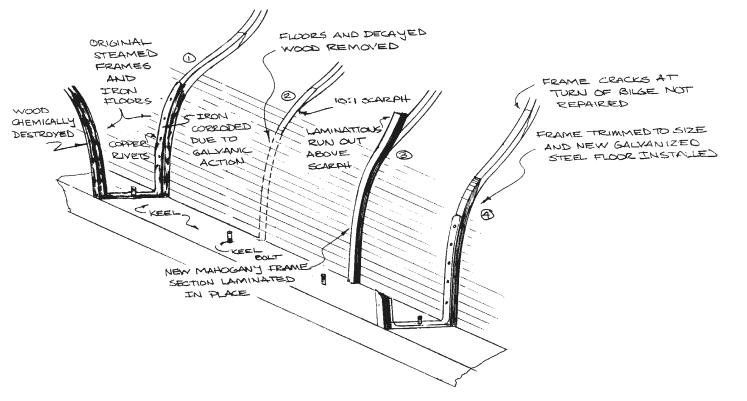
Unfortunately, she also needed some structural repairs, repairs of the type that have most sailors rejecting the thought of a wooden boat out of hand. Nomad is a production boat built by Cheoy Lee Shipyards in Hong Kong. As such, she was built to a price, and some economies made in her original construction caused the problems we faced 30 years later. She is built of strip-planked mahogany over steam-bent frames. Her planks are nailed every three to four inches with 3-inch (75-mm) copper nails and fastened to the frames with copper rivets and bronze screws. So far so good, but then came the cost savings: iron strap floors, which were copper riveted to the frames, iron bolts through the stem and stern posts, and cast-iron ballast with iron keel bolts.
This mixture of metals was Nomad’s Achilles heel: 30 years of exposure to moisture in the bilge had caused many of the iron floors to waste away to almost nothing. What’s more, the frames were chemically destroyed in the vicinity of the copper rivets holding the floors to the frames. In some instances, the wood was softened only in small areas surrounding each rivet, while in more extreme cases we found the entire frame that lay beneath the floor strap was soft and stringy. But what it meant was that two-thirds of the floors and lower frame ends had to be replaced.
Critical steps
These problems didn’t sneak up on us: we discovered them in the course of surveying Nomad before we bought her. Yet we went ahead with the purchase, because on balance she still represented a good buy. A critical factor for us was that we were able to isolate the serious problems and determine their cause. We were also able to map out a reasonable repair strategy, and come up with estimates of the cost, before closing the deal. These steps are critical for anyone buying a used boat in less than perfect condition, no matter what she is built of.
One of the biggest challenges in repairing an older boat is to keep the time and money invested in the project from getting out of hand. Approaches that are proper and cost-effective when building a new boat may not make sense if undertaken as repair work. This can lead to a situation that we’ve seen repeatedly as we cruise the Pacific: sailors who have invested five or 10 times as much money in repairing and rebuilding their boats as their craft are worth, but who have not gained any advantages in terms of seaworthiness, comfort, or overall longevity compared with what a common-sense, well-thought-out repair would have achieved. How to avoid this? Always consider the problem and any proposed solution in the context of the overall boat, and be very mindful of practical difficulties and obstacles.
We faced a number of the latter. In our case, the work had to be accomplished as quickly as possible because of Hawaii’s exorbitant haulout rates. Even so, they consumed about a third of the repair budget. We also had to plan the work so it could be done without reliance on specialized tools or skills; we lacked access to a workshop and had nothing but the simplest power tools. And finally, while we had a volunteer crew that was eager, our friends were essentially unskilled in boat-repair work.
Extracted screws
The approach we used to repair Nomad was chosen as a result of these limitations. After removing the remains of the original strap floors, we moved outside and extracted the bronze screws that connected the planking to the frames beneath the floors.
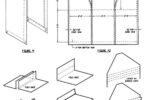
Returning to the bilge, we then cut away any weakened or soft framing, beveling the ends to leave a 10-to-1 scarf that followed smoothly from the plank line to the inner frame edge (see illustration above). We then epoxied new frame sections directly to the hull, holding each subsequent laminate to the hull and/or preceding laminate with bronze ring-shank nails. As a result, we could laminate continuously, without waiting for the epoxy of a previous layer to cure; it also ensured that the fit was precise. The laminates were allowed to run out at the upper end, and when all were cured, we used an anglehead grinder to smooth and fair the frames.
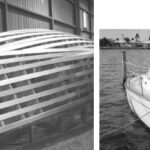
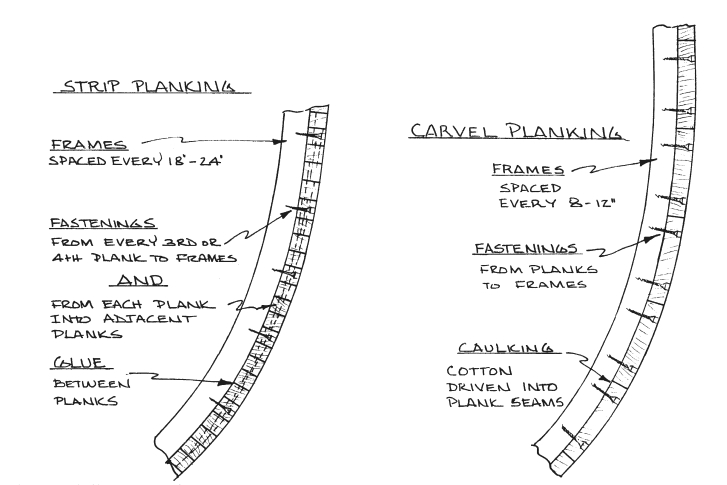
The approach we chose was possible because Nomad is strip-planked. A strip-planked hull, particularly one in which each plank is glued to the adjacent plank, moves very little, and this allowed us to laminate new frames directly to the hull. If Nomad were carvel-planked, we would have been compelled to fit new frame sections without laminating them in place. This would have added significantly to the time and expense of our repairs. (See illustration on Page 16.)
With the lower frame sections fitted, we then installed the newly fabricated galvanized steel floors. These were cut, welded, and drilled by a local machine shop, using the original floors as patterns. After considering various possibilities, we chose to fasten them using stainless steel lag bolts, with both the bolts and the floors set in epoxy resin. By bedding the floors and fastenings in epoxy, we sought to minimize their contact with the frames, thereby reducing galvanic action.
Regular maintenance
Structural repairs of this type are not needed often, fortunately; we expect our repairs to last as long as the original construction, or another 30 years. For many cruisers, it’s the regular maintenance that spells trouble. We’ve found that the secret lies in being satisfied with a reasonable level of finish. Bright-work, the hallmark of many classic woodies, requires the most dedication, particularly if one is out cruising. Varnish that may require little attention in temperate latitudes will need frequent retouching in the tropics. The simplest and probably most sensible solution is not to have any, and although we’ve talked about it, to date we haven’t painted Nomad’s bright teak cabinsides. They remain varnished, receiving a few coats every few months. The key is that the finish must be kept up; if you slack off, and the varnish becomes crazed or peels, the real work of stripping, sanding, and revarnishing begins.
We have sworn off varnish for trim, hatches, handrails, and the like. These are much more difficult to maintain in good condition than large flat areas such as cabinsides, due to the many corners and hard edges, where varnish typically wears and begins to lift. Our trim is all teak and suffers little from being left bare; most other woods should be kept painted or varnished.
We use one-part epoxy or enamel paint for topsides and deck. It’s easy to apply and relatively long-wearing. The topsides receive two coats every year at haulout, and the deck gets a couple of coats every few years. This treatment keeps the boat looking smart with a minimum of upkeep and expense and frees us from agonizing over the fate of an expensive sprayed topside finish. Any delusions we had about maintaining a “boat show finish” disappeared when we began cruising in countries such as Papua New Guinea and the Solomon Islands, where the locals view their canoes — and your boat — as practical watercraft rather than objects of beauty. Dings and scrapes are inevitable.
Dry and quiet
Cruising aboard Nomad has also shown us how comfortable wooden boats can be to live on. They are quiet, inherently insulated against extremes of heat and cold and, if nicely finished, offer a soothing retreat. These may seem like minor points, but take on significance when your boat is your home. We’ve come away from dinner aboard friends’ fiberglass boats amazed at the noise generated by waves slapping against the hull in only moderately choppy anchorages and thankful to return to Nomad’s quiet cabin. Likewise, while even the relatively mild chill of spring or fall in New Zealand waters caused significant condensation for those on uninsulated glass or steel boats, we experienced no problems.
Wooden boats usually have less interior space than do fiberglass boats of similar length. The reason typically given is the wooden boat’s structure, and it’s true that the planking, frames, deck beams, and other structural members intrude on the interior to a greater degree than the structural features of a fiberglass boat. Much more important, however, are differences in hull volume, which are a factor of the boat’s basic design.
Nomad’s planking is 1 inch thick, her frames are a bit under 1.5 inches, and she has a substantial keel and stem. A glass boat built to the same design would have a hull thickness of less than 1 inch, and no frames or internal keel. As a result, she would have slightly more room below. But either boat would have far less room than a 35 footer with a 12-foot beam, high freeboard, and a high cabin to boot. The amount of useable space on a boat is primarily one of basic design rather than construction material. There are older wooden boats on the market with considerably more freeboard and beam for their length than Nomad has, and their useable interior space is vast compared to ours, comparing much more favorably with that found on modern glass boats.
After the practical analysis is done, we feel wooden boats offer something extra — some very important tangibles. Boats built in the years we’re discussing have character. Even if they are production boats, such as Nomad, they’re built by hand, piece by piece. Thought and care went into the original design and construction of wooden boats. Their lines are dictated by the dual requirements of the sea they sail on and the wood of which they are built. All of this produces character, and while that character can be imitated — countless fiberglass boats have been built that copy the look of a wooden boat, right down to the molded-in plank lines — it is never reproduced. We have yet to meet other wooden boat owners who don’t recognize this spirit in their own boats. For most it is an important aspect of owning a boat.
Galvanic corrosion and wood
All metals suffer from electro-chemical corrosion when they’re immersed in an electrolyte such as salt water or wet wood. The corrosion rate varies; noble metals (such as copper and bronze) corrode more slowly than do less noble metals such as iron and steel. This explains why 90 percent of the iron stempost and sternpost bolts on Nomad needed replacing, whereas all the bronze and copper fastenings were in good condition.
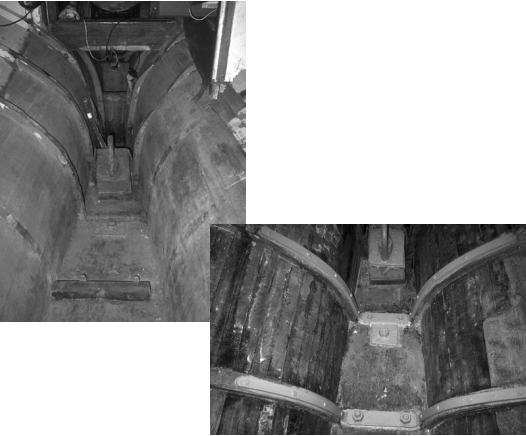
In addition to the simple electro-chemical corrosion that affects isolated metal fastenings and fittings, dissimilar metals that are in direct contact with each other and with an electrolyte will form a galvanic “cell.” The resulting galvanic corrosion will result in an increased rate of wastage of the anode, or less noble metal, and a slower rate of corrosion of the cathode, or more noble metal. In our case, we found that the majority of the iron strap floors were severely corroded, some to the point where they fell apart while being removed, while the copper rivets that secured the floors to the frames were in perfect condition.
Unfortunately, the effects of the galvanic cell are often not confined to the metals involved. The reaction between the anode and the cathode results in the production of negatively charged hydroxyl ions in the electrolyte around the cathodes. In our situation, the cathodes consisted of the copper rivets holding floors to frames, while the wet wood of the frames themselves were the electrolyte. We thus had a buildup of hydroxyl ions within the frames, concentrated at the copper rivets piercing those frames; this resulted in a strong alkaline solution within the wet wood of the frames that attacked the lignin of the wood.
Construction and repair
Wooden-boat construction methods include carvel, strip, double or triple planking, cold-molded veneers, and lapstrake. There are many variations to these general approaches, and the suitability of any repair technique must be carefully considered with regard to the nature of the damage, and the boat’s construction. Carvel and strip planking are by far the most common for cruising boats of the vintage discussed here, and below is a closer look at what can be involved in a repair job with these types.
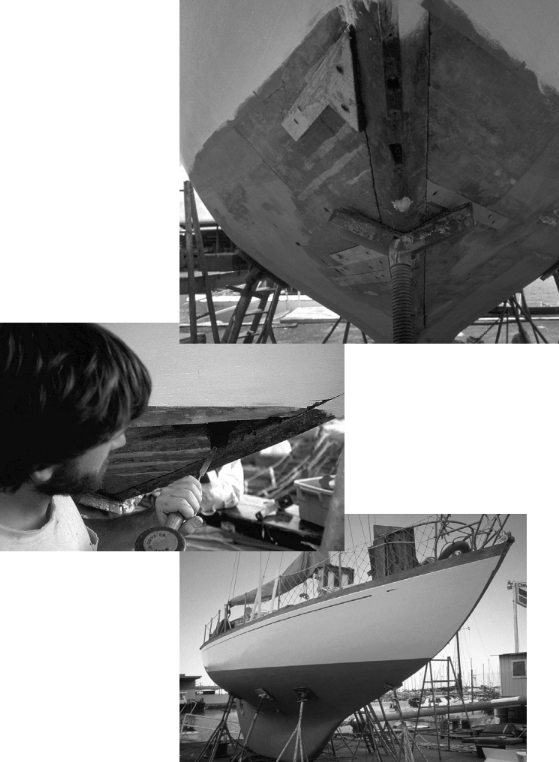
A damaged section of some 3 x 12 inches on a strip-planked hull can be repaired by cutting away any damaged wood, as well as any plank-to-plank fastenings that fall within the section. The sides of the resultant hole are then beveled, and a new plank section fashioned that matches the hole as closely as possible. If necessary, a backing block can also be made that is fastened to the inside of the planking. With the latter in place, a liberal coating of thickened epoxy is applied to all surfaces, and the new plank section is drawn up tight against the backing block. Such a repair is simple to make and very strong; no special skills or materials are needed, with the exception of some epoxy.
On a carvel-planked hull, a damaged area of 3 x 12 inches would require replacement of a much longer plank section, as very short plank sections lack adequate strength. The situation is complicated further if the damage involves two or more adjacent planks, as joints in adjacent planks must be well staggered. A relatively small amount of damage may, therefore, necessitate the replacement of a sizeable amount of planking.
Conversely, carvel boats get my vote as being the simplest to repair if the repairs affect a large area, due to the ease with which a damaged plank can be removed. Anyone who’s tried to remove the many nails that join strip planks to each other will have wished for the relative simplicity of carvel construction, where a damaged plank or planks can be simply unscrewed from the frames. If the damaged plank can be used as a pattern, then the repair is further simplified, as the process of spiling (making a pattern for) a new plank is unnecessary.
Large repairs on a strip-planked boat are carried out in much the same way as the small repair already described. The primary difficulty lies in getting the damaged wood and fastenings out of the way, and appropriately beveling the resultant hole. Once this is done, fitting new planks is relatively simple.
Any repair job will depend on the availability of good-quality wood. Strip planking has the edge here, as the strips used for most boats won’t exceed 1.5 inches square, while carvel planking stock may need to be 6 or 8 inches wide. Furthermore, the strip planks can be fashioned from kiln-dried wood, as the planks will be glued and nailed in place in such a way as to make movement all but impossible. Carvel planks should ideally come from air-dried, vertical-grain wood where the moisture content and shrinkage characteristics are similar to the rest of the planking. This is because the carvel planks rely on the swelling of adjacent planks, both for watertightness and hull stiffness. Unfortunately, wood meeting these specifications can be difficult or impossible to obtain in many places, and will almost certainly be expensive. A little extra (or a little less) caulking cotton applied to the seams of repaired planks can help make up for differences in wood type and moisture content, but knowing how far to go with such adjustments can be tricky. In the end, carvel repairs require high quality materials and somewhat skilled labor; strip-plank repairs require tenacity and epoxy.
Repairs to frames — commonly needed on older boats, particularly when frames are steam bent — are simpler on boats with planks that are fastened to each other, as new frame sections can then be laminated directly to the hull, an approach not possible with carvel-planked hulls. In the case of repairs to backbone members, such as stem and stern post, carvel planking is preferable, as plank fastenings can be withdrawn and the planks backed off while the damaged member is repaired. This is not usually possible with the other construction methods, and backbone repairs are consequently much more difficult.
Mark started sailing at 10 on an 8-Ball dinghy his dad built. He studied boat design with the Yacht Design Institute and says any number of “next boats” sail across the drawing board. Since buying Nomad in 1993, he and Kim des Rochers have been alternately sailing and repairing her in various parts of the South Pacific. They’re currently in Australia. Mark has a website which shows his recent designs and cruising philosophy.
Thank you to Sailrite Enterprises, Inc., for providing free access to back issues of Good Old Boat through intellectual property rights. Sailrite.com