A hangover with a dangerous potential
Issue 35 : Mar/Apr 2004
On a sunny Tuesday morning last summer I awake in a our aft berth with a headache for the second time in as many days. Monday’s headache I could understand. . . the skipper in the adjoining slip had been mixing rum-and-Cokes the night before. Not that he makes a strong drink but the word on the dock is that the Coke cowers beneath run in a corner of the glass.
I noted that my mate had opened the ports to our cabin berth during the night — apparently trying to get some fresh air. She complained that the boat had a faint odor, like wet sweat socks . . . perhaps a gas leak?
Couldn’t be gas, we use compressed natural gas (CNG). One of the things I like about it, beyond the hotter flame, is that it’s lighter than air; hence it doesn’t collect in the bilges or cabin. It must be something fermenting in the bilge, or an odor from the paper mill located nearby.
Seeking the source, I lifted the floor-boards. The bilges were all clean — no odor. I checked the valve on the CNG tank under the port settee. The pressure was good and the valve was firmly turned off. I checked the sump under the Yanmar thinking we might be reacting to an accumulation of diesel fuel. It was dry. Puzzled, we left for work and, in the course of the day, forgot about the headaches. Left for work? We live aboard our boat six months a year.
Tuesday evening our crew gathered for the weekly club race. All set about their respective routines for getting us race ready. This is quite a transformation for a “cottage,” but nonetheless a serious racing cottage. While stowing mooring lines in the cockpit lazarette, our daughter called out, “There’s a little can in here with frost on it. I’ve seen the can here before, but never with the frost — is that OK?”
Open valve
A quick check of the lazarette confirmed the presence of a small propane tank for the gas-fired barbecue. Out of sight, out of mind; the valve had opened slightly, apparently jarred while loading gear in the locker. Gas had collected in the lazarette and, being heavier than air, had somehow found a path to the aft cabin, causing our headaches. Fortunately the gas-to-air ratio in the hull had never become critical — potentially leading to an explosion. I quickly closed the tank valve and banished it to the dock to be dealt with after the race.
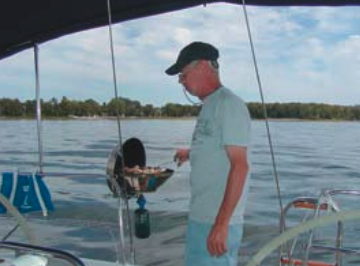
We were very lucky that an arc in the refrigeration or air conditioning motors or some other ignition source hadn’t touched off an inferno. We learned our lesson. Now propane-grill canisters are stored in a fabric-and-net pouch that hangs off the stern pulpit. Any escaping gas goes directly overboard or out the stern of the open cockpit. We are also much more aware of anything stowed out of sight. What hazards are stored in your boat — both below and above deck?
Thank you to Sailrite Enterprises, Inc., for providing free access to back issues of Good Old Boat through intellectual property rights. Sailrite.com