When the fog arrives, it’s time to blow your own horn
Issue 35 : Mar/Apr 2004
Operating your boat in a dense fog can be an anxiety-filled experience. You need to maintain a safe course; check your compass, radar, and chart; set up waypoints; listen for other boats; and keep a sharp lookout for anything emerging from the fog. It’s not surprising that few recreational boaters, in this situation, remember to sound a foghorn signal every two minutes, even though this is required by law whenever there is restricted visibility.
In 1972 the International Maritime Organization adopted the Convention on the International Regulations for Prevention of Collision at Sea. The regulations adopted by this global convention are known as COLREGS and have been incorporated in the Rules of the Road for the United States and many other countries. Part-D, Rule-35 of these rules define signals that must be used in or near an area of restricted visibility, whether by day or night. Although we usually consider “restricted visibility” to mean fog, the USCG describes this restriction as “any condition in which visibility is restricted by fog, mist, falling snow, heavy rainstorms, sandstorms, smoke, or any other similar causes.” (Darkness is not considered a condition of restricted visibility).
Vessels over 12 meters in length (about 39 feet 4 1⁄2 inches) are required to sound specific signals under these conditions. For vessels under 12 meters in length, the same sound signals are recommended but not required — however, those smaller vessels must still use “efficient sound signals at intervals of not more than two minutes.”
Although most boaters consider their radar the ultimate method of preventing collision when visibility is restricted, every year a surprising number of collisions occur in fog when both boats are using radar. Few accidents occur, however, when both boats are using the required sound signals.
The radar trap
The collision of the luxury liners Andea Doria and Stockholm, in which both ships were using radar, is one of the most notable exceptions. On the evening of July 25, 1956, the Andrea Doria, a day away from her destination in New York City, collided with the outbound Swedish ship, Stockholm, south of Nantucket Lightship. Within minutes the Andrea Doria was listing 20 degrees and water was pouring over the open tops of her watertight bulkheads, condemning her to a fate similar to that of the Titanic. Ironically, if neither ship had been using and misinterpreting their radar signals, it’s probable that there would not have been a collision.
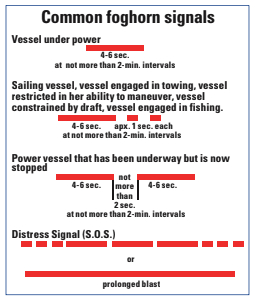
The U.S. Coast Guard regulations prescribe certain sound signals, depending on the vessel’s operating characteristics. There are different types of signals for a power-driven vessel that’s underway; a power-driven vessel that has stopped; a vessel under sail; a vessel constrained by her draft, restricted in her ability to maneuver, or towing another vessel; a vessel being towed; a vessel at anchor; a vessel aground; or a distress signal (see chart at left). With this multitude of different signals to contend with, many small boat operators just sound none at all.
Unfortunately, in a fog this increases the tension. While you can expect commercial craft to follow the rules, you never know if there is a recreational vessel operating nearby that is keeping silent. This makes it doubly important that you make your own whereabouts known, so other boats nearby know of your presence.
Hailers help
Electronic hailers, found on many powerboats, sometimes have internal circuits that will automatically sound a fog signal. These units are seldom seen aboard sailboats, however. A few years ago I tried to find a module that would do this for my schooner but was unsuccessful. I designed and built a small unit for my boat that would sound the foghorn automatically. It was very basic, built from Radio Shack parts, but it allowed me to sound proper signals while under sail or power, without taking me away from the duties of navigation, listening, and watching.
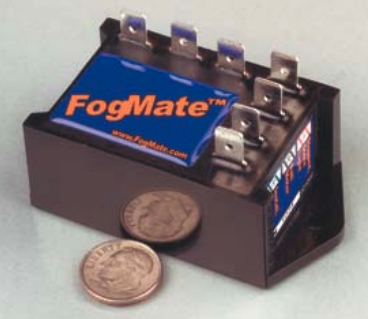
Recently, this electronic safety void was filled by TSX Products Corp., which came on the market with a small automatic foghorn at a reasonable price. The FogMate is a tiny module, about half the size of a pack of cigarettes, that can be connected to any existing electric horn to send the various sound patterns specified by the USCG. Although the FogMate is designed for boats that already have electric horns, it’s not too big a project to add an electric horn to any boat. The module is wired into your electrical system and has several installation configurations, depending on your specific requirements. Installation can even be made without adding any other additional switches or taking up any additional space on your console. In this configuration, the unit is powered from your navigation lights (which should be on whenever you are in a restricted visibility situation) and the automatic horn pattern is selected by hitting the horn button a specific number of times.
The FogMate is contained in a flame-retardant ABS plastic case, and the electronic circuit is encapsulated in epoxy, making it waterproof. When activated — except for when the horn is blowing — the unit consumes a minuscule 6⁄1000 of an ampere; however, the horn relay in the module can handle a hefty 20-amp horn current. The unit can also sound an automated distress sound signal — SOS — that will continue while the crew is preparing to abandon ship.
In a fog there’s the remote possibility that you may not hear another boat’s fog signal if the timing of that signal happens to coincide with yours. To eliminate this small possibility, the FogMate varies its horn timing randomly between 100 and 120 seconds.
No matter which system you use, whether you blow your horn manually every two minutes or whether it’s done automatically, proper sound signals in restricted-visibility situations can be one of the most effective and inexpensive precautions you can take to ensure the safety of you, your crew, and your boat.
Thank you to Sailrite Enterprises, Inc., for providing free access to back issues of Good Old Boat through intellectual property rights. Sailrite.com