A successful circumnavigator passes on lessons learned
Issue 70 : Jan/Feb 2010
My wife, Carol, and I have been bumbling ever westward for the last 20 years in our good old boat, Mary T, an Offshore 40 built in 1970 by Cheoy Lee. In that time, while we have made our share of mistakes and suffered a few bruises, we’ve found that someone was always there to help us. Others taught us valuable lessons that kept us out of even more trouble. We owe a lot to those who generously shared their experience and we feel obliged to pass it along. I love to tell stories, particularly ones that convey ideas or attitudes that have survival value. Following are three of my favorites.

1. Take only what you need
Years ago, I prowled the boat shows emptying my wallet and filling my boat with stuff I thought it impossible to sail without. I loved to troll the boat-show aisles gathering, I thought, nuggets of wisdom but, instead, filling my head with sales hype.
The Long Beach boat show was as chaotic as Newport Beach at spring break. The one island of calm was the Perkins Engines booth, presided over by a distinguished gentleman with graying temples, blazer, and regimental tie. He had the cultivated plummy voice that inspires confidence. I asked him what spare parts I should carry for my Perkins 4-107 on a six-month shakedown cruise to Mexico in our Offshore 40. He provided me with a colorful brochure listing recommended spares and wrote a long list of additional items.
Innocent and grateful, I took those lists to Don Peters, my diesel guru, at S&W Diesel in Wilmington, California. Don studied the list thoughtfully and observed, “You list well over $2,000 worth of parts here.” He paused, then asked, “Do you happen to have a 50-ton hydraulic arbor press on board?”
“No. Why?” I asked.
“You have on your list an impeller for the freshwater circulating pump. First, you need a press to remove and reinstall the impeller. Second, they rarely fail, and the mode of failure is a slow drip, not sudden and catastrophic. You can run a long time with that, so you take either the whole pump or nothing at all.”
He continued, “You have tubing for high-pressure fuel lines on your list. Do you have the hydraulic equipment on board to bend and swage the tubing? In 33 years, I have replaced many fuel lines but never seen one broken. Besides, you can run for a while on three cylinders. If you need one, just have any automotive brake shop fabricate what you need from hydraulic brake lines.”
A gradual awakening
I was beginning to catch on as he observed, “You list four injector tips. Picture this: it’s three in the morning, bucketing down rain, blowing like stink, and you are off a lee shore. Are you going to disassemble and rebuild the injector, with its tiny and delicate parts, while the boat is standing on its head? I’ll give you a complete rebuilt injector in a jar of clean kerosene. It will be clean, protected from corrosion, and filled with fuel, ready to instantly re-start.
“You have on your list a hand crank. That is a 40-horse diesel engine with no compression release. King Kong couldn’t hand-start that engine! Take along an extra-long (1/2-inch drive, 24- to 36-inch) ratchet wrench with a socket to fit the nut at the end of the crank- shaft. You can use that to turn over the engine, to determine the presence of water and clear the cylinders after bad weather and following seas. You will also use it for doing the valves, timing, and other operations. Most important of all, have on board the factory shop manual and illustrated parts list. Even if you intend to hire out all the work, it will help you communicate with overseas mechanics.”
Don went down the list item by item, in much the same way. “You will delay major repairs until you can sail to a safe haven with telephone and airport, or at least bus service,” he continued. “I can airfreight parts to you anywhere in the world. I do it every day for the tuna clippers, rig-tenders, and fishing boats.”
Don had a few more gems. “Always, always, use your Baja filter to clean all fuel. Carry enough lube oil and oil filters for at least four oil changes, in case you flood the engine with seawater.
“Never, ever use ether starting fluid. It dries the cylinder walls. It can blow a hole in a piston, stretch or break head bolts, or blow the head off the engine. But don’t leave home without it. When you need it, don’t squirt it into the air intake. Spray a little on a rag and then wave the rag in front of the air intake, while cranking.
“Carry several raw-water pump impellers as well as spare V-belts. Failure of these items can disable the boat. Install an electric lift pump to polish fuel and to purge air from the fuel system.”
Don saved me a lot of money. He finished with, “Keep your money in your pocket. Do you know what’s the most versatile spare part you can carry on board? It’s cash!”
As I left, he waved and called out, “Take a case of fuel filters and have a good time.”
I did.
Don was right. Over the years of pelagic cruising, we have found that 30 percent of our spares corroded to uselessness, 30 percent we gave away to cruisers in need, 20 percent we still have, and only 10 per cent did we ever use.
2. Fix it yourself
This lesson in the full, unedited version is: accept the responsibility of fixing it yourself and help others to do so too. Welcome it as an opportunity for invaluable on-the-job training. You have nothing to lose. Miles Smeeton was fond of saying, “When I pay someone to do a job, at the end of the day, I am not smarter, just poorer.” In my own cruising I have found that 40 to 50 percent of the work I hired out, I wound up doing over again anyway. That applies equally to first-world and to third-world countries.
Tio Alvino, as he was known to the Mexicans, was the best delivery skipper on the West Coast. To my knowledge, in 1959 he was the only one. I was privileged to go on a delivery with him, from Newport Beach, California, to La Paz, Mexico, and back, in the motor vessel Fengshui, a beautiful, 55-foot, all-teak, motor yacht custom-built for Dick Stuart.
On the trip south, we had a nasty night off Magdalena Bay. Fuel jugs and any loose gear were washed over the side and we suffered some minor damage. During my midnight-to-4 a.m. watch, the sweep on the radar quit. I logged the event and noted our position. For safety’s sake, I altered course 5 degrees to carry us farther offshore.
I was upset about losing the radar because Baja California was then, and remains, a wild, dangerous, and remote coast. We had the latest charts available, made by USNS Narragansett in 1855. They had been updated in 1885 by USNS Ranger, so they were not as accurate as we would have liked.
On the whole 2,500-mile cruise, we saw only one functional light-house. The only electric light on the whole coast was at the cannery at Cabo San Lucas. Although now a mega-resort, at the time, Cabo San Lucas consisted of an abandoned sardine cannery and a few mud huts. The airstrip was a straight patch of dirt road guarded by buzzards. The radar had been a great comfort on that wild and often foggy coast.
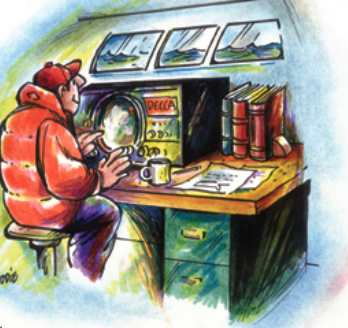
As I came on watch the next morning, Tio greeted me with: “Sig, fetch my toolbox. We’re gonna fix that radar.” I protested, “Tio, you can’t do that. That radar cost more than our combined wages for the next 10 years.”
At that time, only a few freighters and no fishing boats or yachts had radar. That 40-mile Decca was the pride and joy of the owner. Panicked, I pleaded, “Tio, if you break that radar, we’ll both lose our jobs.” Always laconic and seldom grammatical, he replied, “How can I break it? It don’t work now, do it?”
Dismantling the Decca
His first act of apparent insanity was to remove the rear cover from the set and poke around inside with a huge screwdriver, the same one we used for setting the valves on the GMC 6-71 diesel main engine.
There was a blinding flash and a report that sounded like a .45-caliber pistol. I fled to the upper deck in panic. When the dust cleared and Tio quit laughing, he explained that he was discharging static electricity in the cathode ray tube and capacitors.
He proceeded to dismantle the machine, carefully examining and numbering each piece as he went. We recorded the disassembly sequence and location of every piece for reference on reassembly. Today, I use a digital camera for the same purpose.
By noon, the set was stripped down to its empty chassis and the saloon table was covered with numbered components. I was convinced that there was no way he would get that thing put back together. A grunt of satisfaction announced that he had found the fault. One of the four bearings supporting the rotating sweep-collar was worn flat. “It’ll run just fine with three,” he said, as he wrapped and labeled the offending part as a sample for eventual replacement at the tractor-supply house in Ciudad de Constitucion.
By sunset, the thing was up and running again. That radar ran continuously, without fault, for the remaining 33 days of the voyage and possibly years longer.
“How can I break it? It don’t work now, do it?” Over the years, those wise words have encouraged me to undertake the most astonishing repair challenges.

3. Choose simplicity
It was a clear crisp autumn morning. Sam and Nancy were coming down the dock, each pushing a cart piled high with cartons of new electronic gear for their big cruise. They stopped to chat. With pride and great enthusiasm Sam explained, “With this unit we can monitor and display boat course and speed; GPS position; VMG; CTX; chart plotter display; radar display; water depth and temperature; wind speed, direction, and air temperature; weather charts and GRIB files; engine RPM; lube-oil pressure and temperature; bilge water levels; as well as fuel, water, and battery levels . . . ” Sam went on, waxing rhapsodic about the virtues of the new system.
It seemed inappropriate, at just that moment, to point out that they were operating a 40-foot sailboat, not a jet fighter aircraft at 49,000 feet in cold, clean dry air. With the writing of a check, they were throwing themselves upon the mercy of equipment that relied upon the boat’s electrical system, the most unreliable system on board.
I didn’t dare to suggest just then that they would be depending upon equipment they did not fully understand. I didn’t mention that they could find themselves waiting months for parts and replacements for equipment they could not repair by themselves or have repaired in remote places. Worse, they exposed themselves to extortionate shipping and import fees, visa overstays, and losing favorable weather windows.
While I was lost in these thoughts, Nancy brightly chirped, “We bought all this stuff at the boat-show prices, for just under $7,000.” I didn’t have the heart to tell her how many months they could cruise in third-world countries for that kind of money.
Caught in the throes of cruise preparations, Sam and Nancy had not considered that their whole system could be knocked out by a nearby lightning strike, a voltage surge from the engine starter motor, a voltage spike from the alternator, or a deck leak that soaked the circuitry.
Reality check
That evening, I recounted for them how once, years ago, I watched helplessly as white smoke leaked out of our Magnavox Sat-Nav. A short circuit in the remote speed sensor sent full battery current back into the set, destroying it and rendering useless all its sensors and ancillary equipment. That was not a problem 1,200 miles out in the Pacific, as we had our sextant and sight-reduction tables. In close quarters in darkness or bad weather, however, that could have led to disaster.
Nancy reacted in horror, “You mean, if this one unit goes down, all our other navigational systems could go down too?”
Nancy is beginning to realize the meaning of independent redundancy and the importance of simplicity. Sam and Nancy will be fine. They are figuring it out.
Sig Baardsen bought Mary T, a Cheoy Lee Offshore 40 yawl, in 1987. A year later, he and his wife, Carol, sailed south from San Pedro, California, and on to a 17-year circumnavigation.
Thank you to Sailrite Enterprises, Inc., for providing free access to back issues of Good Old Boat through intellectual property rights. Sailrite.com