This proven safety feature is now practical for all sailboats
Issue 43 : Jul/Aug 2005
Radar is an acronym for RAdio Detecting And Ranging. A marine radar is used to determine the distances and azimuths of landmasses, boats, and buoys by measuring the time between the transmission and return of an electromagnetic microwave signal that has been transmitted and reflected back from the target. In some cases this return signal may also be retransmitted by a transponder on the target, which is triggered by the original signal.
A single, rotating, highly directional antenna is used for transmitting and receiving. The size of the antenna and the frequency of the radar determine the beam width of the transmitted signal, with a very narrow “horizontal beam width” being optimal. This antenna, which rotates through 360 degrees, may be an open array, which presents the most precise display, or a rotating antenna enclosed within a radome (preferable for sailboats since there is no rotating antenna to foul the running rigging). Some radomes are as small as 12 inches in diameter — but as the diameter of a radome becomes smaller, the resulting display is less precise.
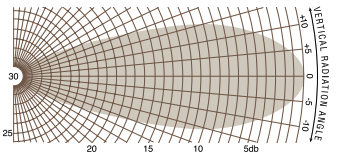
Since radar frequencies are nearly line-of-sight transmission, the height of the antenna and the height of the target determine the radar’s maximum range. The radar transmits very short, yet very high-powered, bursts of microwave energy thousands of times a second. Between the transmitted bursts, the radar is in the receive mode for the reflected signals returning from the target. Due to the high intensity and frequency of this microwave beam and the fact that the vertical beam width is much greater than the horizontal beam width, the radar’s antenna should not be located where the microwave energy will be directed toward any people or animals on board or toward other onboard antennas, such as a GPS.
Radar signals can be attenuated by rain and, to a lesser extent, fog. The higher a radar’s output power, the greater its ability to produce a usable return signal under these conditions.
Although a radar’s power is rated in kilowatts, this power level is only transmitted for short periods (usually considerably less than a microsecond), so a modern 12-volt radar unit does not consume much overall power. In addition, these units take up very little physical space. Even the smallest of boats, for an investment of less than $1,000, can now have the security of a radar when the fog rolls in.
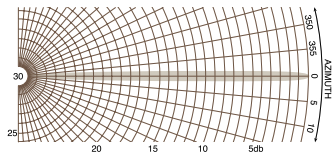
Operational controls
All modern radar units feature automatic and manual controls. Usually the automatic mode results in the most satisfactory display, but manual adjustments are also available and can be handy under special circumstances. The range, of course, is operator-selected.
Dual-range displays
As the name implies, a dual-range display allows the simultaneous display of two ranges on a split screen. Typically this would be a detailed display of the immediate area and a long-range display that allows a sailor to keep a watchful eye on what is approaching in the distance. The operator has the option of selecting the range for each display.
Multi-function displays
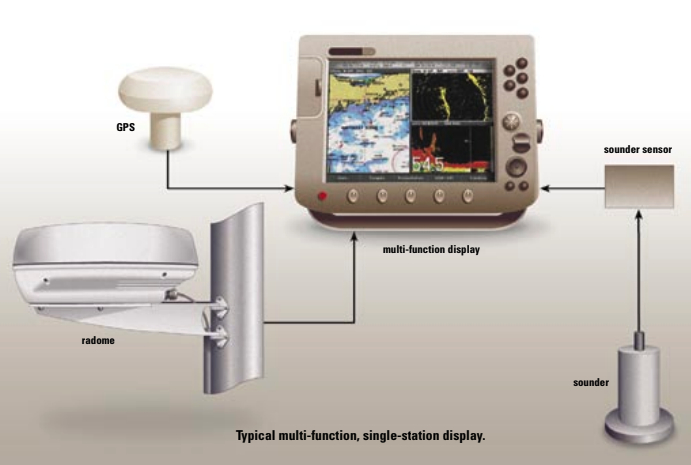
In the past few years there have been incredible changes in marine electronics. One of these is the multi-function display, which can provide two or more of your boat’s navigational electronics on one screen. Multi-function displays allow you to select and view radar, GPS, an electronic chart plotter, depth sounder, and other onboard electronics on one display unit. Usually these displays use a wide, split screen.
Although seldom used except aboard the largest of sailboats, networking allows more than one multi-functional display in different locations, such as at the helm or in the cabin at the nav station. At each location, the display unit can access and control any of the functions available in the system. Most marine electronic manufacturers have their own proprietary networking systems and equipment that allow for future expandability.
Radar overlay
One of the biggest recent advances in today’s radars is the chart/radar overlay, in which the radar display is overlaid on a GPS-controlled electronic chart, eliminating many of the problems associated with trying to monitor and interpret separate displays.
Misinterpretation
With any radar, it’s of vital importance to spend time using your radar on days with good visibility. It’s best, when the visibility is good, to use the controls and display options while comparing the appearance of various types of targets on the screen with those you can see.
If you wait for a foggy day to use the radar for the first time, you might be better off not having a radar on board at all. Even with trained, professional crews, many ship collisions have resulted from misinterpretation of the radar display — especially in the early days of radar’s use at sea. Notable were the collisions of the Neceto de Lorrinage with the Sitala and the Crystal Jewel with the British Aviator. The collision of the Andrea Doria with the Stockholm in 1956, which sank the Andrea Doria, occurred even though both vessels were monitoring (but misinterpreting) their radar displays.
Thank you to Sailrite Enterprises, Inc., for providing free access to back issues of Good Old Boat through intellectual property rights. Sailrite.com