Good old boats, good old folks, and the Pardeys add spice to the America’s Cup festivities
Issue 13 : Jul/Aug 2000
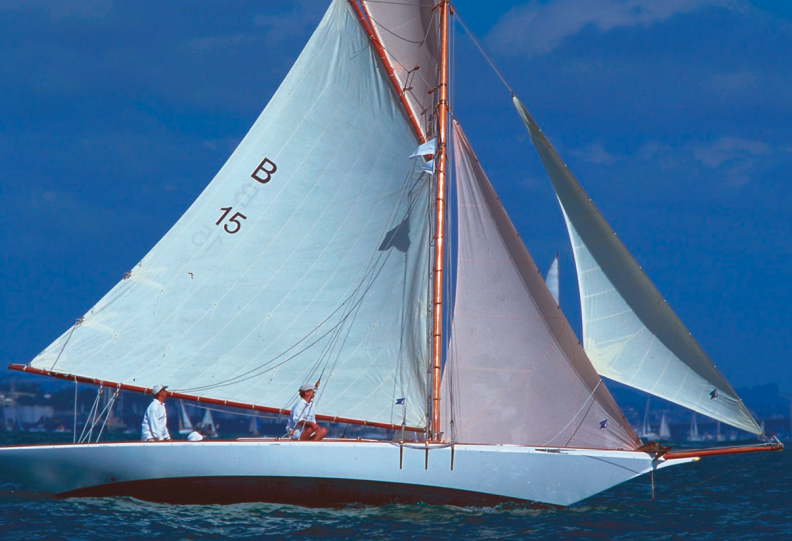
Here is one definition of a good old boat: standing on a dock in Auckland, New Zealand, I asked the owner of a nearly 100-year-old classic racing yacht how many boat like his the 19th-century shipbuilders had built.
“Eight,” he said proudly. “How many are still floating?” I wondered aloud, expecting his was the surviving remnant, and he’d tell me how he’d preserved her.
He looked puzzled, then said matter-of-factly, “All eight are still active racers.”
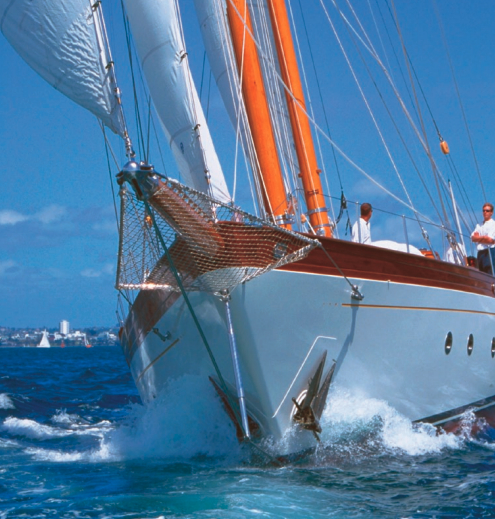
If you watched the America’s Cup events carefully this past winter, you might have caught, behind the huge transparent Cup mainsails and paper-thin carbon-fiber hulls, an occasional peek at a bowsprit or gaff. . . specters of an earlier age.
Classic yacht racing in New Zealand predates even the 1851 America’s Cup; New Zealand was not yet an independent country when early pioneers raced for cash prizes in the 1830s on the Waitemata, the Auckland harbor made famous by television coverage of last February’s Cup racing.
So, during a break in Cup trials, I was honored to join the classic yachts involved in the Logan Classic for three days of stiff winds and stiffer competition in Auckland. This is a land where sailing is taught in physical education class at school, and if two things can move, somebody will organize a race and others will have a punt (a bet) on the outcome.
Famous sailors
I was especially honored to crew for two famous sailors, hearty classics themselves: Lin and Larry Pardey. These prolific authors and salty world cruisers have spent more than 30 years touring the world — with no engines or electronics, in a fashion 19th-century sailors would instantly recognize.
Now New Zealand migrants and celebrity residents of Kawau Island, 90 minutes north of Auckland, the Pardeys are a particularly good fit with Kiwi culture. It is easy to see why they feel welcome here in the land of “the #8 fencing wire solution” (fixing your old gear rather than buying new). Resourcefulness, the ability to keep things “running on the smell of an oily rag” as the locals say, is a trait Kiwis admire, and the Pardeys have made an art form of building it themselves, making do, and being determinedly self-reliant.
I first caught up with them at the Mahurangi Regatta, just off Kawau, where Larry, 60, a native of British Columbia, was asked to captain the heavy 40-foot ketch, Spray II. Lin, 55, originally from Michigan and later from California, sat out the race that first day. As I found out later, she had struggled in the chop with a dragging anchor on a friend’s boat.
I am eager to sample the classic yachts and see how these world cruising sailors navigate the local club-racing scene. True to form, when I arrive Kiwi families were organizing foot races on the beach, racing their “littlies” (children), each other, and the “oldies” (grandparents) as well. Then come kayak and dinghy racing, and the main classic yachting event. (By the way, Kiwis call anything that sails a “yacht;” powered boats are just “launches.”)
Rail meat
When the Pardeys don’t need crew, I volunteer to serve on a 1904 cutter whose owners reckon they can use my weight on the rail. Soon we are all busy in 30-knot winds and a fresh chop, rails nearly under, like spiders crawling over sloping decks, on vessels without lifelines, mainsail winches, or camcleats, racing the way colonial settlers here would have raced 150 years ago.
Hours later, we are all as authentically wet, exhausted, and achy as our ancestors would have been. Larry has helped the owner of Spray II take a prize, and the owners of my boat have taken a respectable position in the front of the fleet.
I ask Larry whether racing is useful training for a true cruiser. “Absolutely,” he says. “Racing teaches you to get the best from your boat, how to respond quickly, to measure her against others; it quickens your reflexes.” And he notes with a twinkle, “It’s a great way to meet people.”
Lin agrees; she notes that when they arrived in Cowes, Isle of Wight, years ago, they joined a local race only two days later. It was a fast introduction to the area and the people, she remembers. And she says there is no reason why a boat can’t be home, transport, and fun, too.
After seeing her picture dozens of times over the years and reading her lean and natural prose, Lin loomed large in my mind’s eye. Imagine my surprise when this authoritative, engaging, and thoughtful voice of the cruising life turns out to be a petite 4 feet 10 inches tall. She says it’s an advantage in a small boat to be small, and she has never worried that she was not up to the task.
Simple sailors
The Pardeys cheerfully confess to being the Luddites of sailing, foregoing most modern equipment and even what most sailors would consider the bare minimums (engine, VHF radio) for gear they design and fix themselves. Of radios, both Larry and Lin are quick to remind me that a radiotelephone can give you a false sense that someone will always come to your aid and can even create panic. In the Queen’s Birthday Storm off New Zealand in 1994, they argue, some owners abandoned their boats because they heard how bad the storm was, not because they were in immediate danger.
“We cruise to get away from crowds, not to take them along,” Lin says, when I ask her opinion of the single-sideband “nets” and radio rendezvous many cruisers favor.
Lin points out that time spent at the radio, GPS, or SSB is time away from just “looking around.” She recalls the time she nearly hit a large buoy, but was alerted by their “11-minute watch alarm” (the interval they figure it takes a large ship to reach them from a hull-down position on the horizon) and was on deck to see it. “Would we have been safer if I had stayed below and relied on a GPS?” she asks.
I asked Larry if they did their own swaging or used swageless fittings for standing rigging. He trumped the question by saying he uses eye-splices he does himself, reminding me that even do-it-yourself standing rigging costs more than $100 a stay just for fittings.
Lin writes her books longhand, and they both estimate a laptop computer has a limited life on a boat: 18 months or less. They do have kind words for photocopy/computer shops — why own a computer when you can rent one, with an office, whenever you need one?” they ask.
Not philosophical
The Pardeys feel that most cruisers load their boats with “stuff” they cannot fix themselves, so they have to get jobs to pay for the maintenance and repairs, which keeps them from cruising — a “Catch-22” situation. Larry adds that the reason Seraffyn, the original world cruiser they built, did not have an engine was not that they made a deep philosophical choice. “It was simply,” he says, “that we figured for the cost of an engine, we could cruise Mexico for a year.”
“We don’t ‘eschew’ or abstain,” Lin laughs, when I suggest as much diplomatically, “we’re just cheap.”
I feel a bit sinful discussing technology around the Pardeys, as one might feel giggling at a Quaker meeting. And I notice they are underwhelmed by the sight of the breadcrumb trail on my car GPS screen as we drive around Auckland (“a city, like London, of winding streets,” I whimper in defense). But their nautical abstemiousness is cheerful and tolerant, not Puritan. “Things come to own you,” says Larry practically, “you need to spend time to earn them, and then you can’t fix them. All the while you are not building traditional skills and are wasting time you could spend sailing.”
Back at the next classic boat race (the Logan Classic was named after a turn-of-the-century boatbuilding firm which has now morphed into a clothing company), I join the Pardeys for a day of racing. This time we meet at Devonport, the Auckland harbor town that is home to the entire New Zealand Navy, all four small ships, itself a lesson in small is better. I hide my GPS under the car seat. My “brief” (task, in Kiwi parlance), the standard demand made of any green crew — is to be heavy on the weather rail, but at other times to stay small, quiet, attentive, and aerodynamic. It is a splendid honor to join these famous sailors, and I expect to learn heaps.
Glorious assembly
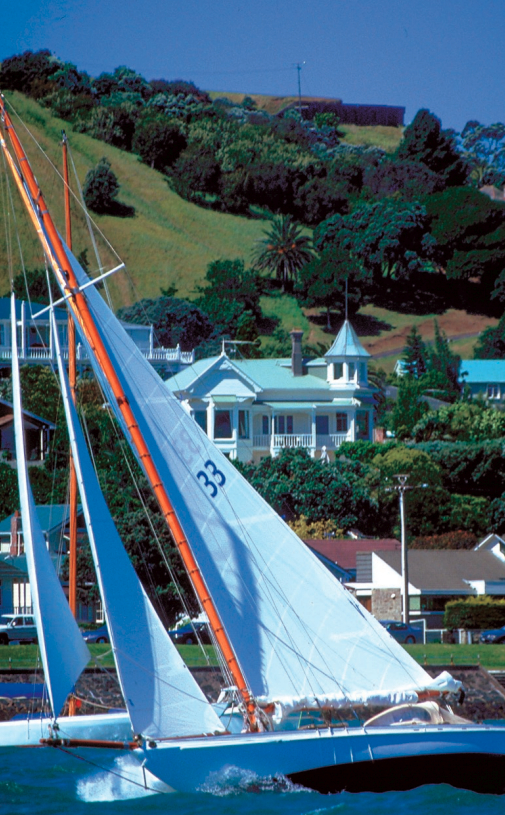
The Pardeys had agreed to help her owners race Jonquil, a gaff-rigged Herreshoff Buzzard’s Bay 25 (as Larry reminded me, actually much longer than 25 feet overall — old Nat, not market-savvy, used waterline lengths), on this third day of the Logan Classic. What a glorious assembly of antique craft join us at that start line, their many crew members typically in matching T-shirt-and-shorts livery. (T-shirts are a concession to modernity. Old photos of the same boats we sail today show the crews in mid-summer wearing three-piece vested wool suits, ties, and bowler hats.) But in all directions, as it has been for more than 100 years, there are sprits with dolphin-strikers and chain bobstays and whisker stays, long boomkins (Kiwis say “bumkins”) with gaff sails on boats 50 feet long but barely 8 feet wide, gleaming spars, graceful hatches, and spiffy brightwork.
There is a crowd on hand to cheer us at the start line, conveniently drawn close to shore between a long wharf and a nearby buoy. Overhead beat the helicopters of TVNZ and private photographers who swoop down, rotors often below mast tops, to take photos “on spec” of individual boats and crews.
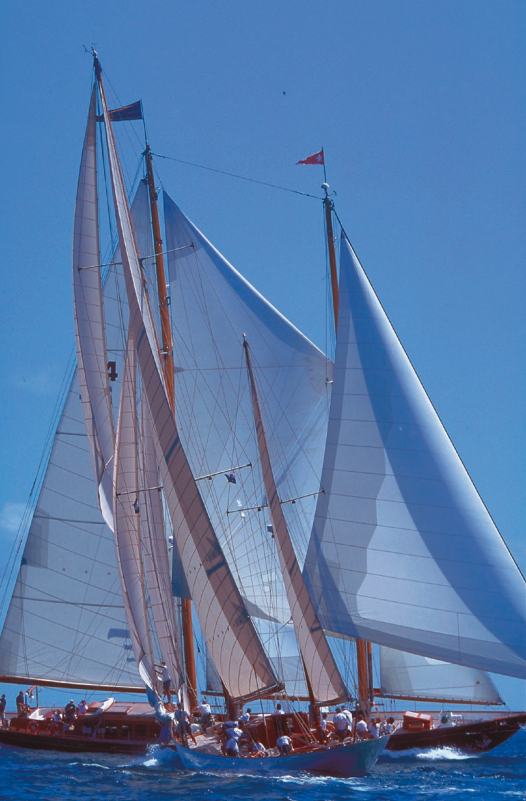
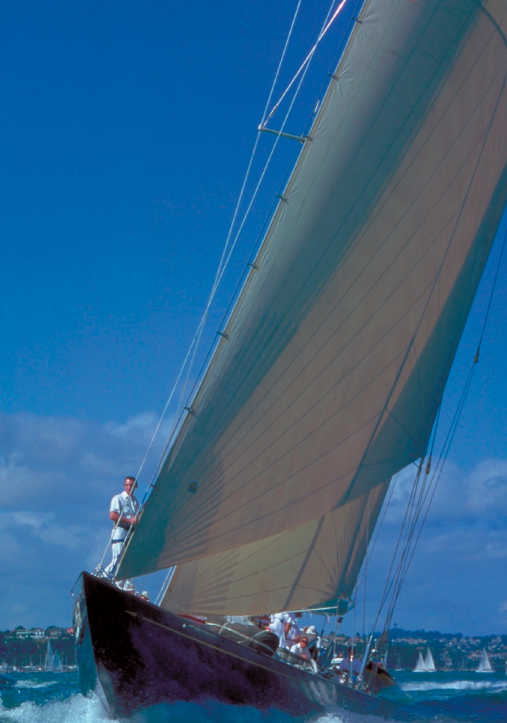
Among the contestants is a giant J-class boat, Velsheda (pictured on Page 39), one of those 130-foot monster sloops of the America’s Cup of the 1930s, her crew of 35 in crisp white uniforms. We can sense when she closes with us — in the shade of her dark hull, high freeboard, and giant mainsail, the sky around us darkens as this behemoth slips by at 12 knots plus.
Once on the course, I am in for a splendid surprise — again. These old designs, even the gaffers, are fast and stable. Normally we assume that an old boat is long on appendages and nostalgia but a slacker to weather. But after a couple of days spent racing on several classic boats, I am amazed to see classics regularly overhaul the modern designs paralleling the race. Admittedly, these were all-out racing boats, then as now: sitting headroom, flush decks, narrow beams, and huge sail areas, not cruiser/racers with modern headroom.
Raw hands
Larry and Lin, owner Sarah, and her daughter Sibyl, draw Jonquil steadily forward, capitalizing on a good start. We hug the shore to avoid the tide and soon pull parallel with other, larger, classics required to give us time — a good sign.
True to classic form, Jonquil’s mainsheet has not even a snubbing winch, nor any cam or jam cleat, and I wear my hands raw and shoulders to aching hauling the mutton-chop mainsail inboard onto a wooden cleat, though the jib, with winches, is easier. Free advice: before you volunteer to handle the main on a traditional design, consider you’ve just agreed to trim three-quarters of the sail area.
We crew spend the final downwind leg sitting on the long boom as ordered, a three-human vang, as we sweep across the finish line, first in class on corrected time. “Old Nat knew a thing or two about boat speed!” says Larry, with an Irish grin and sparkling eyes, graciously conceding our win to Jonquil’s design.
Later, at a swank downtown Auckland hotel, we lurk in the lobby, salt-encrusted and hungry, waiting to crash, tie-less, the black-tie-only awards banquet at the exact moment to collect Jonquil’s trophy . . . another story in itself. It seems anticlimactic and an embarrassing snub for so famous a cruising team, but Larry and Lin are mellow, and Sarah and Sibyl are glowing with the anticipation of their first trophy.
Have I learned any new sailing tricks? Well, absolutely, but not the sort I’d imagined. I was satisfied that the Pardeys tack and jibe like the rest of us (but with that hint of discipline that racing teaches). And I was impressed by how they scramble to the work with passion and enthusiasm, even after all these years. It was a treat for me to see them anticipate each other’s moves but curiously, I felt more at home when they raised their voices just a tad . . . a tiny hint of fallibility.
Let it go
And what of those who deride long-distance cruising as “fixing your boat in exotic places,” a way to visit a country only to tour its yacht clubs and chandleries? Lin reminds me that she and Larry have traveled far inland many times, even going on a long safari in Africa while their boat bounced at anchor. The secret, she says, is to hire a shipkeeper to watch it and to learn to let go.
And what do they plan next? This northern summer they have returned to the U.S. to reassemble their mothballed Taleisin, do more research on wooden boatbuilding methods, and to cruise the U.S. East Coast, especially Chesapeake Bay. “To sail,” as Lin has written before, “as long as it is fun.” Adds Larry, “At our age, that also means as long as we stay healthy.”
I ask them if they have any parting advice for armchair cruisers, those with grown-up lives of quiet desperation, who long for some adventure. (I sense they parry this question 30 times a week but will humor me.) “You need to figure out what you enjoy,” Lin says. “If you enjoy sailing, then a smaller boat where you can really feel the sails and rudder is far more fun than a big cruiser where the feel is lost. We have had the most fun of all our trips just sailing our Fatty Knees dinghy.”
Larry adds that a big boat is much more work and harder to handle. “Lin can sail our boat alone,” he notes proudly, “but a 45-foot Swan, for instance, is a handful of a boat.” Lin mentions that Susan Hiscock, lifetime world cruiser with husband Eric, started racing 13-foot dinghies when she was 78 and was midfleet at 84, delighted to rediscover what drew her to sail in the first place.
Larry shakes his head with mock pity and impatience at my question. “Go now, go simple, go small.” He shrugs his shoulders, “an old idea, but it is no harder than that. A well-built stock boat will make it, and if you wait until you have the ultimate gear and the stoutest boat, you’ll never leave.”
After stints in the U.S. Merchant Marine and careers as an English teacher and maritime lawyer, New Zealand native John Geisheker now directs Sailboats Inc. Sailing School, in Superior, Wis. When he is not teaching on the Great Lakes, delivering boats, or visiting his native land, he lives on his Westsail 32 on Lake Union in downtown Seattle and sails Puget Sound. He has sailed the Great Lakes since 1967 and has taught sailing and cruising, as the expression goes, “man and boy these 30 years.”
Thank you to Sailrite Enterprises, Inc., for providing free access to back issues of Good Old Boat through intellectual property rights. Sailrite.com