An innovative design that’s fast and fun
Issue 95 : Mar/Apr 2014
Jack Wolf caught the sailing bug at the age of 18 aboard a friend’s 32-foot Columbia Sabre. He later owned and sailed trailerable boats, including an O’Day 22 and a Kells 23 that he sailed on Lake Michigan and out of Jacksonville, Florida. When he was sent to Europe in 1976, he could not have imagined how much that move would enrich his life. He worked in the Netherlands for five years, and there he met Anneke, whom he soon married. They began their lifelong sailing partnership aboard a 27-foot Dutch-made Defender sloop on the IJsselmeer. Jack and Anneke were transferred to England and for the next 14 years they sailed with friends on the south coast and the North Sea.
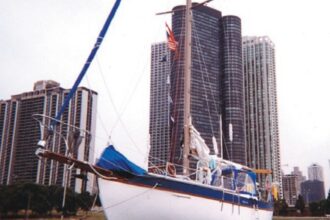
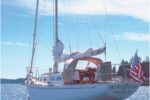
In 1996, Jack, Anneke, and their son Mark moved from Europe to Grand Rapids, Michigan. Sailing was a deeply ingrained way of life for the family. The culmination of their sailing dream came when they purchased their 1976 Islander 36, Trillium, in 2009. In May 2013, Jack and Anneke welcomed my wife, Sandy, and me aboard Trillium in her homeport of Muskegon, Michigan, for this review.
History
The history of Islander Yachts can be traced to Joe McGlasson, who began building small fiberglass craft in the early 1960s. Due to high demand for his popular 24-footer, his fledgling McGlasson Sailboat Company partnered with Glas Laminates, the precursor to Columbia Yachts, to produce a version of the boat.
McGlasson later withdrew from the partnership and produced the Islander 32, a boat of his own design. His company was incorporated as Wayfarer Yacht Corporation in 1963 and shortly thereafter it was sold to new investors. Joe McGlasson moved on to Newport, Oregon, to build boats under the Cape Foulweather name.
Cosmodyne, Inc., acquired Wayfarer in 1968 and within three years it was sold to Radlon, Inc. Islander boats ranging from the Islander 24 up to the fairly rare Islander 55 were produced at the Costa Mesa, California, facility under the name Islander Yachts. Some models were even offered in kit form for finishing by buyers.
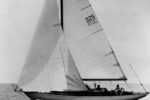
The Islander 36 proved to be one of the company’s most successful models. Production began in Costa Mesa, California, in 1971 and a reported 770 hulls were built over the 15 years that followed. This period was a turbulent time in the industry. While the lines of the boat remained constant, construction materials and methods varied due to material shortages and other factors. The company reportedly shifted production from Costa Mesa to Irvine, California, and then, in 1984, to Costa Rica. Islander Yachts closed its doors in 1986.
Design
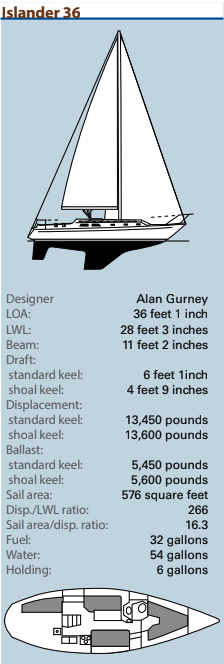
Alan Gurney, a gifted British naval architect, designed the Islander 36. He was better known for his work on custom designs, such as his famous Windward Passage, Guinevere, and Kittiwake. He much preferred performance-oriented boats and, while cruising was often a consideration, his designs were always quick and seaworthy.
He made a brief foray into the world of production sailboat design in the early 1970s. He drew the lines for the Carib 41 and the Whitney 41, but only a few were built. His greatest production successes were the O’Day 27 and the Islander 36. He also drew a 41-footer for Islander, but only six were built.
Alan grew increasingly frustrated with the demands of custom design and the changing preferences of clients and he left the yacht design world to pursue a second career exploring the Antarctic and Arctic regions. He wrote two books on his travels and a third book, Compass, chronicling the history of that essential instrument. He died in 2012 at his home in England.
The Islander 36 is also notable for its coordinated interior and exterior styling. Joe Artese, an industrial designer and ocean racer, developed many innovative features that first appeared on the Islander 36. From coachroof and cockpit design to comfort and convenience amenities below, the boat carries his mark. His Joseph Artese Design studio is still active and he graciously provided his original design notes on the Islander 36 for use in this review.
Construction
Islander 36 hulls were built using a solid fiberglass layup. Tumblehome in the hull necessitated the hull mold be in two halves that could be separated to release the finished hull. The joint was bonded with fiberglass, and the gelcoat over this area is prone to minor cracking. Some hulls seem more likely than others to develop blisters. This may be due to variations in layup procedures over the years.
Four transverse stiffening ribs that were glassed into the bilge also support the mast step. Liners were also used and some of the earlier boats had a textured fiberglass sole. Later boats were fitted with teak-and-holly soles.
The deck was laid up over a 1⁄2-inch plywood core that tapered toward the rail so the layup was solid glass where the deck mated to an inward-turning flange on the hull. The joint was sealed with bedding compound — reportedly Dolfinite — and fastened with through- bolts on 4-inch centers through the extruded aluminum toerail. This joint between the smooth hull flange and the rough underside of the deck was prone to leaks if the bedding compound had not been applied consistently.
The standard keel is a deep fin with a swept-back leading edge and a nearly vertical trailing edge. It is a lead casting and is bolted to the hull. A shoal-draft keel was also available. Some of the boats were fitted with cast-iron keels rather than lead, reportedly due to material shortages. The iron keels can exhibit corrosion, especially when a boat is hauled for an extended period. The skeg-mounted rudder has a stainless-steel stock and is supported on a bronze bearing at the base of the skeg.
Bulkheads are tabbed to the hull but not the deck, and owners report that this is a potential maintenance issue, especially on older boats.
Rig
The Islander 36 has a painted, keel-stepped aluminum mast with double spreaders. The upper and intermediate shrouds terminate at a chainplate bolted to a bulkhead at the forward end of the saloon. Forward lower shrouds are attached to a bulkhead-mounted chainplate and aft lowers terminate at a deck-mounted plate. The aft-lower chainplates on some boats have been modified to include a rod to carry rig loads to an added stringer glassed to the hull. A single backstay was standard, but many of the boats were fitted with split backstays.
Mast steps are aluminum. With age and saltwater corrosion, many have deteriorated and some mast butts have fused with their steps. Rebuilding the mast step is a common repair and various materials from oak to rigid polyurethane have been used to fabricate new steps. Refinishing the painted masts is another common activity.
As is common in boats designed under the IOR, the sail plan uses large headsails and a relatively small mainsail. As a result, the boom extends only a short distance over the cockpit. The mainsheet is attached to three points on the boom and to a traveler that spans the companionway sea hood.
Lewmar 45 primary winches are mounted on the coaming just forward of the helm. Smaller secondary winches are mounted farther forward on the coaming and two cabintop winches serve lines led aft. Halyard winches on the mast complete the complement.
On deck
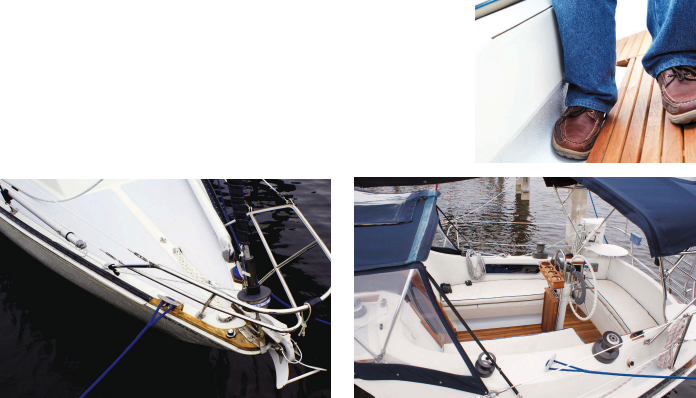
The Islander 36 presents a sleek and racy appearance. Joe Artese designed the cabintop with more slope than usual to the sides and with an oval top section. It’s finished off with a teak eyebrow that runs the length of the sides. Teak grabrails along the outer top surfaces provide good security going forward and convenient toe stops for crew working at the mast. Trillium has a fiberglass hatch contoured to match the forward coachroof profile, but later boats were fitted with a smoked-acrylic forward hatch and an additional hatch over the saloon. There are no ventilators on the coachroof other than the hatches.
There is no anchor locker on the clean and open foredeck, but a navel pipe directs the anchor chain and rode to a locker aft of the stem. Trillium has a single anchor roller and a chain stop to secure the anchor in place.
The cockpit shows several of the innovative touches Joe Artese added to the boat. He sculpted the aft end of the cabin trunk to an angled and curved shape that makes an excellent backrest. The sweeping line from cabin trunk to coaming adds to the boat’s distinctive appearance. One of the more noticeable improvements is his “heel-walk,” a curved fillet at the junction of the cockpit sole and seat front that provides comfortable footing even when the boat is heeled.
The steering wheel is mounted on a standard Edson pedestal. The seats are in a T-configuration that assures good access around the helm, but with the traveler mounted over the coachroof, singlehanding the boat is more difficult. There are sizable cockpit lockers under the starboard and aft seats and convenient coaming cubbies on each side for winch handles, gloves, and other small items. The cockpit seats are just over 4 feet 6 inches long — not long enough to stretch out on.
The companionway does not have a bridge deck and the cockpit drains are fairly small. Dropboards should be
left in place in any conditions where boarding seas might occur.
Belowdecks
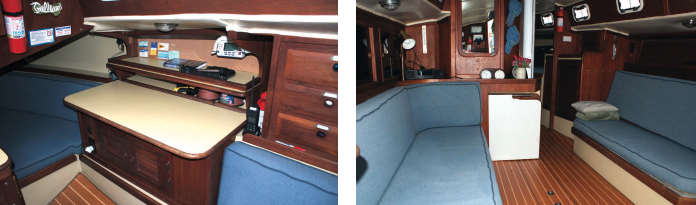
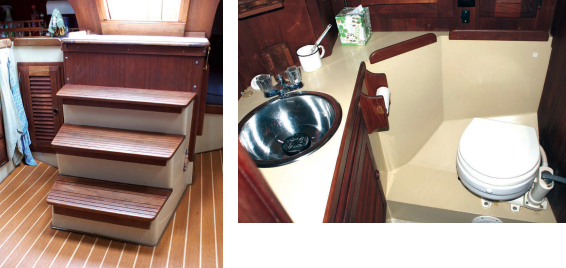
Stepping below on an Islander 36 is an experience unlike that on most other boats of this size. Joe Artese fitted the boat with actual stairs rather than a traditional companionway ladder, and as you walk easily down you enter a saloon that is open and airy. Handsome teak surrounds the entry and provides good handholds, and the interior teak has angled and curved features that distinguish it from the more traditional look of the furniture in many boats built in the ’70s. Two large fixed portlights allow a good amount of light into the saloon. Forward of them, three opening ports on each side provide decent ventilation. The fixed ports were made larger in later models.
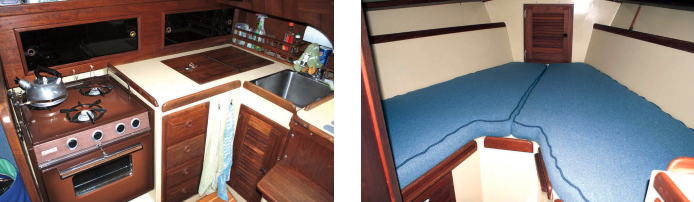
The V-berth is 6 feet 8 inches long and more than 6 feet wide at the head. With the insert in place it makes a comfortable berth for two. A louvered door at the forward end provides access to the anchor-rode locker. The fiberglass hull liner forms the sides, and there are molded-in storage shelves trimmed with teak.
Located aft of the V-berth and to port, the head compartment is small but serviceable. The marine toilet is mounted on a fiberglass platform and a vanity with a round sink abuts the compartment’s aft bulkhead. Teak cabinets provide ample storage behind louvered doors.
The saloon is the focal point of the interior. The settees along both sides have different configurations and the combination of curved and angled teak surfaces breaks up the usual boxy feel of a boat cabin. Shelving along both sides provides good storage. Joe designed the table to fold neatly out of the way when not in use. It can be used in a half-deployed or fully deployed position depending on need.
The galley lies to starboard, aft of the settee, and its main features are a three-burner gimbaled stove and adequate counter space along the hull with an icebox and drawers beneath. Just to starboard of the companionway is a single deep stainless-steel sink with storage below it accessible through a louvered door. The insulation around the icebox will likely need to be augmented.
To port and aft of the settee lies another Joe Artese innovation: a large storage box or cabinet located outboard doubles as a nav station and provides shelf storage above with room for the radio and electronics. Aft of this box, a fair-sized quarter berth extends under the port cockpit seat. The main electric panel is mounted on the port side of the stair housing next to the quarter berth, so anyone getting into or out of the berth must be careful not to inadvertently throw switches.
Under power
The original engine installed in the Islander 36 was the gasoline Universal Atomic 4. A few early hulls were fitted with the Palmer P-60, also a gas engine. Diesel engines were used as well, including the Perkins 4-108, Westerbeke L-25, and the Pathfinder, a marinized Volkswagen engine. Some of the later boats were fitted with Yanmar engines. Trillium has been repowered with a Yanmar. Access is fairly good. Removable sections of the stairs allow access to the front and top of the engine. The injector pump and secondary filter, which are located on the side of the engine, can be reached through the starboard cockpit locker.
Trillium moves smartly under power from the Yanmar, which is fairly quiet. There is some noticeable port prop walk in reverse, but once the boat has steerageway the big rudder helps to overcome it.
Under sail
On the day of our photo session conditions were a bit blustery, prompting us to stay within Muskegon Lake rather than venture out into Lake Michigan. Jack and Anneke sailed under a partially furled genoa while followed by the chase boat, Michael J, a Morgan 41 owned and skippered by Captain Bob Burns.
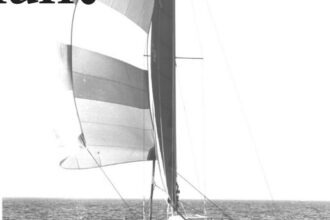
Sailing Trillium is an eye-opener for those who are familiar with traditional cruising boats. Alan Gurney’s original design was for a tiller-steered boat. Most of the boats were fitted with a wheel, as is Trillium, but helm feedback is good nevertheless. It is easy to imagine how fast a tiller-steered Islander 36 might be with the tall rig, less cruising weight aboard, and hanked-on sails in lieu of roller furling. Even equipped with wheel-steering and outfitted for cruising, the boat is very quick and responsive, and the large skeg-hung rudder and fin keel provide good tracking and stability.
Although the headsail was partially reefed, the boat pointed quite well, not losing much drive even at 35 degrees apparent. The boat is fast on a reach and stable on a run, although some owners report that it can develop an uncomfortable roll on a deeper run in higher seas. We did not experience those conditions in the confines of Muskegon Lake.
The Islander 36 is fun to sail, responsive, and easy to steer. It is still a popular club racer and, with a base rating of 144 for a standard rig and keel, the boats hold their own in PHRF fleets. For comparison, the much more modern J/35 rates 72, and a Hunter Legend 35 is 135. Some boats were ordered with a tall rig that cuts this rating down by a few seconds and shoal-keel boats like Trillium may have a few seconds added.
Availability and price
An Internet search in late 2013 for boats then on the market found six listed for sale at asking prices ranging from a low of $18,000 for a 1972 boat to a high of $39,900 for a 1979 model. The average asking price was just over $32,500. To be fair, the least costly boat appeared to be the victim of “deferred maintenance.”
An Islander 36 will make a capable, enjoyable coastal cruiser for someone who is aware of the age and condition of these boats and willing to make some repairs and improvements.
Tom Wells is a contributing editor with Good Old Boat (and he has also earned the honorary title of Troubadour through his musical contributions at boat shows). He and his wife, Sandy, have been sailing together since the 1970s and own and sail a 1979 Tartan 37, Higher Porpoise.
Thank you to Sailrite Enterprises, Inc., for providing free access to back issues of Good Old Boat through intellectual property rights. Sailrite.com