Hush those tapping halyards
Issue 95 : Mar/Apr 2014
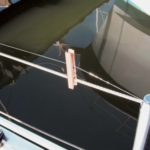
A halyard slapping on an aluminum mast is probably the most annoying noise on the water. It’s bad enough if it’s on someone else’s boat, but if yours is the one ruining the ambiance, something must be done! Simply cleating the halyards off tightly to the mast rarely does any good. Pulling them away from the mast with a bungee cord or lanyard works to some extent. However, if your shrouds are not offset forward or aft of the mast, halyards tied off in this manner will most likely chafe against the spreaders.
Soon after I replaced my spinnaker halyard — the outer cover having been abraded by the spreader — I reached the point where something had to give. I searched the Internet for a device to help manage my halyards. I thought there must surely be something designed to hold halyards away from a mast. I came up empty-handed. Although I found some old patents that address the issue, it appears that no one has brought such a product to market.
The Halyard Handler
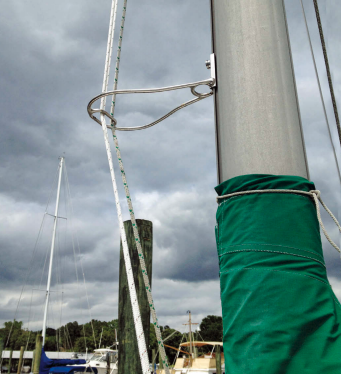
I decided to design my own device. I needed something to hold my spinnaker halyards and the winch end of my main halyard away from the mast. My thought was to create a rigid “strut” to be mounted on the forward side of the mast to keep the halyards about 15 inches forward of the mast at a point about 7 feet up from the cabintop. While brainstorming in the foredeck area, I decided the spinnaker-pole track on my mast might be the perfect spot to attach such a device.
Having decided on an anchor point, I procured a stainless-steel spinnaker-pole slider, 6 feet of 3⁄8-inch-diameter stainless-steel rod, and a stainless-steel carabiner and began construction. The carabiner would capture the halyards. It would be attached to the slider with the 3⁄8-inch rod. One guiding principle was to create a device that would not snag or disrupt the jib, so smooth curves were the order of the day, and I made sure that any sharp corners and welds were generously rounded.
When I position my Halyard Handler near the very top of my spinnaker-pole track, the angles work out nicely to allow the halyards to be cleated off on the mast and not interfere with the mainsail cover. It is also high enough off the cabintop to clear any but the tallest of heads. I have a 150 percent roller-furling genoa that slides past the halyards without any fuss at all. And best of all, my halyards no longer slap or chafe.
Tom Stevens is a retired mechanical engineer with a passion for sailboats. He began sailing at age 8 with his father and younger brother in an 8-foot pram. He’s progressed since then through a number of vessels and currently enjoys his Tartan 34C. Much of his fascination with the older sailboats is due to the Atomic 4. In 1993, he started Indigo Electronics to provide unique upgrade kits for the engine, and that has become his full-time retirement job.
Thank you to Sailrite Enterprises, Inc., for providing free access to back issues of Good Old Boat through intellectual property rights. Sailrite.com