A newcomer takes to sailing like a duck to water
Issue 36 : May/Jun 2004
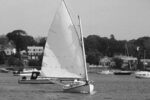
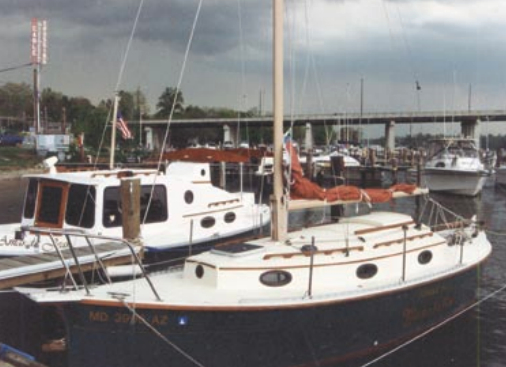
This is Willi’s first time at the tiller. Her sharp brown eyes stare past the tanbark sails at the cumulus clouds building to the north as our 24-foot sharpie yawl sneaks out of the channel between Lennoxville Point and Bird Island. Two dolphins spurt by, heading west toward the inlet, getting ready for the incoming tide. We are in the swirling shoal waters where Taylor’s Creek meets the North River. The buoys lean forward with the last vestiges of the outgoing tide.
Willi intuitively points the sailboat southeast, bucking the rebellious current, her eye on the red buoy, the wavelets created by shallow bottom, wind, and current colliding. I wait for the familiar sound, “slew, slew, slew,” of the centerboard hitting muck and oysters, then an abrupt stop. Grounded. But not today, not with Willi at the helm. We sail on out toward Middle Sound. I scan the green marker No. 56 for the signs of the osprey nest, the fledgling, and its parents. Vacant.
Willi and I knew each other at an earlier time in our lives. She lived in the hills above Jordan Lake, and I lived along the Rocky River of Piedmont, North Carolina. She was a counselor in a busy office, and I was hired as an consultant to help the staff grow into a larger practice. Then 10 years ago, I moved away and lost track of Willi.
One day while thumbing through the Yellow Pages of my new home phonebook, I noticed an ad for “Willi Foster, psychotherapist,” with a Beaufort telephone number.
“I wonder?” I said to myself. I took a chance and left a message on her answering machine. A week later she called back, and we had a cup of coffee at her place overlooking the North River. She didn’t have a sailboat and had never sailed.
“Prepare to come about!” Willi is standing, looking over the starboard side, where it shoals close to Bird Island. The sails flutter as Willi drives the tiller to the right; the boom passes over and we head toward Harkers Island.
Her tongue sticks out, her round sunburned face has a look of relish and bit of the trickster, as if she were trying some new device out for the first time. Willi grew up near the canals of Amsterdam. Her parents were afraid of the water, disliked the river barges. “A class thing, beneath us,” Willi tells me. “My mother wouldn’t have it. But I’ve wanted to be on the water all my life.”
Figure it out
My dad gave me a used Sailfish when I was 12. It was a flat, wooden board, 13 feet long with a white sail. “Figure it out, I’m not much of a sailor,” he told me. My older brothers preferred water-skiing and powerboats. I taught myself how to sail by capsizing, getting stuck behind an island, and asking for a tow home. I learned the importance of a triangular course. Go out against the wind, come about on a beam reach, and then return home downwind.
Since then I have taught children and adults how to sail on lakes, bays, and oceans, using the triangular course. But I have never taught anyone who handles the sails, sniffs the wind, and moves the tiller with such delicacy as Willi.
“McCabe, the bottom is changing from murky brown to light sand, get ready to come about!” Sailing in coastal North Carolina calls for constant vigilance because storms and currents move tons of bottom sand and silt overnight. Channel markers are hopelessly out of date and misleading. Before I ready the genoa, Willi has already turned the bow back to the south.
“You didn’t say ‘hard-a-lee,’ ” I tease, as I pull up the centerboard, our bow pointed at Shackleford Banks in the far distance. We steam by the next marker and come about again, hoping for deeper water. Off to the right, a fisherman with waders pulls a long net, hoping for a mess of croaker to appear out of the swirling water. We pass some crabpots, then white stakes. “Coming about!” Willi yells, knowing these markers are leading us back into shallow water.
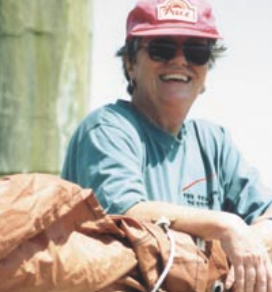
With a red bill cap on, gray sweatpants rolled up to her knees, black Keds, and white T-shirt, she hardly looks the sailor type as she pushes the tiller to the right. She’s a bit on the short and stocky side, her graying brown hair trimmed. I can tell she focuses her energy as she drives the tiller to the right. We go with the tide, giving up on finding a path through the narrow passage between Harkers Island and Middle Sound.
Catching up
Being on the water is different from being in a coffee shop. Willi and I have a lot to catch up on. Job changes, marriage endings, geographical shifts, spouses, gardens, the muse of water. But we don’t talk about any of that. We point out to each other the black skimmer, osprey, and oystercatcher, the changing current and wave patterns. And then we fall into silence, taking in a world filled with color, change, and imagination.
When we return to Taylor’s Creek the tide is going against us, and I start the outboard. The wind died at dusk, and there are few birds flying.
“Willi, want a break? I’ll be glad to take the tiller.”
Willi shakes her head as if I am a mosquito, buzzing around, distracting her. Her gaze is straight down the creek, the bow pointed at the recycled gray Navy minesweepers now used for menhaden fishing. I walk up to the bow, enjoying the unique vantage point. Usually I singlehand this vessel and am at the helm watching the ibises and egrets peck about the marsh.
“You bring her into the slip. I don’t understand the current. It’s too strong,” she says. So I take the tiller and motor past the dock, turn the bow perpendicular, and let the current drift us into the 12-foot-wide empty space. Willi jumps on the dock with the bow line as I put the engine into reverse. She ties an unorthodox knot, but it holds and we are safely home.
We stuff the sails into bags and then practice some knot-tying. She gets the “two people under a blanket” knot right away. I’m dumbfounded. I like to teach, give instructions and words of advice, but I have been silenced most of the afternoon with this woman. I ask her what it was like being on the water, taking the tiller for the first time.
Her gaze is beyond my right shoulder, where the Town Creek and Taylor’s Creek meet at Gallant Channel and then head out to the Atlantic.
“It just seemed like I was called home, and I knew the way and how to get there.” Her eyes are still drawn way off, reliving the afternoon or possibly readying for the next voyage, this one out of the inlet where the horizon is forever and quiet reigns.
Good sailing day
We sailed through the fall and into the winter. Any day with the sun out, the temperature above 50 degrees, and with at least 5 knots of wind is a good day to go sailing. Willi has dealt with gusts, ocean waves, and coming about in tight quarters. Her technical competence will increase with time on the water. We’ll sail through the winter, watching the winds shift back to the southwest from the northeast. By summer Willi will be able to captain her own sloop.
Sometimes I think of myself as a midwife, not a teacher. I provide a vessel and some sailing skills. The novice jumps aboard. The two of us are held in sway by a world like none I know of. No telephone, no traffic. No phone calls to return, no shopping list to take to Food Lion. Just water, a bit of wind, a vessel that floats, and somehow, when the sails are set, the vessel with two passengers enters through a translucent door of sun, waves, and quiet movement. As sailors, we adopt an unaccustomed patience to go no faster than the speed of a jogger for hours on end. Then we turn around and return, sometime before sunset. What goals were accomplished? What deep conversations shared?
As a midwife, I let the bountiful free gift of nature work on each of us, stirring old memories, forging new ones, encountering the grace of watchfulness. Wind, waves, time of day, current, birds, moon. No words need to be exchanged. The conversation is between the islands, creeks, ocean, and the yearning soul. Maybe later we might talk. Or maybe not. Each of us is a monk attending to the daily elements of life on the water. Nothing more is asked of us. Nothing more is needed.
Thank you to Sailrite Enterprises, Inc., for providing free access to back issues of Good Old Boat through intellectual property rights. Sailrite.com