The solution for simple boats and limited budgets
Issue 35 : Mar/Apr 2004
I had known about my delaminated foredeck for a very long time. The surveyor had missed it when I bought the boat, but I discovered it soon afterward. While poking around the anchor locker, I noticed the overhead was discolored. A few taps with a hammer produced the sickening dull thud that indicates problems. After drilling a few small holes through the skin into the core, my worst suspicions were confirmed — the balsa core had turned to a soggy, pulpy mass.
I am a boater who cruises on the extreme low end of the economic spectrum. I refuse to let my boat be a financial millstone around my neck, causing household stress and delaying retirement plans. I was, therefore, a bit nervous when I asked the local pros for quotes on this extensive repair. Their prices hovered around the $5,000 mark — “more if the rot extends to the sidedecks,” they said. My trusty 1979 27-foot Watkins is only worth about $10,000. Common sense would indicate alternative action. I had to find a way to get the job done cheaply, yet effectively, or my boating days were numbered.
After reading everything I could on deck repair at the local library, I decided to determine the extent of the damage, replace the core where necessary, and re-fiberglass the areas involved. Don Casey, boat repair guru, states that this problem can be attacked from above or below the deck, depending on the situation. From above you have more space, and gravity is working for you as you apply the messy fiberglass. It also means you have to refinish the entire deck. I chose to work from below.
Removed overhead
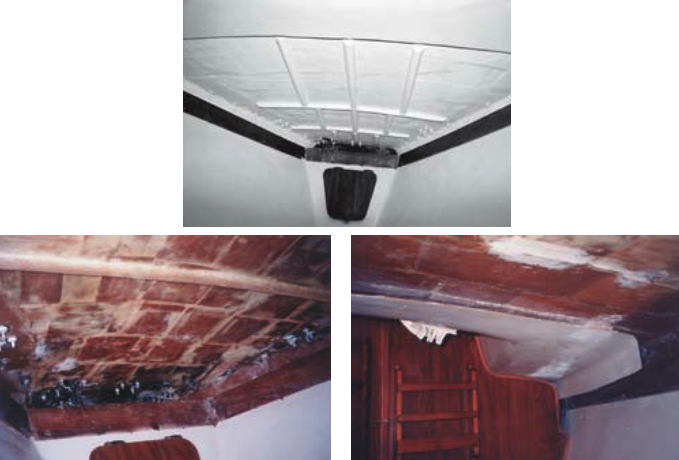
I cut away the overhead liner in the forepeak with a rotary tool (Dremel), using a grinder with a cutting wheel occasionally. The fiberglass skin came away easily — it was delaminated extensively. The rot extended about 4 feet back from the bow, then it was beautiful, clean, new looking balsa. Unfortunately the sidedecks were implicated as well, so I had to remove hardware, stanchions, chainplates, toerail screws, deck fills, cabinets, and parts of the hull liner to excise the damage. At this point I was thinking that working from above might have been the better choice. The balsa core came away easily in most places. The grinder with an abrasion disk took care of the rest. Of course, I used a respirator and goggles for this and had good ventilation.
Next came the fun part. Reaching upward, I applied epoxy, thickened to a dense peanut-butter consistency, all over the underside of the deck where I had removed the core. The original core had been pieces of balsa about 8 inches square. Nobody stocked balsa core in my area, so I ripped marine ply into similar-sized pieces and squeezed them into the gooey epoxy overhead. I smoothed everything out with a squeegee and let it dry. A few days later I again used a grinder to make the repair fairly smooth. A respirator is critical when grinding or sanding epoxy, especially if it has not completely cured. Apparently the small particles finish the curing process in your lungs. Not a nice picture.
Then I applied four layers of 6-ounce cloth to the area. Using epoxy means you can use just cloth for this type of repair, according to Don Casey, you need not bother alternating mat and roving as you would for a repair using polyester resin. This was a messy job; it was hard to keep the resin off of myself and other parts of the boat. Epoxy in my hair was the worst mess I have ever dealt with — be careful!
Still springy
The foredeck of my boat was still slightly springy. I decided to laminate two athwartships and several longitudinal beams to act as stiffeners. The experts say it doesn’t matter what material you use for the actual beams because the strength comes from the fiberglass. This reinforced the deck nicely, and it now feels much stiffer than before the repair.
When I was finished with the fiberglass, I sanded all surfaces and applied white marine enamel. It looks pretty good. I can now see the underside of the deck easily, so leaks will be detected before they cause major damage. In my case, the overhead liner was concealing a serious problem, and I’m glad to be rid of it. I carefully re-bedded every screw and fitting, drilling the holes oversize, filling them with epoxy to seal the core, then re-drilling the proper size for the screw or bolt. This will help ensure that any future leaks do not enter the core to cause further damage. I wondered whether the pros would have been this thorough. Maybe.
It felt good to have solved the problem myself. Although I am not a particularly handy person, the job presented no real diffi culties besides being unpleasant and messy. The best part was that the repair was completed for less than $500, well within my means. Although it may or may not look as good as a professional repair, it is every bit as strong and functional. For those of us sailing simple boats with limited budgets, sometimes the only solution is to roll up our sleeves and get the job done ourselves.
Thank you to Sailrite Enterprises, Inc., for providing free access to back issues of Good Old Boat through intellectual property rights. Sailrite.com