Keeping out the heat
Issue 81 : Nov/Dec 2011
Whether your icebox holds ice or houses a refrigeration evaporator, to be efficient it must be very well insulated. To achieve this, the box should have a minimum of 2 inches of high-R-value foam for insulation. Four inches is better and on our schooner we have 6 inches.
The function of icebox insulation is to slow down the movement of heat from the outside to the inside. This heat transfer can take place in three ways: radiation, convection, and conduction.
Radiation, the electromagnetic transfer of heat, is how our Sun warms the Earth. Radiation contributes the least amount of heat transfer into an icebox or refrigerator — only a couple of percent.
Convection is the transfer of heat by the movement of a gas or a liquid. An open drain at the bottom of an icebox combined with a leaking door gasket can cause a large amount of heat to be transferred by convection as cold air flows out the drain hose and is replaced with warm air entering through the poor door seal.
Conduction is the transfer of heat in a solid or a fluid due to molecular interaction. The majority of heat transferred from the outside to the inside of an icebox or refrigerator is due to convection and conduction.
Radiation, convection, and conduction from outside the icebox are not the only sources of heat. Filling the box with room-temperature food introduces a significant amount of heat, so a box filled with food will have a higher heat load on it than an empty box. This heat load is less when frozen food is placed in the box.
R-value and K-factor
An insulating material’s R-value is a measure of its resistance to heat flow. The R-value is derived from the thermal conductivity factor, or K-factor, which in the U.S. is defined as the number of BTUs that will pass in one hour through
1 square foot of insulation 1 inch thick with a temperature difference of 1 degree F between the two sides. The higher a material’s K-factor, the poorer its insulating quality. The R-value of a material is its thickness divided by the material’s K-factor, so the higher the R-value, the better it insulates. This R-value varies with the temperature of the insulating material.
Icebox construction
An icebox should be top-loading, not only because it is more efficient in maintaining a cold temperature inside, but also because it eliminates the possibility of everything spilling out of the front if a door is flung open by a violent motion of the boat.
Even a top-loading icebox should have a means of locking the door against its opening in the event of a knockdown. In fact this is often a requirement for sailboats taking part in offshore-racing events.
When constructing an icebox within a designated space, you face a trade-off: the more you increase the thickness of the insulation to make your icebox more efficient, the smaller the potential storage volume inside the box.
Some advocates insist that closed-cell foam is the best insulation, but the problem is not that simple. Two-part polyurethane foam suffers the disadvantage that it absorbs water and its R-Value decreases over time. Other materials sharing this problem include polyisocyanurate and expanded polystyrene.
Extruded polystyrene is the best type of foam insulation since it doesn’t absorb water and will maintain its R-value indefinitely. These foams go under the commercial names of Styrofoam Brand Square Edge Insulation (also known as blue board) and Insulpink-Z.
But what are the recommended R-values for a boat’s icebox? This depends largely on the climate where the boat is being sailed. For warm climates, R-20 is recommended for an icebox or refrigerator and R-30 for a freezer. Extruded polystyrene has an R-value of 5 per inch of thickness, so it would take 4 inches of thickness to achieve the recommended R-value for the refrigerator and 6 inches for a freezer.
An alternative to foam insulation is a technology called vacuum insulation panels (VIP) which, although more expensive, can have an R-value of 50 at 1 inch of thickness. VIPs can deliver a high R-value while also increasing the available interior size of the box. Panels for this type of insulation have to be custom-built for a particular application.
Meltwater drain
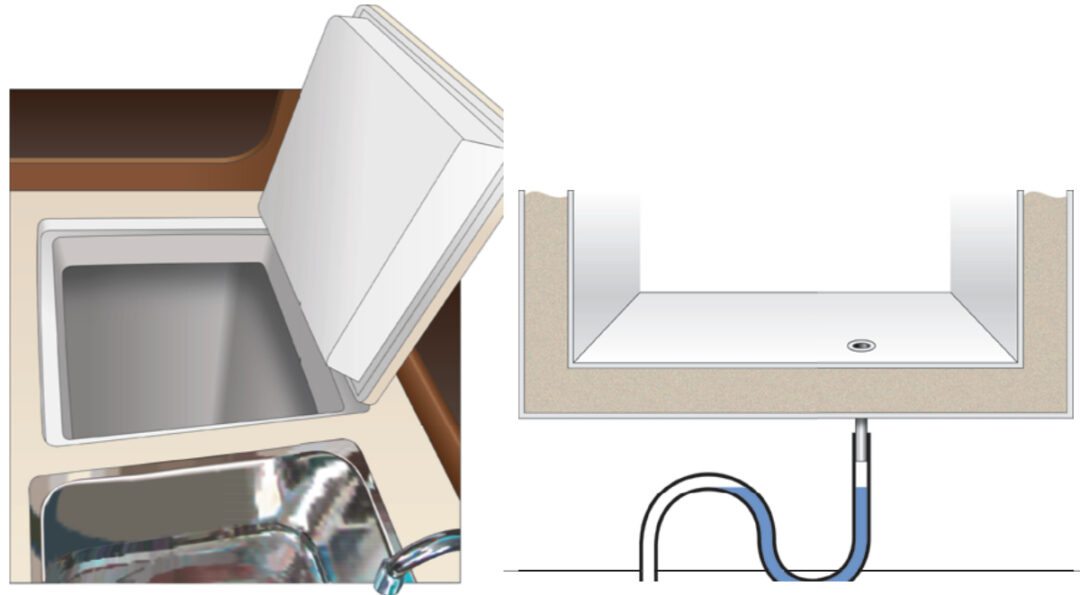
Although not required for refrigerators, an icebox that uses block ice for cooling will need a drain in the bottom for the melting ice. This bottom drain should include a trap, similar to the trap used in home sinks and tubs, to prevent the cold air inside the box from fl owing out and being replaced with warm, outside air. If the drain tube can also be insulated, it will help maintain the low temperature of the icebox and eliminate condensation drips. The icebox drain should not discharge directly into the bilge, where it will promote an unpleasant rotting-food smell that’s hard to eliminate, but into a container in the bilge. This container of meltwater must be manually emptied at least once a day, depending on its size. Alternatively, it can be emptied with a pump, such as a small automatic bilge pump, that discharges through a through-hull.
Don Launer , a Good Old Boat contributing editor, built his two-masted schooner, Delphinus, from a bare hull and has held a USCG captain’s license for more than 36 years. He has written five books, including The Galley: How Things Work and Navigation Through the Ages, and frequently gives talks on the history of navigation.
Thank you to Sailrite Enterprises, Inc., for providing free access to back issues of Good Old Boat through intellectual property rights. Sailrite.com