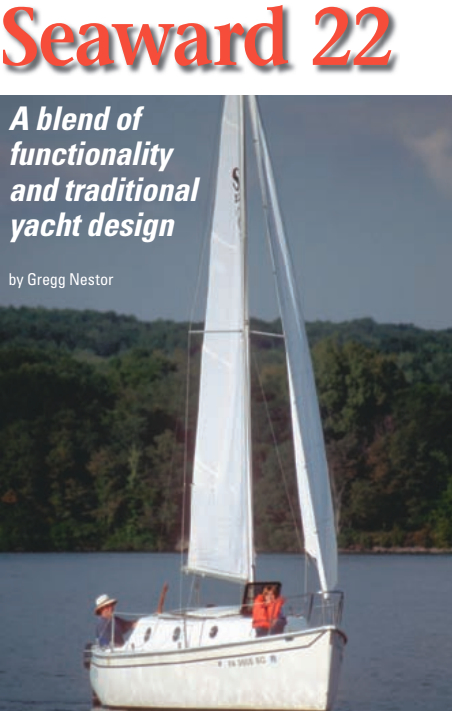
A blend of functionality and traditional yacht design
Issue 45 : Nov/Dec 2005
Nearly three decades ago, in a warehouse near the Miami, Florida, airport, Nicholas Hake began his boatbuilding business. His initial offering consisted of four dinghies of different sizes. Soon thereafter, around 1977, he introduced his first sailboat, the Slipper 17. And with that, the new direction of Starboard Yachts was defined.
As company owner and designer, Nick decided to concentrate his efforts on designing and building sailboats. Since he regularly sailed the shallow waters around his Florida home and the Bahamas, all his designs incorporated thin-water capabilities. In the 1980s, he introduced the Seaward series of sailboats. The series included the Seaward 22, launched in 1985. This model later evolved into the popular Seaward 23.
In 1993, Nick sold the company to a group of investors. They struggled along for a couple of years with what was then referred to as Seaward Yachts. Then, after having “seen enough of the boatbuilding business,” they sold the company back to Nick Hake. With this return in ownership in 1995, Hake Yachts was born.
Nick has been quoted as saying, “I build boats for myself. I like shallow-water sailing.” And over the years his company has delivered a variety of shallow-draft trailerables, including the 19-foot Fox and the Seaward 22, 23, 24, and 25. The company’s new facility in Stuart, Florida, turns out about one boat per week. All of the models undergo sea trials in the company’s Manatee Pocket testing area. This is a wide expanse of the inland waterway, located near the St. Lucie Inlet, most of which is shoal water.
Continuing the company’s philosophy of shallow-water sailing capability, Nick plans to concentrate his company’s efforts on the 32-foot Seaward Eagle and the Seaward 26RK, which was introduced in 2004. Both are equipped with an electrically operated, vertically retracting, bulb keel.
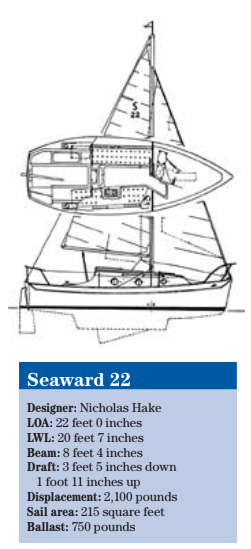
Although the Seaward 22 has long been out of production, it embodies all the elements of design and functionality associated with Hake Yachts. It has an overall length of 22 feet, a waterline length of 20 feet 7 inches, and a beam of 8 feet 4 inches. It displaces 2,100 pounds, with 750 pounds of ballast.
Design and construction
In appearance, the Seaward 22 blends functional and time-honored traditional design elements. The boat exhibits a sweeping sheerline, giving it a strong traditional look. There is a fair bit of freeboard along with a plumb stem and stern. These increase the boat’s waterline and hull speed, while adding interior space. The topsides display a subtle tumblehome, aft and down low. This extends the waterline beam, further enlarging the boat’s interior. It also adds a salty look and offers some form stability. The height and slope of the coachroof, which terminates in a classic turtle shell, blends well into the overall lines of the boat. Along with the graceful aft sloping of the cockpit coamings, the six round, stainless-steel portlights add to the boat’s salty looks.
Both the hull and deck are hand-laminated fiberglass sandwiches cored with Coremat (synthetic glass microballoons). This microsphere core material adds reinforcement, without adding weight, to the hull and deck and is said to be impenetrable by water. The hull-to-deck joint is bonded, fastened with stainless-steel bolts, and covered with a marine anodized aluminum rubrail.
The Seaward 22 has a fixed shoal-draft keel comprising 750 pounds of lead. To add increased windward performance, a 25-pound stainless-steel centerboard is incorporated. This centerboard can be raised and lowered by a direct-pull stainless-steel lanyard located just inside of the cabin on the first step. With the centerboard down, the boat draws 3 feet 5 inches; when raised, the boat can be sailed in less than 2 feet of water.
Suspended from the transom is a balanced, foil-shaped rudder, which extends no further than the bottom of the shoal-draft keel. Good thing. Since it’s not a kick-up type, it could easily be damaged by a grounding. A transom-mounted stainless-steel swim ladder and an adjustable outboard motor bracket are commonly installed options.
On deck
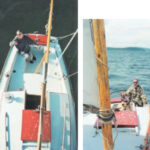
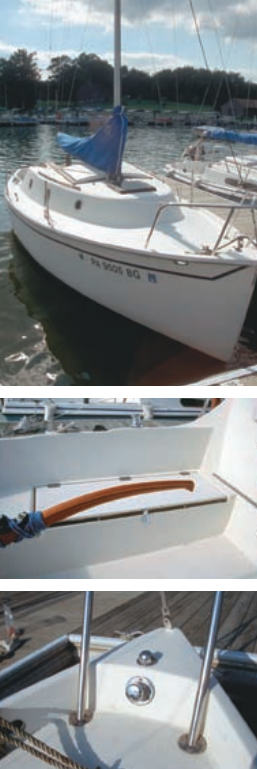
The cambered foredeck is clutter-free and features 5-inch-high bulwarks for secure footing and to keep errant spray out and deck lines in. However, while 5 inches high at the stem, the bulwark gradually tapers to nothing 10 feet aft. There are two built-in hawse holes, a hawse pipe leading to anchor-rode stowage, and a single, solid bronze Herreshoff-style mooring cleat. There is no anchor locker.
The sidedecks average about 10 inches wide, generous for a boat this size. However, maneuverability is impeded by the chainplates and headsail fairleads, which are situated in the center of each sidedeck. Cabintop handrails, molded-in nonskid, a stainless-steel bow pulpit (a stern pulpit was originally optional), and single lifelines with 20-inch stanchions complete the on deck safety package.
The cockpit of the Seaward 22 is 6 feet long and has 13-inch-high straight-backed coamings that provide good back support. It is self-draining, but the tiny drain (not much larger than 1 inch in diameter) would be of little help in a pooping. Likewise, the 2-inch-deep bridge deck is a token structure, whose primary function is to provide a surface for mounting the traveler track, rather than preventing water from cascading into the cabin. Aft and to starboard is a dedicated fuel tank locker. This is to keep gas fumes out of the cabin. To port is a large cockpit locker with access to the cabin.
On deck, bright work is kept to a minimum and consists of the cabintop handrails, the tiller, and the companionway trim.
Belowdecks
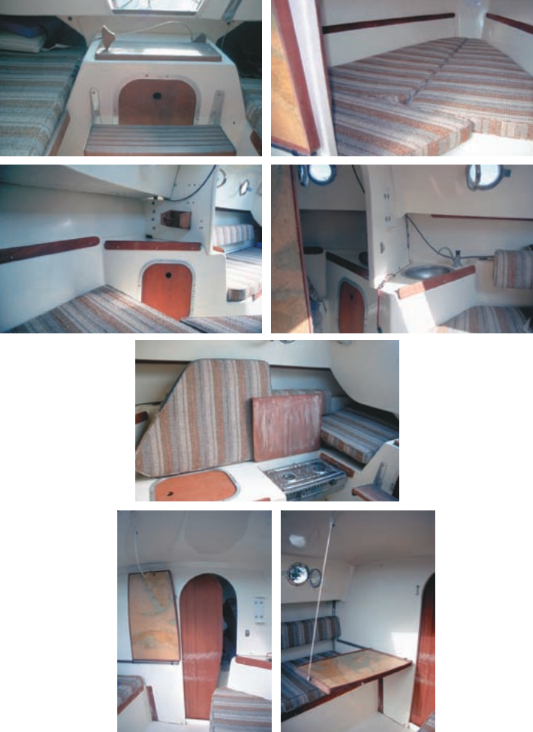
Entry below is via a fairly wide companionway and by taking two steps down. The bright, open appearance might be attributed to the depth and fullness of the hull. But it more likely results from using a molded fiberglass pan for the cabin sole and a similarly constructed overhead liner. All structural members (including the overhead liner) and mast-supporting bulkhead are integrally molded and bonded to the hull. The finish is clean, white, and trimmed in solid teak.
The forward cabin contains a 7-foot 3-inch double V-berth that favors the port side of the boat, a Porta Potti aft and beneath the berth, and a molded-in bureau of sorts, aft and to starboard. Shelving is located on each side of the V-berth with additional stowage beneath the berth. The forward hatch is overhead and, on each side, there’s an opening portlight to provide illumination and ventilation. Privacy from the main cabin is achieved by sliding a teak door across the passageway.
The main cabin configuration of the Seaward 22 is the traditional port and starboard opposing settees/berths. While the port settee/berth is 6 feet 6 inches long, the starboard one is 7 feet 1 inch. There is sitting headroom of 36 inches and, with the sliding companionway hatch open, standing head- room is unlimited.
A stainless-steel sink with a hand pump is located forward on the starboard side and is set into a corner shelf that has been molded into the bulkhead. Beneath the starboard settee/berth, aft and adjacent to the companionway steps, is a gimbaled, two-burner, alcohol stove. Stowage for culinary gear is provided for in a locker beneath the companionway steps. Completing the galley is a folding table mounted to the forward port bulkhead. In lieu of a supporting leg, the free end of the table is suspended from the ceiling by a cable.
Four opening portlights plus the companionway provide excellent illumination and ventilation for the main cabin. Shelves outboard of the settee/berths and bins beneath provide for good stowage. The battery is located beneath the starboard settee/berth and aft of the stove. Aft of the starboard settee/berth is a long stowage space directly beneath the starboard cockpit seat. By situating a cooler aft of the port settee/berth, it can be conveniently accessed from both the cabin and cockpit since there is no partition separating the cabin from the port cockpit locker.
The rig
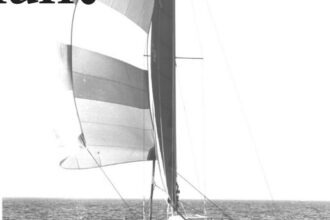
The Seaward 22’s mast extends to 29 feet above the water, is stepped on deck, and is supported below by a structural fiberglass bulkhead. It is a single-spreader rig with upper and lower shrouds and a single backstay. Both spars are anodized aluminum and halyards are external and cleated at the base of the mast. The high-aspect sail plan of this fractionally rigged sloop provides 215 square feet of sail in the form of a Bermudan mainsail and genoa. The mainsail comes standard with one reef point and jiffy reefing. There is a fixed topping lift, and mainsail sheeting is midboom and cleated to a traveler on the bridge deck. Headsail sheet controls consist of a fixed lead block, positioned in the center of each sidedeck, and single-speed Arco #6 winch and clam cleat, located on each cockpit coaming.
Under way
The Seaward 22 is a very solid performer. Its wide beam contributes to its stability, and the tumblehome stern helps maintain waterline length when heeled. It enjoys good light-air performance, and the shoal keel/centerboard combination opens up all kinds of sailing grounds. The helm generally responds well, and it is a dry craft.
On the other hand, the fixed sheeting angles limit the boat’s windward performance. Also, when the wind picks up, reefing the mainsail does little when compared to reducing headsail area. The boat is a good candidate for roller furling. It has been said that the mid-boom sheeting eliminates the need for a boom vang. However, improved sail shape can be best achieved with the addition of a vang and making the topping lift adjustable.
Things to check out
When considering a Seaward 22, keep in mind that the boat may be close to 20 years old. With age comes wear and tear and possibly even neglect and poor maintenance.
Check out the pintles and gudgeons; they are undersized and may need to be replaced with a more substantial set. I know of a boat that’s on its third rudder!
Boats with fiberglass pans and liners, like the Seaward 22, pose unique problems. Leaks around hardware and through-hulls can easily go unnoticed, because they’re hidden between the two skins. Question any holes that have been cut in the liners. They were made there for a reason.
Since there’s no compression post beneath the mast, carefully examine the structural bulkhead supporting the mast. There have been reports of cracking and failure.
The synthetic core material is said to prevent water migration and subsequent delamination, but nothing is 100 percent waterproof. Check for delamination, especially around deck fittings and beneath the mast.
In short
The construction of the Seaward is above average. Its broad beam and tumblehome add to the boat’s stability and make for both a roomy cockpit and cabin. While it is fairly nimble, there’s a lot of room for tricking out the controls and improving performance. It’s a salty looking craft and a minimalist when it comes to brightwork. When new, the Seaward 22 wasn’t cheap and over the years it seems to have held its value. Expect to pay around $7,000 or more for a 15- year-old boat in good condition . . . that is, if you can locate one. Owners seem to hold on to their boats.
Thank you to Sailrite Enterprises, Inc., for providing free access to back issues of Good Old Boat through intellectual property rights. Sailrite.com