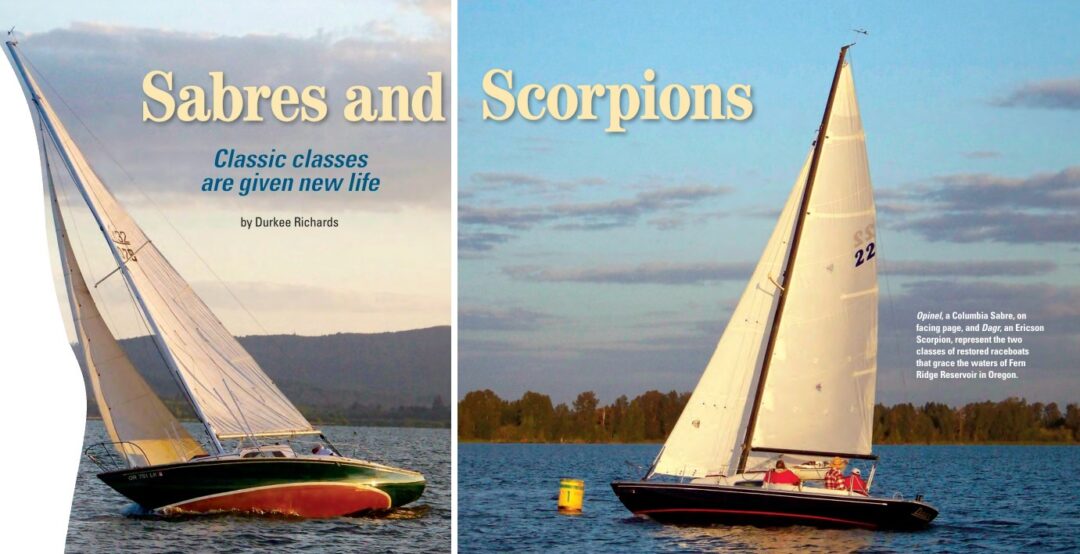
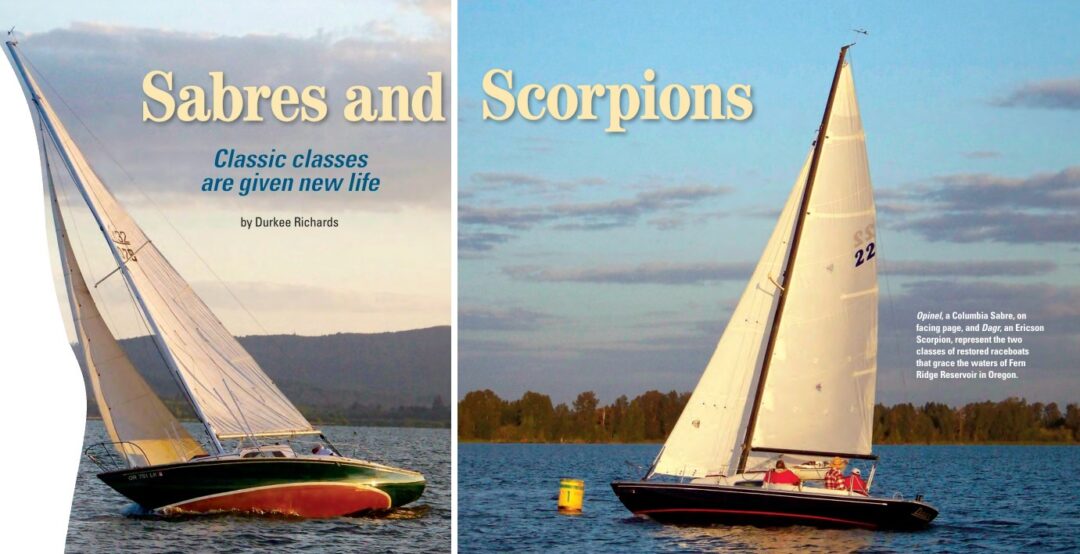
Classic classes are given new life
Issue 83: March/April 2012
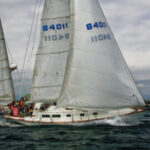
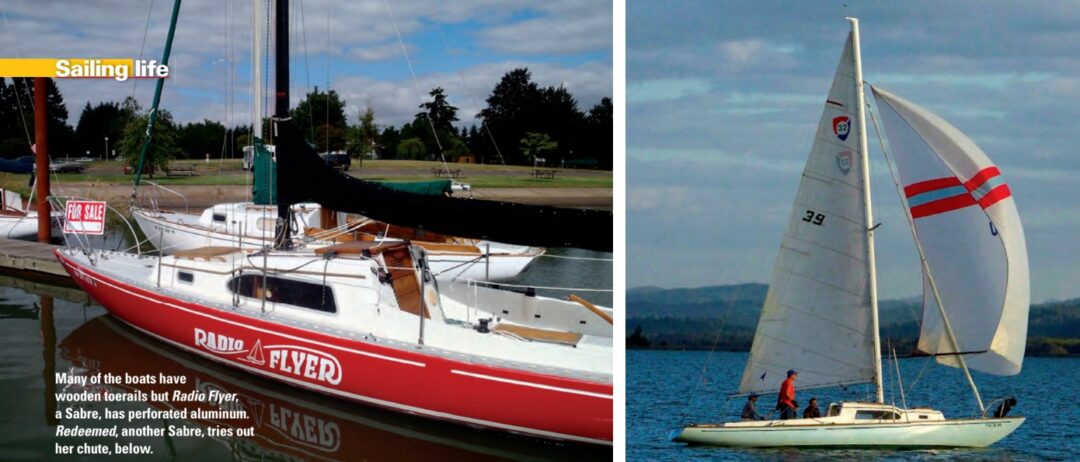
A few paces down the first dock, I was captivated by a bright red hull. Radio Flyer is long and lean with the beautiful overhangs commonly found on designs from the 1950s and ’60s. She looked fast and nimble. A few paces farther along I saw another . . . then another. In all, there were six of them in adjacent slips, each more beautifully conditioned than the next. Looking out toward the end of the next dock, I saw four more.
Sabres and Scorpions: we had driven most of a day, down into the farm country of central Oregon, to see them. This would seem a strange thing for a sailor to do, unless you happened to know that a fleet of elegant old sailboats closely related to the 5.5-Meter Class racers is based at Orchard Point Marina on Fern Ridge Reservoir, just west of Eugene.
Any casual dock-walker would quickly realize he had encountered something unusual, remarkable, and unique. Truly unique. The sailors of this fleet know of no other such fleet of restored and actively sailed 5.5-Meter cabin boats anywhere in the country or elsewhere in the world. If one does exist, they would very much like to know of it.
It began with Scott Colman and the two Columbia 5.5-Meter (C-5.5) boats he owned and sailed on Fern Ridge Reservoir in 1999. These were the ush-deck, molded-fiberglass versions of the 5.5-Meter Class raceboats that Columbia Yachts introduced in 1963. Scott enjoyed sailing his boats but couldn’t find anyone on the lake willing to race against him.
One day, two sailors from the Alameda, California, C-5.5 fleet stopped by. They argued that — since they were part of an active fleet and Scott’s boats were orphans — Scott should sell them his C-5.5s and move on to something else. It was further noted that the C-5.5s do not have self-bailing cockpits, which makes them rather impractical in an area with an annual rainfall of more than 40 inches. Scott was only too aware of the importance of a really effective boom tent. Reluctantly, he yielded to their logic and watched his boats head south.
Scott was determined to find a more practical boat with the same beautiful lines and superb sailing qualities as the C-5.5. The answer was the “cabin versions” of the 5.5-Meter boats from two manufacturers, Columbia Yachts and Ericson Yachts.
In 1964, Columbia Yachts set its in-house design team to work on a new deck mold for the C-5.5 hull that would incorporate a modest interior with galley, head, and sleeping accommodations for up to four. They called this boat the Sabre. Two years later, Ericson Yachts introduced a remarkably similar boat that it called the Scorpion. The sailing performance of the Sabres and Scorpions is so similar that the Orchard Point sailors race them as a one-design fleet.
A fleet is born
Scott began searching for Sabres and Scorpions in need of good homes. As the owner and operator of Underway LLC Sailboat Shop, Scott had the resources to haul, store, and restore sailboats. So when he found a 5.5-Meter cabin boat at a good price, he brought it home to his yard. There, the boat would be reconditioned to the point that it could be sailed. He then sought a kindred spirit — another sailor with a love of classic boats — to become its owner.
Scott notes that these boats were very well built. The hulls are solid fiberglass. The decks have, at most, small sections of marine plywood in the foredeck. Hence, even after 45 years of use, the boats he has found have all been structurally sound.
A collector with a specialty, Scott has owned a dozen 5.5-Meter cabin boats over the years. He currently owns eight, both Sabres and Scorpions, including five in his yard awaiting reconditioning and new owners. He also has a line on eight more. Many have come from California, where classic boats are all too often being broken up and hauled to land fills when their owners lose interest in them, don’t want to keep paying high slip fees, and cannot find buyers.
Once Scott locates a buyer for one of his boats, he encourages the new owner to base his purchase at Orchard Point Marina and become part of the fleet. Over the past decade, this process has brought the fleet up to 15 active boats: seven Sabres and eight Scorpions. Most owners have gradually upgraded their boats by taking on the tasks for which they have appropriate skills and equipment. They typically engage Scott’s boatyard to do the rest of the job. The excellent condition of most of the boats in this fleet is a tribute to the skills of the boat owners and Scott’s yard.
Major upgrade projects are done during the winter. In the Pacific Northwest, most keelboats remain in the water year round. However, starting in October each year, the Army Corp of Engineers lowers the water level in Fern Lake Reservoir so the reservoir can perform its primary role of flood control when late-winter and early-spring rains arrive. Unfortunately for boaters, when the water level is lowered, the marina docks settle on the muddy bottom. Like boaters in areas where the water freezes in the winter, Fern Ridge Reservoir sailors must haul and store their boats each winter. Spring brings the usual anticipation of sailing once more. For members of this fleet, it also brings an opportunity to see whose winter efforts have raised the bar to a new high for boat enhancements.
Most of the 5.5-Meters in the Orchard Point fleet have exteriors in better-than-new condition. They also sport useful equipment and rigging upgrades. Interiors are another matter. Ron Titterington, skipper of Namaste, says, “These are not really practical boats. No family today is going to buy one to go cruising. However, they sail wonderfully well and look bewitching in their slips.” That well explains why these sailors love their boats and keep putting effort and dollars into sails, rigging, and handsome paint jobs.
Two boats in the current fleet are “fathers’ boats.” Paul Bartlett inherited his Scorpion from his father’s estate. Appropriately, it is named Legacy. Bill Guske sails a Sabre his father bought in 1965. Bill sailed aboard her as a kid while growing up in San Diego. The family sold the boat in 1972.
In 2006, Bill and his family were living in Eugene when he learned his Dad’s old boat was for sale in San Diego and in need of a lot of TLC. He purchased her, trucked her home, and began her restoration. He started with the tiller and moved to the interior. He credits his wife with the decision to start from the inside out.
The fleet is fortunate to have an independent sailmaker nearby. Lynne Fabricant calls her business Sailmaker’s Art. Her shop shares the office building in Scott’s boatyard. Lynne often races with the fleet, usually aboard Dagr for which she constructed both the mainsail and the jib.
Class origins
The Columbia C-5.5 traces its roots directly to the 5.5-Meter class raceboats. The design for these wooden one-of-a-kind boats resulted from the International 5.5-Meter Rule.
The first boats built to this rule were constructed in 1949 and raced in the Olympics for the first time in the summer of 1952. The class last competed in the Olympics in the 1964 games. Because the 5.5-Meter was a development class, considerable resources had to be invested in the design and construction of each new boat, which made it increasingly expensive to field a competitive boat.
Seeking to make a more affordable version of this appealing racer and daysailer, Columbia Yachts produced a molded- fiberglass version it called the C-5.5. Columbia secured the rights to make a mold from Carina, a 5.5-Meter designed by Sigurd Herburn that had been built in Norway in 1952 and brought to the U.S. by Bus Mosbacher.
The C-5.5 went into production around 1962 and about 40 were sold. I was able to visit with Dick Valdes via phone. Dick co-founded the company that ultimately became Columbia Yachts. He is still active in the industry through his involvement with the new Columbia Yachts, founded by his son, Vincent Valdes, that produces a line of high-performance racing yachts.
Dick notes that his company was successful in developing active C-5.5 one-design fleets around the country. He then approached the class association that governed 5.5-Meter racing to secure approval for fiberglass boats to race with the wooden ones. Unfortunately for Columbia Yachts, the head of the class association at the time was the King of Norway. The idea of fiberglass boats competing against the wooden 5.5-Meter boats did not sit well with the king’s traditional view of the sport.
Dick knew this would limit the market for the C-5.5, so he decided to bring out a cabin version of the same hull with a “cruising interior.” This boat was called the Sabre and went into production around 1964. Ultimately, about 130 were produced (judging from the Columbia Owners’ Registry). As expected with such a lean hull, interior volume was quite limited. However, the Sabre did offer a modest galley with a top-loading icebox, a marine toilet, 17 gallons of potable water, and berths for four.
The mast was stepped on deck. To avoid having a compression post obstruct the space belowdecks, a box beam was molded into the coachroof to carry the mast compression loads to the main bulkhead on either side of the passage to the V-berth. Bruce King was the primary designer for the new deck and the interior.
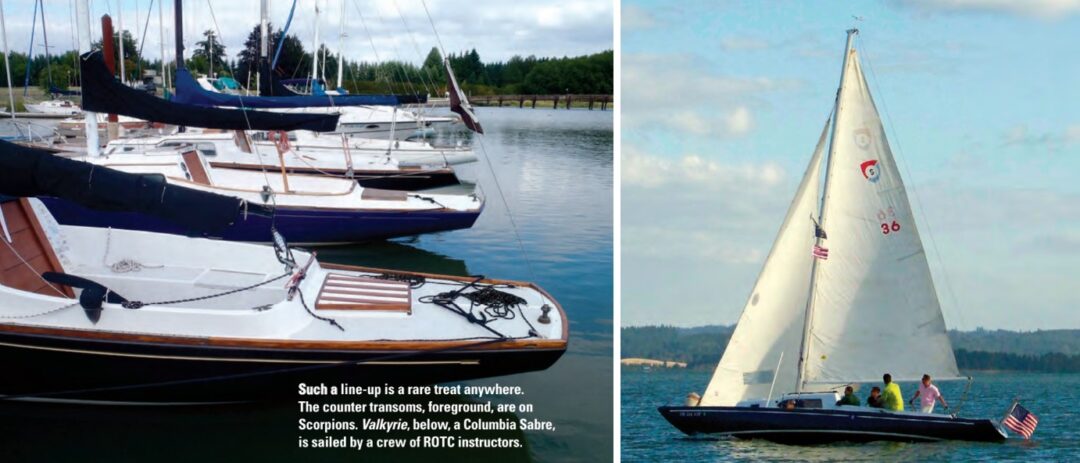
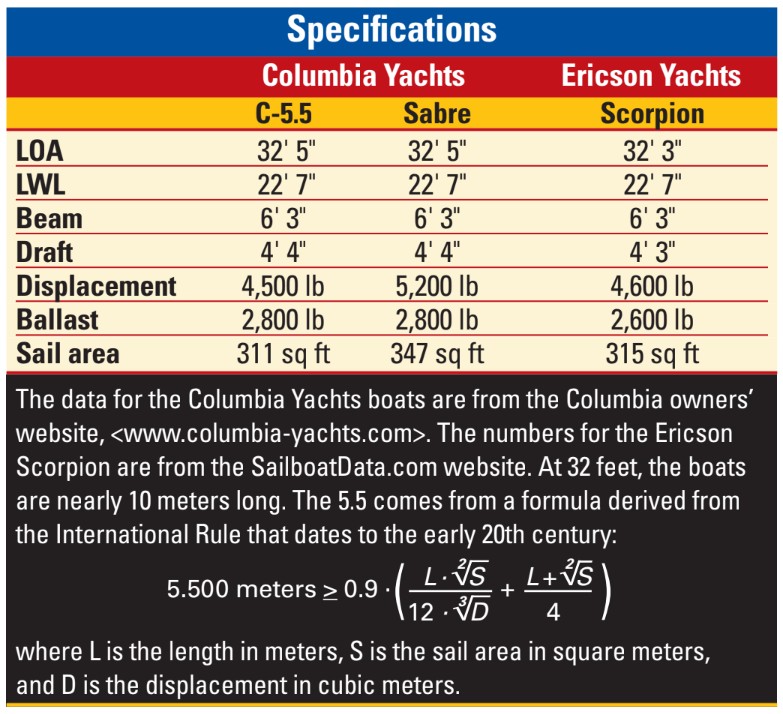
Bruce left Columbia Yachts about the time the Sabre was introduced and joined Ericson Yachts. In 1966, Ericson introduced its own version of the 5.5-Meter cabin boat that it called the Scorpion. It had a remarkably similar hull and only slight differences in the shape of the keel and rudder, the transom, and the size and number of portlights. The boat was slightly lighter and had a bit less sail area. Both boats had a fractional rig, although the Scorpion had swept-back spreaders and thus only single lower shrouds.
Dick Valdes brought suit against Ericson Yachts. According to Dick, the basis of the lawsuit was that to produce the Scorpion, Ericson Yachts had acquired one of Columbia Yachts’ 5.5-Meter boats and pulled a mold from it with only cosmetic changes to the transom. Given the language in the law at the time, Columbia did not prevail. Nonetheless, Ericson soon ceased production of the Scorpion. Dick believes that the decision was primarily driven by economic factors.
Evening racing
My wife, Mary Jeanne, and I met Scott at Orchard Point Marina on a Tuesday afternoon. He patiently answered our many questions and supplied a wealth of background material. When we parted several hours later, we were both looking forward to participating in the weekly Wednesday-night race.
The fleet has set up an Olympic Circle in the center of the lake. This consists of a hub, where the race committee boat anchors, and eight buoys that serve as turning marks. Mark #1 is due north of the hub. Proceeding clockwise, each higher-numbered mark is located another 45 degrees away from the preceding one.
Steve Norris serves as the race committee and uses his 1984 C&C as the committee boat. (Steve says he gets to satisfy his racing urges aboard two different classes of dinghies other nights of the week.) The course Steve set was: Start, #1, #2, #5, finish, twice around. This seemed a bit ambitious to me, but the results confirmed his judgment. The breeze held until sundown and all the boats were able to finish.
There is no set start time at this club. Most of the sailors in the fleet are in early to mid-career. They arrive at the marina and begin preparing their boats as soon as they are able to conclude their workdays. Their boats were manufactured with wells for outboard motors. However, since all the members of this fleet have faired them over to reduce drag, they have to sail to the start, so the start time is set after all the boats have gathered near the starting line. The gun for our race was nearly 1830 hours.
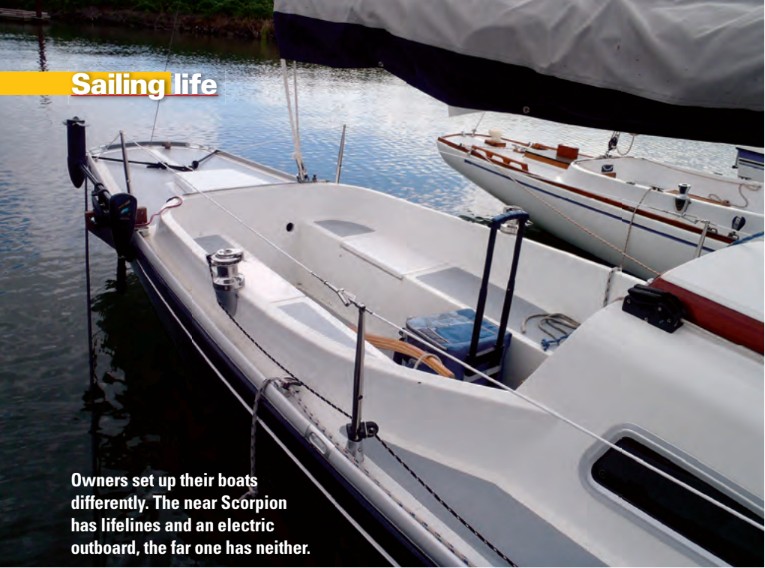
No motors also means that skippers must sail their boats out of and back into their slips. I commented to Scott that sailing a 32-footer into a slip must be quite a challenge. “Not really,” he replied. “They’re easy to handle.” On race night, my skipper, Ron Titterington, pointed out that Orchard Point Marina is favorably situated relative to the prevailing summer winds. The boats are usually able to broad reach out of the marina and close reach back in. One skipper does use a small electric trolling motor to reduce the excitement associated with getting in and out of his slip.
I sailed with Ron aboard Namaste. A veterinarian by profession, Ron usually singlehands Namaste with his black lab, Beau. They graciously welcomed aboard another two-legged crewmember of uncertain pedigree and no papers.
When we were ready to back out, Scott gave Namaste’s bow a gentle push. Ron put the helm over and called for the jib to go aback. Namaste executed a graceful pirouette and we broad-reached toward the end of the breakwater.
Because he singlehands, Ron takes a low-key approach to these races. He uses a working jib and does not fly a spinnaker. This puts him at a competitive disadvantage, since most other boats set overlapping genoas and many fly a spinnaker on the downwind legs. However, Ron got to satisfy his competitive racing urges during his collegiate days racing high-performance dinghies. These days, he races with the fleet for the joy of sailing a lovely responsive classic.
Mary Jeanne was invited aboard the committee boat so she could photograph the grand old boats in action. Ten boats turned out that night, passing close by the committee boat to check in. Once he’d started the race, Steve hauled his anchor and followed the fleet around the course for Mary Jeanne’s benefit.
Slender boats like these 5.5-Meter cabin boats usually feel a bit tender in their slips. Once under way with the wind on or forward of the beam, however, they heel quickly to their lines. The boats have relatively high ballast ratios (54 percent for the Sabre and 56 percent for the Scorpion) so they stiffen noticeably once on their lines. The wind freshened midway through the race, but Namaste’s heel angle increased only slightly. Her helm remained well balanced and light. However, the fresh breeze did give Mary Jeanne an opportunity to capture some nice images of these graceful classic boats on their lines with topsides gleaming in the late-day sun and showing a lot of well-scrubbed bottom paint.
Several boats flew spinnakers on the downwind legs. I frequently work the foredeck when club racing our J/32. Compared to these 5.5-Meter cabin boats, our J/32 has a generously sized foredeck, complete with double lifelines to help keep me and sails aboard. Most of the boats in this fleet do not have life-lines and some even go without a pulpit. I was quite impressed to see spinnakers in the air just after rounding the weather mark following a spirited beat.
The sun was just below the horizon as Namaste sailed into her slip. A crescent moon shining with an orange glow followed the sun down. The docks were busy with sailors chatting about the race results and the lovely evening . . . another fine evening of messing about in boats.
Durkee Richards learned to sail in the Sea Scouts on the Columbia River. His first date with Mary Jeanne, his sail-mate, was on a 15-foot 6-inch Snipe. They spent nearly 40 years in the Midwest where they cruised Lake Superior on chartered boats until they bought their J/32 in 1999. After Durkee retired, they moved to the Olympic Peninsula and are now exploring the waters of Puget Sound and British Columbia.
Thank you to Sailrite Enterprises, Inc., for providing free access to back issues of Good Old Boat through intellectual property rights. Sailrite.com