Late-developing passion brings deeper appreciation
Issue 58 : Jan/Feb 2008
“Maybe I am too old for this,” I thought. Our shiny new 16-foot Precision’s shoal keel was embedded in the muddy bottom at the end of the launch ramp. Blood was streaming down my leg from a wound I didn’t know I had. Worse, standing at the top of the ramp with an enormous powerboat behind him was a large, dangerous-looking fellow with arms and legs so thick they stuck out at odd angles. He looked like an enforcer for a corrupt waterfront union. What’s more, he was telling me in a loud voice that if I didn’t move my boat right now he’d come down and move it for me. I was feeling my 56 years, nearly exhausted from shoving the boat’s bow back and forth trying to wiggle her free from the clutching mud.
I had to laugh.
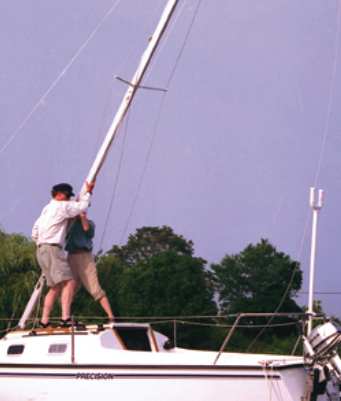
Nothing done for the first time is as easy as we imagine, and on this day Mary Ann and I had done a lot of things for the first time. We drove an old Taurus through Winthrop’s narrow 19th-century streets, pulling a trailer with the 750-pound sailboat sitting on it, occasionally bouncing the trailer up over a curb, and wondering how we could manage to get lost on such a narrow peninsula. We fi nally found the launch ramp and sprang to the task of raising a 20-foot aluminum mast that had complete freedom to topple over in any direction . . . and we had to do it balanced on the cabintop 10 feet above the parking lot asphalt. “The hard” had never looked so hard.
With the forestay secured, it was time to back the boat down the launch ramp. I repeated over and over the rule of thumb for steering a trailer backward for fear I’d forget it again. And now, since everything had taken longer than expected, the tide was at lowest ebb. But onlookers assured us that there was still plenty of water. It sure didn’t look that way to me, but who was I to doubt “local knowledge”?
Disarmed him
“We’ve never done this before!” I yelled back at the bruiser. For some reason, that seemed to disarm him. Was it because in Boston I was supposed to return belligerence with belligerence, so when I instead spoke the simple truth, my antagonist didn’t know what to say next? Or did I manage to remind him of the days when he didn’t know what the hell he was doing either? Whatever it was, he hesitated a moment and said in an irritated but quieter tone, “Well, hurry up,” and turned away.
The rising tide finally lifted the Truelove enough for us to shove her free of the mud. We scrambled aboard and after six or seven heartbreaking pulls on the outboard’s lanyard someone yelled, “Gas cock!” Oh, right. The final humiliation. As soon as I provided it fuel, the little outboard kicked right over, and I knew at that moment a deeper meaning of the word “relief” than I have ever known.
We motored out into the channel between Winthrop and Boston’s Logan Airport. With airliners roaring overhead every 90 seconds drowning out our shouts, we tried to hoist the mainsail, only to realize we had rigged the halyard aft of the spreader. I tried tossing a messenger line through the tiny triangle a few times but by now all competence was enveloped in numbing fatigue, and it was getting late.
“All right,” I said to Mary Ann, “we’ve made every possible mistake there is to make. Now that’s out of the way. Next time we’ll just go sailing.”
It was only a year before that we had decided to learn to sail . . . though the notion of doing so had occurred to me decades before that.
Over the boats
The southbound Red Line subway trains climb up out of the earth near MIT, arc over the River Charles on the ornate Longfellow Bridge, and plunge underground again at the base of Beacon Hill. Those few seconds in daylight always caused me to look up from my book and out at the dozens of sailboats on the river below as they tacked back and forth in the tricky urban winds. Even though the 14-foot centerboard sailboats were forever trapped between two bridges and the granite riverbanks, they looked like graceful birds free to go where they would, yet happy where they were. Each time I saw them during that brief moment of light, I resolved to try my hand at sailing one, but by the time the train dove underground and pulled into Park Street Station the resolution was always set aside.
That went on for 25 years.
Then one day Mary Ann was with me. At first it all went as before, the bursting out of the subterranean darkness where mangy, stunted mice eke out a dismal living, up into the summer day to fly over the little white fleet. By now, at age 55, my idle declaration of intent had become a dispirited, “I always wanted to try that.”
We descended back into the underworld, but this time there had been an observer, a beam of light to transform a mere quantum possibility into reality. A few days later, she had all the information needed to sign up for sailing lessons at the Community Boating Center, and a couple of weeks after that came the day when I first put one hand to a tiller, the other to a mainsheet, and balanced the forces of wind and water to accelerate our little boat forward until her centerboard hummed. It was as unexpectedly thrilling as the dreams I have of spreading my arms, giving a kick, and taking flight. Mary Ann knew from the delight on my face that we’d be doing this for a long time to come.
Nothing in the way
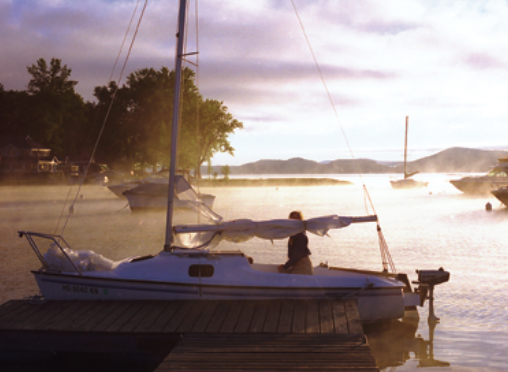
It was only two seasons until the Charles River began to feel confining. I knew we’d never sail to the Azores — no money then and perhaps now I’m too old to be so far from an emergency room — but I wanted at least to know that there was nothing between us and the Azores but the Atlantic and that we could, in principle, head our boat out to sea and make for the Pillars of Hercules. That’s when we bought the Truelove. She was barely able to keep us safe from powerboat wakes, but in her cockpit we explored Boston Harbor and Narragansett Bay until the day we again began to feel fenced in. We traded in Truelove for her 21-foot sister, which we named Sutra (which means a teaching, her lesson being the pleasures of coastal cruising in Cape Cod Bay). Suddenly, standing headroom, a flush toilet, and hot and cold running water seemed absolutely necessary, so along came Puffin, our 25-foot pocket cruiser that we now sail for weeks at a time along more of the beautiful New England coastline, fighting sore backs, muscle stiffness, and all the other ailments of aging flesh.
I never regret getting a late start. True, I would have had more years to explore sailing, years of greater stamina and tolerance for discomfort. Add to that the youthful daring that might have made me a better ancient mariner and might even have gotten us to the Azores. But one of the benefits of age is deeper appreciation. Had I started early, perhaps I would have traded sailing for some new pastime before sailing became more than just fun . . . before I fully realized the sea’s immensity and infinite variety and how wonderful it is that we bravely sail to its horizons and how utterly astonishing it is that the sea and we, its sailors, exist at all.
Michael Hoffman grew up in Northern California riding his family’s tugboats and ferries that once served Humboldt Bay, but 40 years had to pass before he sailed a boat and realized what he’d been missing. He recently retired from software development and now devotes his time to writing and sailing his Com-Pac 25, Puffin, along the New England coast.
Thank you to Sailrite Enterprises, Inc., for providing free access to back issues of Good Old Boat through intellectual property rights. Sailrite.com