A novice learns some tricks from the pros
Issue 83: March/April 2012
Stew must have had a good reason to schedule his knee surgery while our 47-foot Cheoy Lee was in the yard for two weeks, but for the life of me I couldn’t remember what it was. Every liveaboard or cruising boat needs one person who can handle all repairs and maintenance and, on our boat, Stew is that person. He’d hustled to complete technical jobs, particularly those that had to be executed from a kneeling position, but he had not polished the hull or painted the bottom. Those were now my jobs to undertake alone while he sat at our friends’ home in a recliner with ice packs, medication, and . . . books.
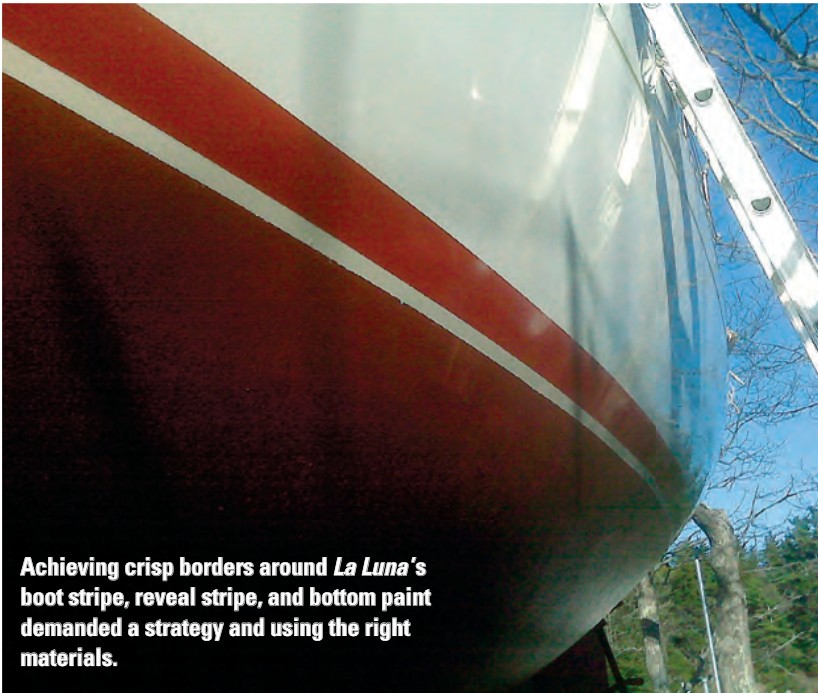
Three years before, I had labored over these projects as Stew’s “apprentice.” It does not speak well of my attention to detail or interest in polishing and painting to say that I remembered little of the process. I did know I had two weekends to polish the hull and to apply three different paints to three adjacent sections of the boat: red on the boot stripe, red bottom paint on La Luna’s bottom and keel, and white on the reveal between the boot stripe and the bottom paint.
La Luna was hauled at Great Island Boatyard in Harpswell, Maine, where Stew is the yacht broker, so those in the work crew know me and two were quick to offer advice. I had applied blue masking tape (provided by Stew) carefully around the hull just above the boot stripe and had lightly roughed up the stripe and the reveal. I’d wiped away the grit and was prepping to paint the boot stripe by applying another line of blue tape below it when Tom walked by.
“That’s good,” he said. “You use that cheap blue tape when you sand, ’cause you’ll want to remove it before you paint.”
“Oh no,” said I. “I was careful with that tape and it’s staying.”
“Well, that tape is going to trap sanding dust and you’ll want to take it off. Plus, you should use Fine Line tape for painting.”
“C’mon!” I whined. “I’m almost done taping the second line. You can’t be serious.”
“Yep. I am. You should take off all the blue tape and use Fine Line. And that Fine Line tape is expensive stuff too.” He shook his head at the cost.
“This is what Stew gave me. I hate taping and all this climbing up and down. I’m almost ready to start painting.” (Told you I whined. Did I mention how large a 47-foot boat can be when it’s standing in the boatyard?)
“Look, I’m the laziest and cheapest bastard I know, and I do it the way I’m telling you. To do the job right, this is what you need to do. Get started now and it’ll go quick. You’ll have it taped in two hours.”
I sighed, sucked it up, and re-taped the boat Tom’s way with added advice from Kevin, one of the yard’s professional painters. I’ll never be a professional boat painter but I soon learned that the job is easier when you do it the right way.
That evening when I told Stew my story he apologized for not telling me to use the Fine Line tape when I painted. “That’s what we did before,” he said. I then remembered isolating the white reveal with the Fine Line tape three years before. That time I had done it the hard way by taping off and painting the white reveal first. The resulting line was three quarters of an inch wide in some spots and one and a quarter inches wide in others.
Taping is the key to success
Painting the lines seems to be a project many captains assign to novices. If you’re a novice, I can offer some advice to make the job easier.
Fine Line is a 3M product used by all three of my coaches. It comes in widths from 1⁄16 inch to 1 inch. According to the company’s website, “Scotch Fine Line Tape (is an) extruded matte finish polypropylene film masking tape that stretches easily over curves and tears easily by hand for sharp, clean paint lines.”
I did not find that it tears easily by hand and used a knife to cut it. I did know that any tape will become one with the hull if left on in the sun. Plan to remove the tape the day you apply it. Here’s what I learned from my mentors and personal experience as a paint application apprentice.
• Kevin taught me how to tape.
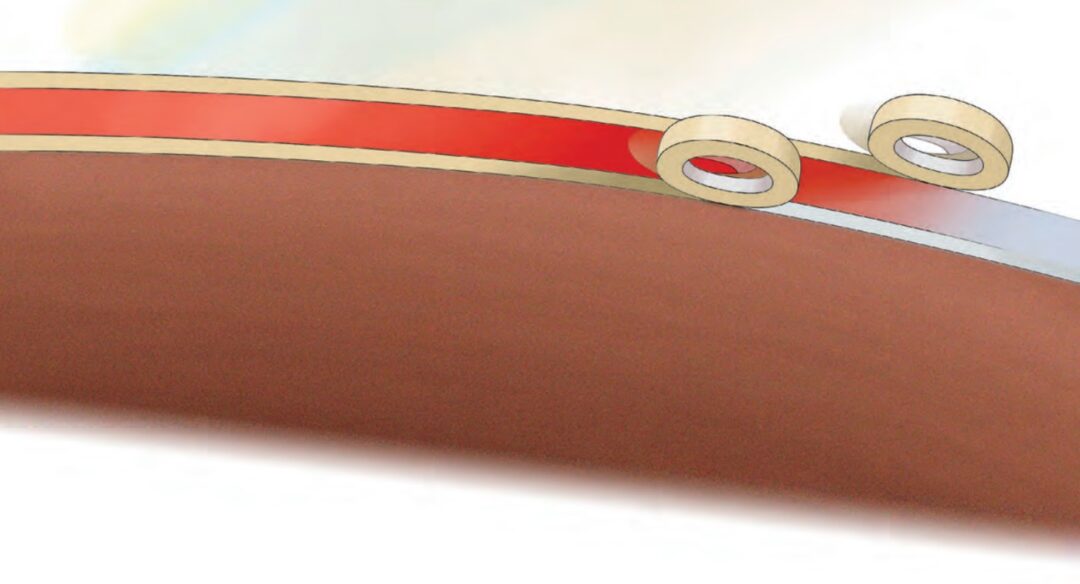
If you’re taping two lines around the hull, use two rolls of tape simultaneously, one for each line. That way you only have to go around the boat once to tape. Tape continuously. Don’t cut the tape when you move the ladder or staging. Let the roll hang and keep the line going all the way around. This reduces the opportunity for paint to seep between the seams and makes removal a breeze. Use your fingernail or a plastic tool to press both edges of the tape down. “Use your fingernail every time, it’s important,” said my coach.
• Isolate the areas you’re going to sand.
Use the blue masking tape for this. If you don’t tape before sanding, you’ll scratch the hull at least once. (I speak from experience.) After sanding, remove the masking tape and remove the dust from the area with paint thinner on a rag.
• Plan your taping and painting for maximum efficiency.
Keep in mind that the paint has to dry thoroughly and harden before you can tape over it.
Puzzle it out
I was painting three adjacent areas and had three days spread over two weekends in which to do this. Since the weather was only in the high 50s to low 60s, Stew, Tom, and Kevin all insisted I wait a week before applying tape to any new paint. This meant I needed a strategy that would enable me to accomplish the job in the available time.
• Day one – protected the stripe in the middle.
The white reveal stripe is a uniform line around the boat. I carefully applied 1-inch Fine Line tape over that reveal, masking off the lower edge of the boot stripe above it and the top of the bottom paint below it. Following Kevin’s advice, I simultaneously applied a line of Fine Line above the boot stripe. With the reveal thus protected from the boot stripe and the bottom paint, I painted the red boot stripe and a band of bottom paint about a foot wide up to the reveal. I removed both lines of tape, which peeled away in nice long sections thanks to Kevin’s advice.
• Day two – painted the reveal stripe in the middle.
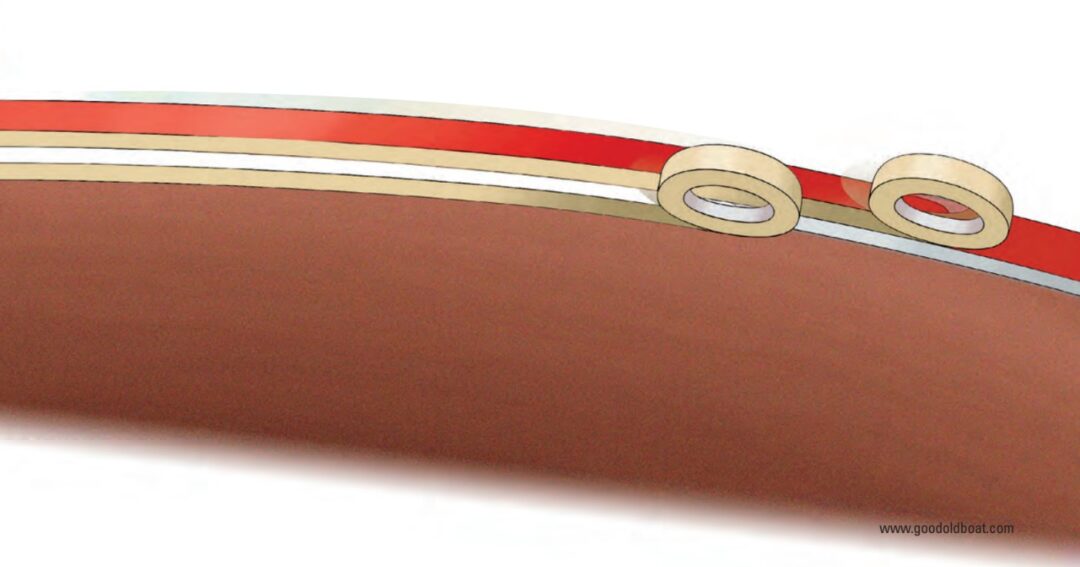
The next weekend, I applied Fine Line tape to isolate the white reveal, putting tape on the bottom of the boot stripe and the top of the bottom paint. Both newly painted areas had by then had a week to cure. After painting the white line, I removed the tape and then finished up the remaining bottom-paint job with a roller. That was possible because I’d painted a foot-deep swath of bottom paint below the white line on my first day. (Even I can avoid painting outside the lines when I have a foot-wide safety zone.)
• Day three – polished the topsides.
By the third day, all that was left on my list was to polish the hull above the boot stripe. Since that had been painted a week earlier, I had no wet paint to avoid as I polished.
Stew was happy with the project and I was happy the project was done. I’d do it again, though — now that I know how.
Barbara Hart, a native Mainer, never sailed until she met Stew, the man who became her husband. Since then she’s sailed and helped maintain a Seafarer 26, an O’Day 17, and La Luna, a Pedrick-designed Cheoy Lee 47. In 2002, Barb and Stew sold their home, purchased La Luna, and moved aboard to live year-round in Maine. In the fall of 2010, they started their world cruise. She blogs about their adventures and projects at www.HartsAtSea.com.
Thank you to Sailrite Enterprises, Inc., for providing free access to back issues of Good Old Boat through intellectual property rights. Sailrite.com