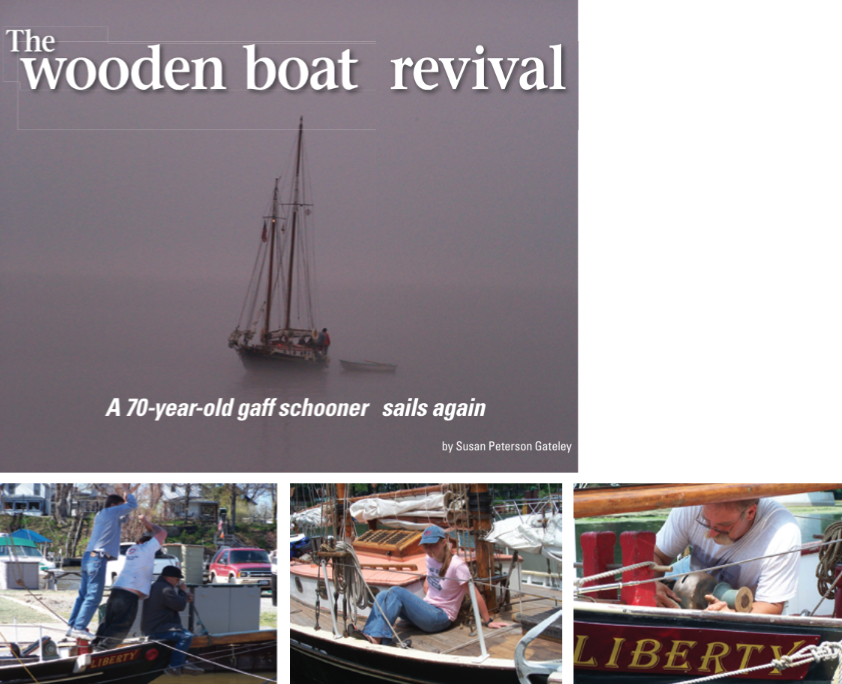
A 70-year-old gaff schooner sails again
Issue 58 : Jan/Feb 2008
Last summer, while puttering around at the mooring, I heard a runabout idling and voices in conversation. The occupants were apparently studying our old boat. I heard one say above the engine noise, “Is that whole thing really made of wood?”
Yes, there was a time, not too long ago, when all sailboats were built of wood. But by the time I began sailing an old cedar-and-mahogany Lightning in 1967 on Lake Ontario, most of the larger cruising boats in our yacht club were fiberglass. The rush to virtually indestructible homogenized hulls of plastic had been underway for 10 years. By then, the handful of surviving operational woodies in our harbor largely belonged to people operating on lean boating budgets.
In 1979, I judged that I had attained a sufficiently reliable level of liquidity to move up to a “big boat” and bought a 23-foot sloop, homebuilt during World War II. By then, biodegradable boats were even rarer in upstate New York. The 1970s were generally not kind to wooden boats. Unwanted and unloved, these relics were left to sit in back corners of boatyards, as owners enthusiastically embraced plastic. And who could blame them? No more yearly caulking of bottom seams. No more replacing rotten planks and frames. No more worries about rusty screws, bolts, or weakened nails holding the whole thing together. The advantages of fiberglass hulls were apparent to even the staunchest Luddite.
A few pockets of wooden-boat interest survived in the Pacific Northwest and New England. In the 1970s a stirring of renewed interest began, fueled in part by a growing number of wooden-boat shows and two periodicals: WoodenBoat and National Fisherman.
Centered on powerboats
During the 1970s and ’80s, much of the wooden-boat revival that I witnessed bypassed larger auxiliary sailboats. It centered on powerboats, smaller sailing skiffs, and traditional rowing and paddling boats. As one upstate New York boat-shop proprietor noted recently, “Wooden boats were being trashed, literally and figuratively.” No longer competitive in races, due to rating changes, the surviving woodies were viewed as old-fashioned and obsolete even though some of the designs, like the widely raced Thunderbird, were excellent all-around performers.
But as decades of production-boat building led to a collective fleet of increasingly indistinguishable white fiberglass sloops, the seeds of a “counter culture” in sailing were germinating. Wooden boats were increasingly sought by a few hardy nonconformists. A small, but growing, number of sailors wanted something different. Some of these stubborn souls built their own in their backyards. Others prowled the late summer boatyard seeking the old, odd, and neglected.
About the time I finally caught up with modern technology and went partners on a 1968 plastic classic 10 years ago, increasing numbers of well-heeled members of the yachting community were fueling a revival of wooden sailboats through orders for custom-built cold-molded and composite wood-cored hulls. The builders of these boats often used new technologies, deck hardware, and materials but crafted the boats to closely resemble the graceful old classics, at least above the waterline. A sort of trickle-down effect from these high-profile ocean racers and boat-show queens helped fan the spark of interest in old sailboats.
Changing times
These days, many of the people who are restoring old wooden sailboats have never owned a biodegradable boat before. They didn’t grow up with planer shavings underfoot or the smell of turpentine and pine tar in the air, and they have no idea what they’ve been missing. Yet a few fearless do-it-yourselfers are taking the rehab thing to a whole new level by rescuing and tackling the restoration of tired old wooden boats. One such is Nick Alexander, a man of courage if I ever met one.
Nick wasn’t looking for a wooden boat when someone pointed him toward an elderly wooden schooner languishing under a winter cover in the far corner of a boatyard in Wilson, New York. He and his new wife, Amanda, simply wanted a bigger boat to accommodate their newly blended family of four children and a dog. Their Catalina 27 wasn’t up to the job.
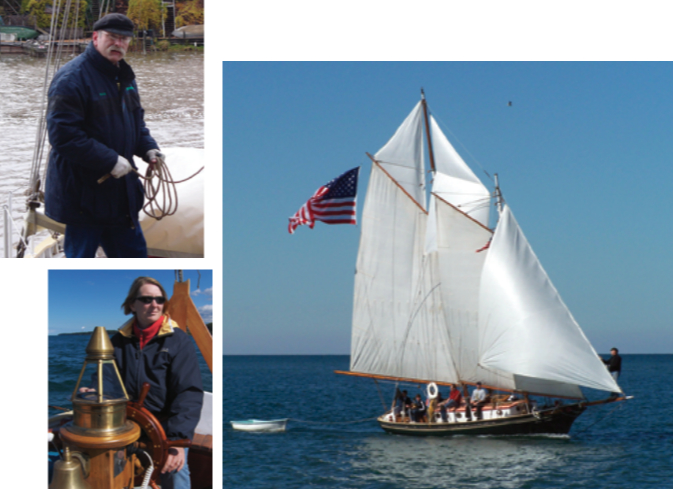
The schooner, 35 feet on deck and displacing 11 tons, was big enough for the whole family, yet was still of a reasonable size for one or two to manage. And as Amanda puts it, “We were totally fascinated” by the classic clipper-bowed beauty. Their unexpected find was a Sam Crocker creation, a traditional gaff-rigger built to the Aunt Sara design in Port Elizabeth, New Jersey, by Henderson and Henderson and launched in 1936.
Unlike many of her depression-era sisters, this boat was bronze fastened (a fact that undoubtedly contributed to her survival into the new millennium). Her framing and planking were of white oak. A long layup, along with 70 years, had taken their toll of both. The elements, with the assistance of carpenter bees and dry rot, had made serious inroads on the boat’s stern, forward mast step, keel, decks, and underlying deck beams. She was so dried out that Nick says, “You could read a newspaper through her hull.”
Graceful hull
But the couple was totally charmed by the schooner with its once-varnished brightwork, graceful hull, and vintage interior, complete with a little cast-iron Shipmate range and coal bin. She had been re-powered, the original Gray-marine gas engine having been replaced by a Perkins 107 diesel, and her sails, rigging, and spars were in good condition.
Neither Nick nor Amanda had ever owned a large wooden sailboat. Amanda had begun sailing only fi ve years before. But Nick had been afloat nearly his whole life. He had considerable knowledge of wooden-boat construction, thanks to a shipwright grandfather who had built large wooden vessels in a commercial yard. Nick is a person who possesses strong convictions and the energy to act on them. He says, “I can outwork two 20-year-olds,” and, after seeing his project boat, I believe him.
Czarina’s owner had some age-related health issues. He had offered the laid-up boat for sale for several years at a price the local market deemed excessive for an old woodie, even if a classy one. Nick recalls, “I offered him $5,000 — $4,000 for the sails and rig and $1,000 for the hull.” The deal was made. It was late summer and time to get to work.
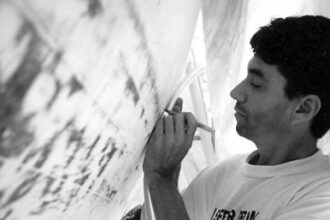
It was none too soon for the old boat. Nick and Amanda began immediately. Perhaps the most profound repair they had to tackle was the replacement of two 15-foot sections of the keel, the very backbone of her hull. To replace the original heavy timber, the cast-iron ballast had to be dropped and the old oak keel removed. Nick then laminated three pieces of white oak to build up the new keel. Using a chainsaw and a power plane to shape and fit the wood, he fashioned two new sections and the scarf joints to fasten them to the rest of the boat. Once these were in place and the 2-foot long holes drilled and new fasteners bolted through the transverse floor timbers that join boat and keel together, he had to jack and wedge and move the several-thousand-pound ballast back into place.
Just take your time
Nick dismisses the skill and strength required for this massive, yet precise, work, “It’s quite easy. Just take your time fitting,” he says. Nonetheless, this was not a job for the faint-hearted. He does add that “if the old-timers had used a chainsaw (for roughing out) they would have lived longer.” And he admits that doing the job in mid-winter in 20-degree weather in the boatyard with a brisk bone-chilling wind was less than pleasant.
The keel was not the only heavy work. Czarina’s entire transom also had to be replaced, as well as all her aft deck beams and some of the steam-bent ribs. To gain access to this area of the boat, all deck planking aft of the cabin had to be removed and ultimately replaced with new white cedar, laid and caulked. The heavy oak transom and its framing was cut and chopped apart and rebuilt, and all the deck beams from the cabin aft were renewed.
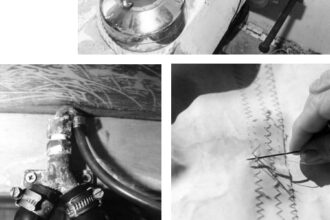
As winter melted into spring, Nick and Amanda reinstalled new wiring with a custom breaker panel, overhauled the long-dormant engine, and re-did the instrument panel using antique-style (but new) gauges. Then
there were many more hours spent sanding, painting, puttying, and caulking. Somehow, in between boatyard sessions, the Alexanders also found time for the three kids at home, Amanda’s landscape business, and Nick’s job at Praxair, where he was a senior R&D technician.
As the two worked on their boat, spending every free hour on her restoration, many people stopped by to watch or give advice. Amanda recalls, “It was challenging — when you are being asked so many questions by curious onlookers — to get work done.”
Obnoxious advisor
Nick also found the abundance of free (but often not very good) advice challenging. He once physically chased off a particularly obnoxious advisor. As it grew colder, the spectators thinned out and the Alexanders fi red up the old Shipmate stove, creating a warm place to get in out of the wind.
The boat was relaunched in March and named Liberty. “To have liberty you must work hard,” Nick notes. Then her new crew set about learning to sail a gaff-rigged schooner equipped with six sails and a bewildering array of down-hauls, halyards, and sheets. As Amanda puts it, “Nick seemed to be a natural when it came to sailing a gaffer. When asked how he knew so much about sailing the old girl, he said he had sailed her a thousand times in his dreams.”
When asked about what was most enjoyable about sailing the reborn Liberty, Nick says it is the attention they get and obvious pleasure that she brings to people seeing her sail by. Without a doubt, Liberty is a head-turner. In late August she attended the Oak Orchard Wooden Boat festival with her entire crew including Ginger, the family Corgi. There she won the People’s Choice Prize for boats over 26 feet.
The Alexanders plan to put their classic gaffer to work doing day trips and charters out of Wilson, New York. As Nick explains, “From the day we saw the boat, we knew others needed to experience a gaff-rigged schooner.” Both of them obtained their captain’s licenses. His boundless energy yet unchecked, Nick is making plans to acquire a second, even larger schooner. Down the road, he hopes to go into chartering full-time with a summer Lake Ontario season and a winter season in southern waters. Liberty has a website with lots of photos and information on charters.
Why restore?
Attention or money-making aside, ordinary mortals not blessed with the energy and guts of people like Nick and Amanda might wonder why — in this age of inexpensive fixer-upper plastic boats of good design and pedigree — would any sane individual of presumably normal intelligence buy a tired old woodie and spend hundreds of hours restoring her. In particular, why would someone, who has previously owned a wooden boat and should know better, ever buy a second one?
For an answer, I’ll refer to Sara B, the elderly Tancook schooner that entered our lives after my spouse’s foray onto eBay two years ago. For me, there is a rock-solid integrity about her sweet-lined design that speaks to my heart. I see beauty, authenticity, and heritage in her being.
In a time of globalized manufacturing and the ever-increasing standardization that goes with it, her workboat heritage — designed solely to get the job done — satisfies deeply, even as I marvel at her perfect and pleasing proportions.
As others have said before me, the combination of seakindliness, ability, and beauty in a traditional boat design fashioned by hand from once-living wood has an enduring appeal.
Long live Liberty and her sisters and long live the git-’er-done spirit of those middle-class do-it-yourselfers who are keeping old woodies (and plastic hulls too) afloat.
Susan Peterson Gateley offers day trips with a good old fiberglass boat and writes about Lake Ontario . Her woodie, Sara B, also has a website.
Thank you to Sailrite Enterprises, Inc., for providing free access to back issues of Good Old Boat through intellectual property rights. Sailrite.com