The boat Bill Shaw designed for himself
Issue 101 : Mar/Apr 2015
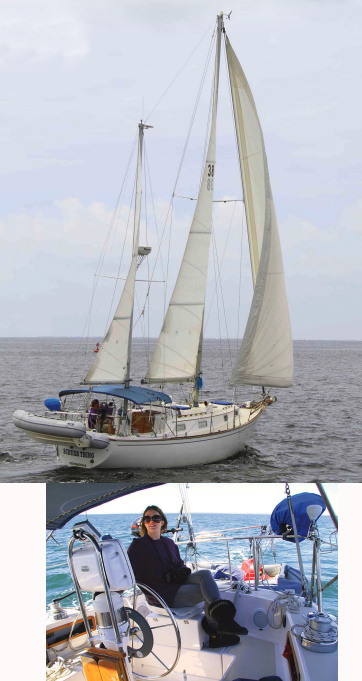
When 33-year-old Don Sailors initially purchased Schurr Thing, 1976 Pearson 365 hull #38, he may have realized he was buying a proven and comfortable design, one of the most popular cruisers ever built by Pearson Yachts. After five years of sailing her and receiving numerous compliments on her beauty and excellent condition, he was convinced. Without question, Don and his wife, Lindsey, have come to appreciate how well designer Bill Shaw pulled together so many diverse features in this boat.
Schurr Thing’s early history is vague, but we do know that Alfred Schurr, founder of Schurr Sails in Pensacola, Florida, purchased her in 1991 Alfred, a longtime fan of Pearson designs, had previously owned and raced a Pearson Flyer and a Pearson 10 Meter. He found the neglected 365 in Sarasota and brought her to Pensacola for an extensive restoration.
In addition to organizing a complete exterior refit that included paint, hardware, running rigging, standing rigging, and sails — Schurr Sails, naturally — Alfred upgraded the interior. Once she was sailing again, after his experience with competitive Pearson designs he was disappointed with the 365’s performance. That’s about the only negative many owners can name.
Design
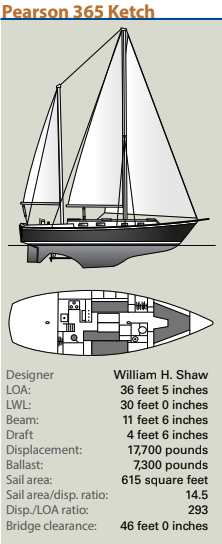
Introduced by Pearson Yachts in 1976, the Pearson 365 was one of the Portsmouth, Rhode Island, company’s most successful cruising designs. Its popularity prompted Bill Shaw, the company’s chief yacht designer and general manager in the 1960s and ’70s, to add a second production line to keep up with demand.
Although designed as a ketch, the 365 was also offered with a sloop rig, and the company built a total of 405 from 1976 to 1982. Functionality, ease of handling, and comfort were priorities in the design, and as a result, this aft-cockpit cruiser has survived as a viable alternative to some present-day sailboat models.
The Pearson 365’s moderately heavy displacement/length ratio of 293 is typical of the average cruising auxiliary of its time, and the 7,300 pounds of lead ballast encapsulated in the modified fin keel provides stability suitable for coastal sailing. The rudder is mounted on a skeg that provides surface area aft to improve directional stability (tracking). A sail area/displacement ratio (SA/D) of just 14.5 underscores the relatively sluggish light-air performance of the Pearson 365 ketch. Without the mizzen, the sloop’s SA/D is even lower at 13.5. Safety and comfort, rather than performance, were the guiding criteria behind the 365.
Construction
As with most Pearsons built over the decades, the 365 has a solid fiberglass hull and a deck cored with end-grain balsa for stiffness. During Bill Shaw’s tenure, which began in 1964, the company stopped making “stick-built” interiors built up of plywood components tabbed to the hull and deck and developed the more efficient and less costly molded fiberglass pans and liners. While an overhead liner provides a clean, smooth one-piece surface, it prevents bulkheads from being tabbed to the deck with fiberglass. Tabbing is stronger than the newer method in which bulkheads are simply fitted into slots in the molding and perhaps mechanically fastened with screws.
Years ago, when fielding a question on this subject in an owners’ association newsletter, Bill Shaw replied that the company’s boats of this era were not intended for offshore work. That surprised a lot of owners who felt their 365s and other models were tough, capable boats. They are indeed. Perhaps Bill was simply hedging his bets. The 365 has made numerous offshore passages safely, but his remarks do speak to the structural differences between boats with monocoque hulls, in which bulkheads and other components are part of the structural whole, and those with fitted parts that will tend to “work” more under stress.
The ballast is a lead casting set into the molded hull and glassed over. The hull-to-deck joint is screwed together rather than through-bolted. Some owners have had to replace the original steel or aluminum fuel tank.
Exterior
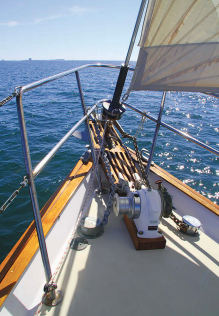
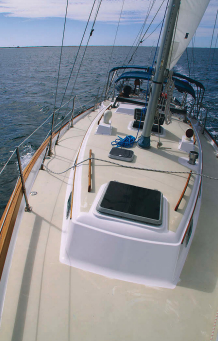
Don and Lindsey are determined to maintain their ketch in pristine condition, and it shows in the brightwork, glistening Awlgrip finish, and polished stainless-steel and bronze fittings. From the varnished original teak bowsprit, to the finely fashioned teak caprail, the cabin trim, and the handcrafted companionway doors, Schurr Thing exemplifies how beauty and function are complementary.
The 8-foot-long aft cockpit was designed for comfortable and safe cruising. A lazarette under the helm seat supplements large storage lockers on each side of the cockpit. Schurr Thing’s aftermarket free-spinning seat with its backrest is elevated to provide clear visibility for the shortest of people from behind the pedestal-mounted steering wheel, which is fitted with one of the popular inexpensive “wheel pilots.” A stainless-steel deck plate in the cockpit sole covers the top of the rudder stock and can be removed for attaching the emergency tiller.
The mainsheet and traveler lines can be easily adjusted from the forward end of the cockpit but are beyond the reach of the helmsman. The jibsheets, however, are handled with two Lewmar #43 winches the helmsman can reach. Under each winch is a handy storage compartment with side access. The mizzen sheet is located directly behind the helm.
The stern pulpit is wide enough to support a grill and a pad for an outboard motor, and Schurr Thing has dinghy davits mounted on the stern.
Interior
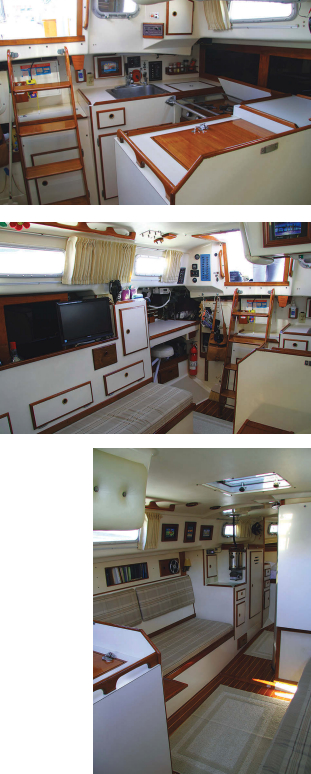
To port of the companionway is a U-shaped galley with a three-burner propane stove, a large stainless-steel sink, and plenty of stowage within easy reach for the cook. Across from the galley on the starboard side is the outboard-facing nav station with a swing-out seat and a large desktop. It has copious storage and plenty of room for installing electronics. Aft of the nav station are a hanging wet locker and additional stowage compartments. This part of the interior receives light from fixed portlights over the galley and nav station and an opening port between the galley and the cockpit.
Forward of the nav station is a settee with pullout sleeping for two. The original design had a pilot berth above the settee, but a previous owner closed in the space to create a cabinet for additional storage and to house a reverse-cycle marine air-conditioning system. A folding table is mounted on the forward bulkhead.
A settee on the port side pulls out to make a single berth. Additional stowage is above and behind the comfortable backrest. Three 50-gallon freshwater tanks are located under the settees and in the bilge. Forward of the port settee is a large cabinet and a bulkead-mounted propane heater that was an option offered with the boat. A large hanging locker is also in this cabinet.
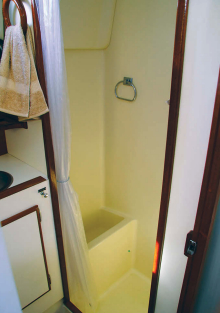
Across on the starboard side is an enclosed head with a mirror, towel racks, teak-trimmed Formica cabinets, an opening overhead hatch, and an opening portlight. There’s also a shower stall with standing room and a seat. A 6-gallon water heater provides hot water for the head, galley, and a cockpit shower.
Completing the sleeping accommodations is the well-proportioned V-berth with comfortable cushion support. Built-in shelving and cabinet space offers plenty of room for personal effects and a large hanging locker is located on the starboard side adjacent to the bulkhead. Two opening portlights and a large overhead hatch provide light and ventilation.
Overall, the interior of Schurr Thing is finished with white Formica set off with varnished teak trim on countertops, drawer fronts, and bulkheads. In some 365s, as in other models, Pearson Yachts made extensive use of laminate with a simulated-teak finish.
All the portlights have curtains. An eye-catching accent, the teak-and-holly cabin sole, was added during the major refit. An overhead hatch lights and ventilates the saloon. Headroom is 6 feet 3 inches.
Under way
Schurr Thing’s Westerbeke 40 diesel turns a Max-Prop feathering propeller via a V-drive. Access to the engine is less than ideal behind the removable companionway steps. The 50-gallon fuel tank is under the cockpit, aft of the engine.
On the day of my visit, clear skies and mild temperatures prompted Don and Lindsey to take me for a sail across Pensacola Bay. With Don at the helm and Lindsey handling docklines, the Pearson maneuvered easily under power out of the marina and into the bay. Lindsey raised the mainsail and then the mizzen, while Don unfurled the jib. In a matter of minutes the engine was shut off and Schurr Thing was sailing.
In the 8- to 10-knot northeasterly breeze, Schurr Thing jumped to life as we reached across the bay on a port tack. Gliding across the flat water, she reached 5 knots with no weather helm or discomfort, very little heel, and a kindly motion. All three sails were trimmed from the cockpit. Well-placed lifelines, raised bulwarks, and clear sidedecks help crew move safely when going forward. Moving about the cabin while under way is easy and effortless, thanks in part to well-placed overhead teak handrails.
When we reached our destination at Pensacola Beach, Don and Lindsey stowed the sails and docked the sailboat with little effort. After lunch, Schurr Thing sailed back across the bay, this time on a starboard tack. The 7-mile reach to her home marina was just as enjoyable as the earlier sail. As we entered the marina, all eyes turned to appreciate the Pearson 365’s graceful lines.
Conclusion
Don and Lindsey have plans to sail south, and they have chosen a boat that’s well suited to their ambitions. Anyone interested in the Pearson 365 can find support and information at the Pearson 365/367 Yacht Club at http://pearson365.com/forum. Since more than 400 were built, there are usually a number of 365s for sale at any given time. Prices range from about $25,000 to $35,000 depending on equipment and condition.
Dick Dixon, a freelance writer, photographer, and avid sailor, lives in Mobile, Alabama. He sails his Beneteau 42s7, Shutter Speed, along the northern Gulf Coast where he enjoys marine and wildlife photography. He can be reached at ddixon3121@aol.com.
Thank you to Sailrite Enterprises, Inc., for providing free access to back issues of Good Old Boat through intellectual property rights. Sailrite.com