Soft barriers keep out bugs and sunbeams
Issue 100: Jan/Feb 2015
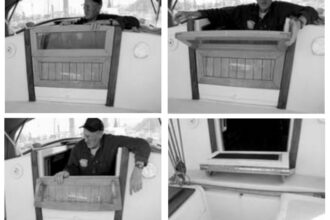
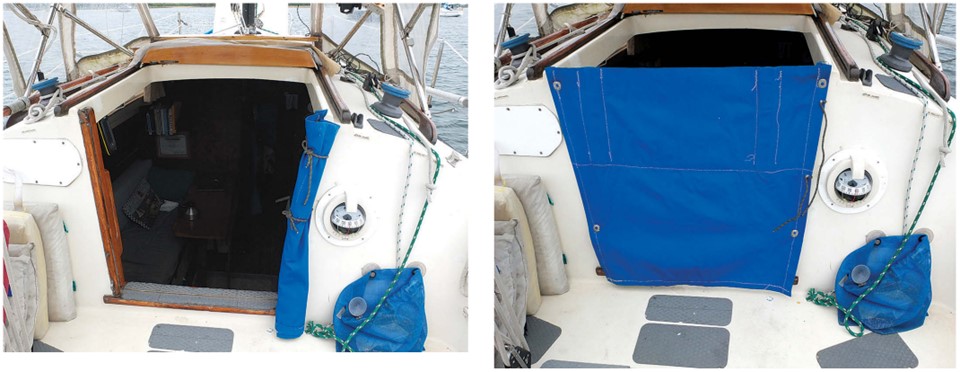
I’ve had it with mosquitoes and also with the sun shining in my eyes when I’m trying to sleep. Maybe it’s about my sense of privacy too. On a small boat, that counts for a lot. I’ve seen custom-made wooden screen doors at some of the boat shows. Elegant as they are, they’re pricey. Happily, I have a sewing machine. So, mostly for privacy, I made a cloth cover for the hatchway on my Paceship 26. It folds out of the way and I keep it attached all summer.
I made the cover to fit with about 2 inches overlap along the sides and I connect it to the wooden hatch frame with snaps. This makes it easy to secure at night and allows for a quick exit, if necessary, without the problem of finding a place to store a wooden screen door. The first one I made was bright yellow. It worked but, when the sun hit it, it was as bright as a big yellow flare. It could wake the dead, so the next one I made was blue and works just fine.
I secure it by rolling it to the side and tying it off with parachute-cord ties. I sewed a couple of vertical battens into it to make it easy to tuck under the closed hatch top so I can keep out the wet when sailing downwind in a squall. In an emergency, I can burst out right through the cloth, as the snaps open up readily without damage. I couldn’t do that with a wooden hatchboard.
Screening out biters
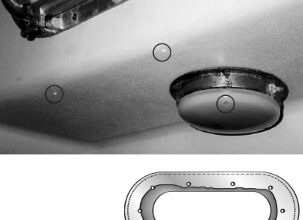
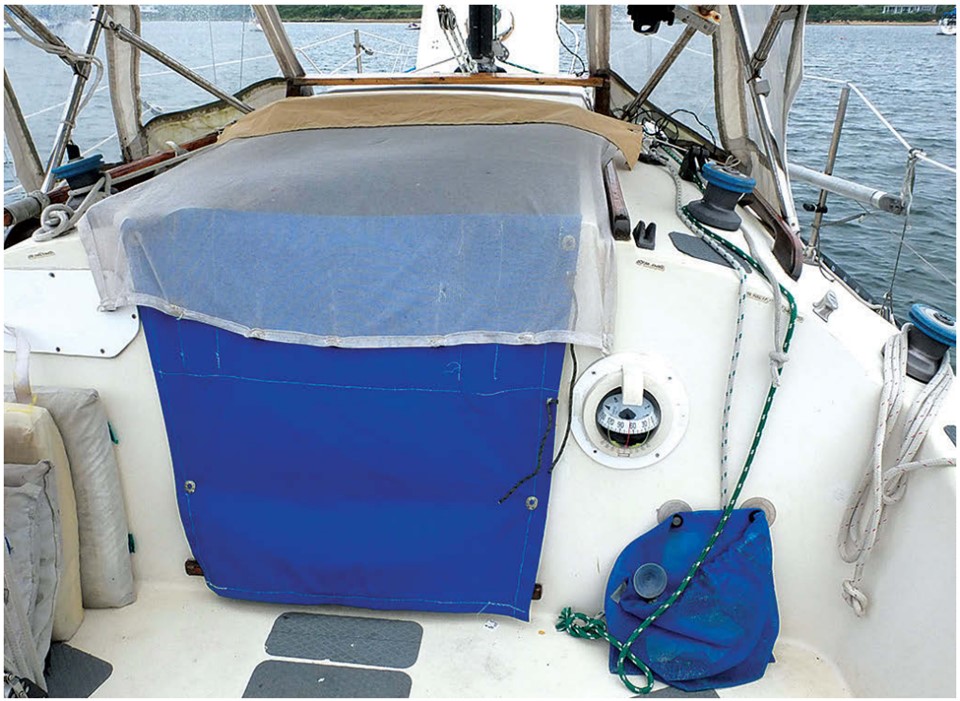
The second issue is bugs, so I made a bug screen with mosquito netting. I hand-sewed 1-ounce lead fishing weights every 6 inches or so along three sides, and gravity holds it in place over the top of the hatch. It overhangs the blue lower hatchway covering. I folded over the edges and sewed them with a straight stitch, as I found the netting didn’t need to be roped around the edges.
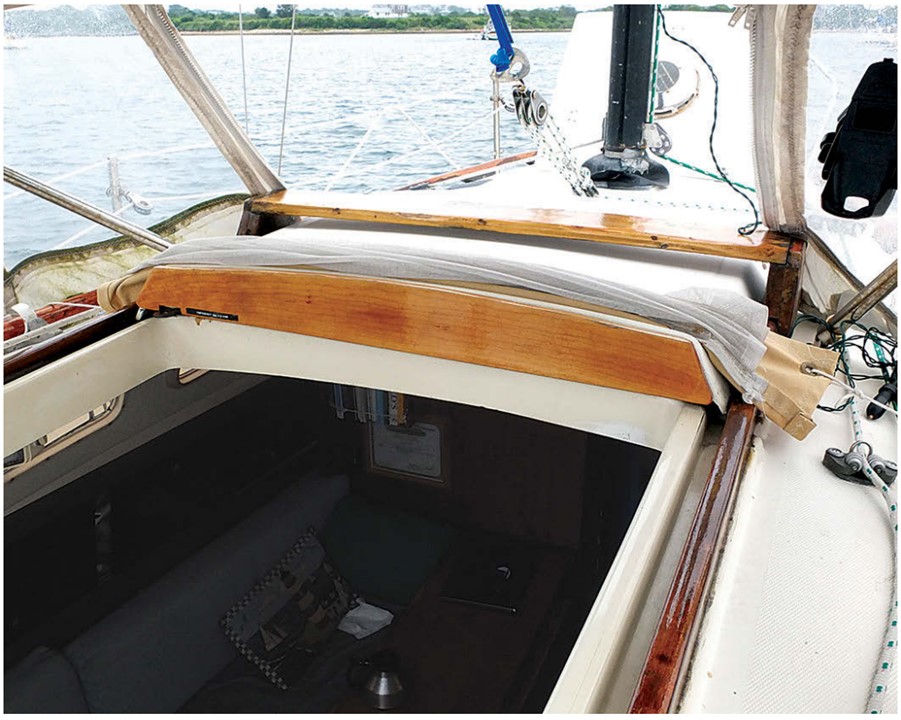
Although the fishing weights hold the edges down and prevent it from blowing out during normal winds, the netting needs to be secured port and starboard by tying it off to the handrails. I sewed a strip of acrylic cloth about 6 inches wide along the forward edge, where it rests against the sliding hatch cover, and tied short lengths of 1⁄4-inch nylon line into grommets set in the ends. I roll it up out of the way during the day if I plan to stay a few nights in the same spot. As with the lower screen, it allows me to make a fast exit during an emergency. The screen folds into about the size of a paperback book for storage.
I also made an insect screen to cover the entire forehatch when it was open, but I seldom use it. I’ve discovered that mosquitoes are nocturnal, generally. They are drawn to the exhalations of mammals and fly upwind to the source (me, in this case). However, I’m told that, depending on the species of bug, they cannot travel upwind if the breeze is more than about 5 miles per hour. In the usual boat, with a hatch that opens facing forward, the fresh air comes in through the open forehatch and the stale, bug-attracting air goes out the main hatch, so the bugs will try to come in through the main hatch. Since I usually spend my nights at anchor, rather than in a marina, I find that I can keep the forehatch open for ventilation but I only have to screen the main hatchway. Of course, the odd mosquito could get lucky and get carried into the forehatch by the wind, but this seldom happens, as they are opportunistic hunters. In a marina, though, I have to screen both hatches.
Each project cost about $20, and the biggest expense was the acrylic cloth at $18 a yard and the lead fishing weights, which vary in price. I bought the mosquito netting at a camping supply store, but it’s also available online.
Ciff Moore’s first boat was a Kool Cigarettes foam dinghy with no rudder or sail. Many years and many boats later, he’s sailing a 26-foot AMF Paceship 26 he acquired and rebuilt after Hurricane Bob trashed it in 1991. He is the editor of a community newspaper.
Thank you to Sailrite Enterprises, Inc., for providing free access to back issues of Good Old Boat through intellectual property rights. Sailrite.com