A big trailerable boat with a lifting keel
Issue 100: Jan/Feb 2015
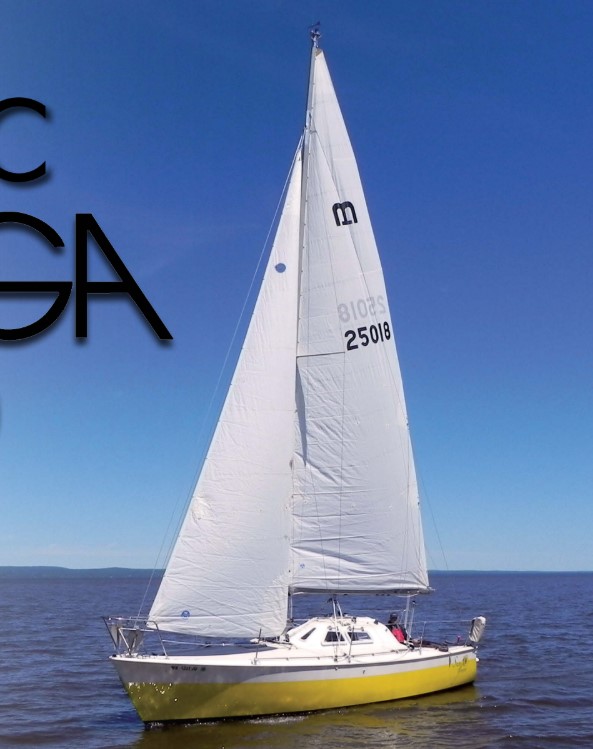
Reviewing the 1980 C&C Mega 30 owned by Good Old Boat founders Karen Larson and Jerry Powlas is something of a daunting project. Here’s a boat that for 11 years has been reported on in this publication, in the first person for the most part. Longtime readers are well aware of the project — its beginnings, years of refit, decisions, and musings.
My wife and I met with Jerry and Karen last June in Superior, Wisconsin, where we spent much time aboard Sunflower enjoying their company and listening as each explained the innovations and improvements they’d made. My objective with this article was to look for the original boat under all of their work and report my findings for any readers who might be interested in owning this comfy, fast, and trailerable (sort of) boat.
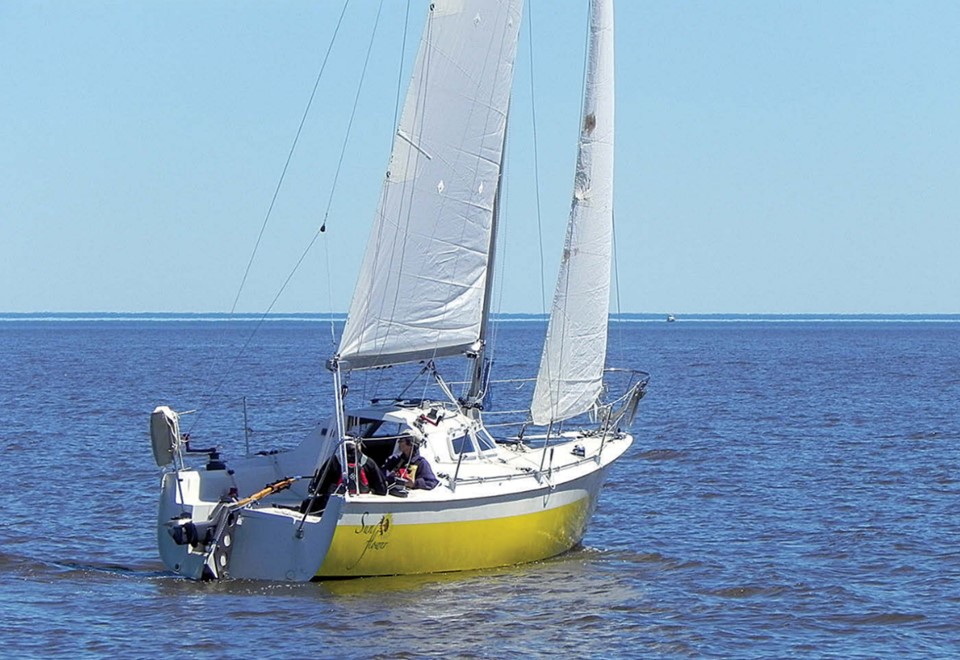
Design
In the beginning . . . there was C&C Yachts, a Canadian builder of racing and cruiser/racer sailboats that was established in 1969. In 1977, the company decided to break into the trailerable-sailboat market in a joint venture with North Sails. The idea was to level the playing field in club racing with an exciting one-design class. Peter Barrett of North Sails and George Cuthbertson, president of C&C Yachts, were the idea guys behind the Mega 30 concept. All the drawings were done by the C&C Design Group under Rob Ball. Good Old Boat contributing editor Rob Mazza was a senior designer with the C&C Design Group at the time and project manager for the C&C Mega 30. The boat would be built simultaneously at C&C’s plants at Niagara-on-the-Lake, Ontario; Middletown, Rhode Island; and Kiel, Germany. At the time of its introduction, the Mega was considered a somewhat revolutionary design.
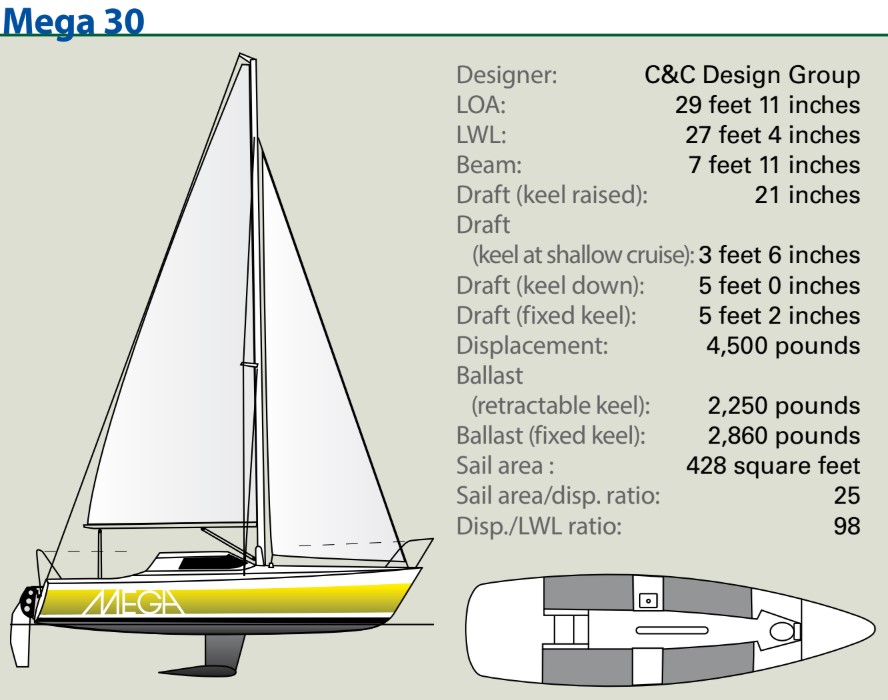
The Mega 30, with its retractable bulb keel, an overall length of 30 feet, and a beam just under 8 feet, was considered to be as big a boat as could reasonably be towed legally. Later, to boost lackluster sales, a U.S.-built version was offered with a fixed keel (the Mega 30 FK), after which time the original version was called the Mega 30 OD (for one design). Just 115 of the ODs were built and only 27 FKs, resulting in a short production run that ended in 1980.
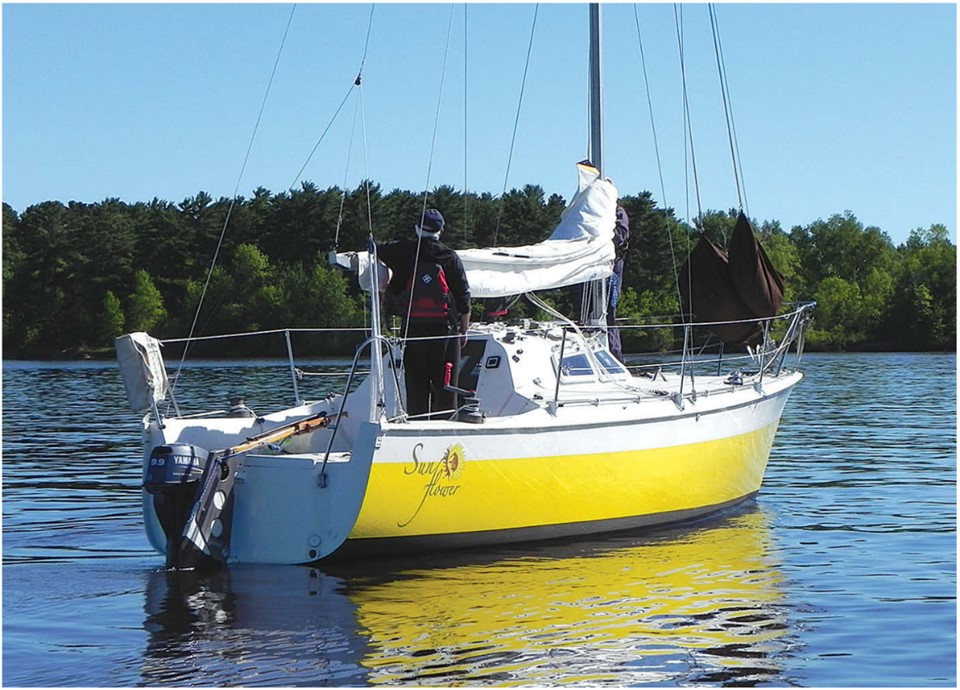
The nice sheer and the bubble-top cabin with dark-tinted wraparound polycarbonate windows make the boat look fast on the trailer or on the water. The topsides are a bit slab-sided due to the need to achieve maximum waterline beam for stability and stay within the 8-foot limit for towing. Narrow beam offers minimal form stability with little initial resistance to heeling, but makes for predictable handling and ease of motion. While the waterline has a fine entry, the top of the stem is a little blunt by modern standards.
Since the boat was designed to be trailered from one race to another, the 2,250-pound bulb keel retracts with the use of a manual jackscrew (most have the optional electrically driven screw). The bulb remains below the bottom of the hull when retracted, yielding a draft of 21 inches. With the keel fully down, the draft is 5 feet. The fixed-keel version draws 5 feet 2 inches but has more ballast — 2,860 pounds. The tiller-steered swing-up rudder is transom-hung adjacent to a large cutout for the outboard motor. A saildrive was optional.
Construction
The hull is a single-skin laminate below the waterline and the topsides, deck, and stringers are cored with balsa. The hull-to-deck joint is an outward-turning flange fastened with pop rivets (no washers) and sealant and covered with a vinyl rub strip. Jerry and Karen fiberglassed the entire length of the joint on the inside of the hull and reinforced some areas with plywood. They also made a considerable effort to reinforce the deck at the bow with plywood and glass while replacing soggy core material.
Rig
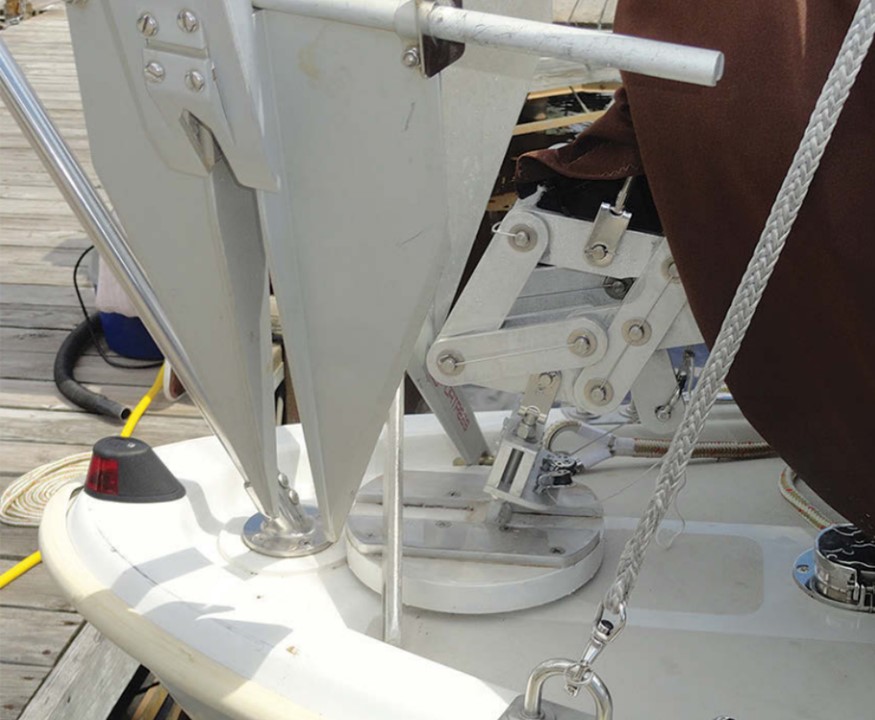
The single-spreader mast is deck-stepped in a tall tabernacle that allows the mast to lie back over the cabin trunk, which is a help when towing. The forestay is attached to the mast about 7⁄8 of its height above the deck. Originally, the jib came on a roller furler, but Jerry has given Sunflower twin forestays and an ingenious rig that, upon the sail (blade jib or genoa) being hoisted to full height, tensions the in-use forestay automatically while easing the other (see “Sunflower’s Forestay Tensioner,” below). It is a remarkable thing to watch this mechanism in action.
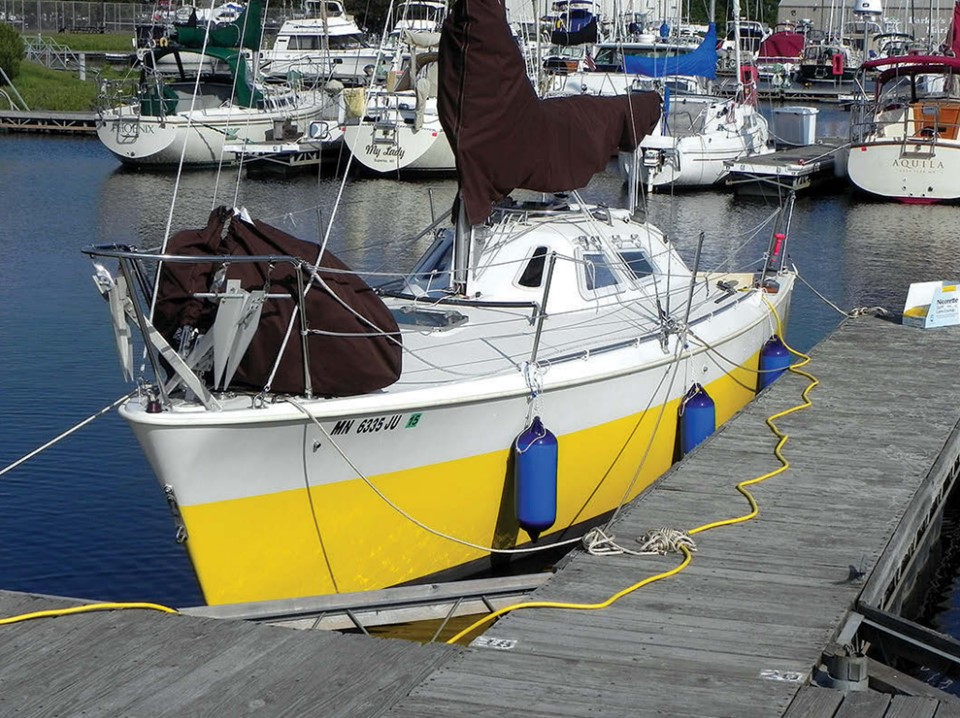
The upper shrouds attach at the same height as the forestay and lead aft a little to provide the controlling tension to the forestay. The lower shrouds connect to the same chainplates. A split adjustable backstay is used to flatten the mainsail.
Sunflower, as do most Megas, has a track for the self-tacking working jib. While this feature makes for simple tacking, it gives up some control over the shape of the jib, particularly off the wind. The mainsheet is at the end of the boom and is attached to a recessed traveler that spans the cockpit just forward of the tiller, where it’s within reach of the helmsman.
Five winches are mounted on Sunflower’s cabintop: a centerline Lewmar #12 for halyards, a pair of Lewmar #7s for reefing, and two Lewmar #10s for the genoa and self-tacking jib. A pair of Barient #25s on the cockpit coamings are used for the genoa sheets in light air and for the Dyneema running backstays. Jerry also installed a double vang/preventer that he attaches to substantially reinforced stanchion bases port and starboard.
Deck
Moving around on Sunflower’s deck, with its aggressive non-skid and good handrails on the cabintop, is fairly straightforward. Double Dyneema lifelines connect the stainless-steel bow and stern pulpits. The foredeck is open, with a good sail-handling area forward of the one opening hatch. There is no anchor locker so, on Sunflower, two Danforth-type anchors hang from hooks on the bow pulpit.
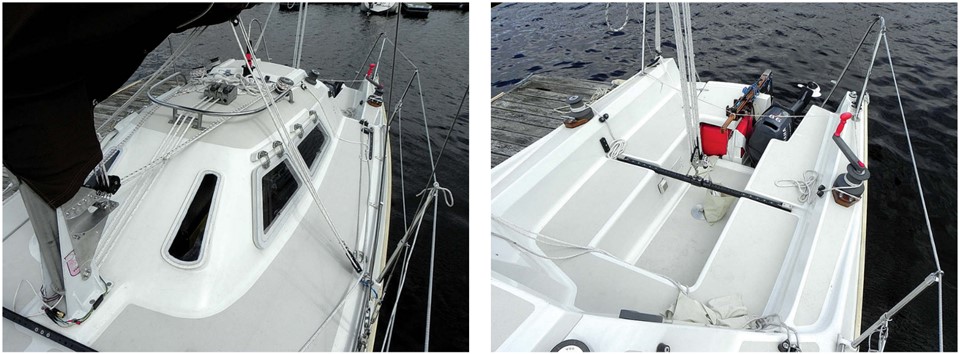
A stock Mega 30 has non-opening wraparound windows. A major modification Jerry made to the cabin trunk on Sunflower was to fit four top-hinged opening ports that swing out and two fixed windows forward — all over the original cutouts.
The companionway has a removable hinged “lid” that aids in access to the cabin and improves ventilation, although it must be in the down position to keep out rain. One large board seals off the companionway. Jerry has made a screen/window dropboard for this large space.
The cockpit is roomy and comfortable, with a single lazarette that holds a large fuel tank. A manual bilge pump can be operated from the helm. The port-side transom opening allows any water that comes aboard to exit quickly, while the high bridge deck keeps it out of the cabin.
Jerry’s modified motor mount swings Sunflower’s 9.9-hp 4-cycle Yamaha up horizontal with the water. Although the raised motor limits the maximum turning angle of the rudder head, it doesn’t seem to affect normal handling. Stock Megas have a swing-up seat over the motor well. Jerry has installed sliding engine controls on the laminated wood tiller.
Accommodations
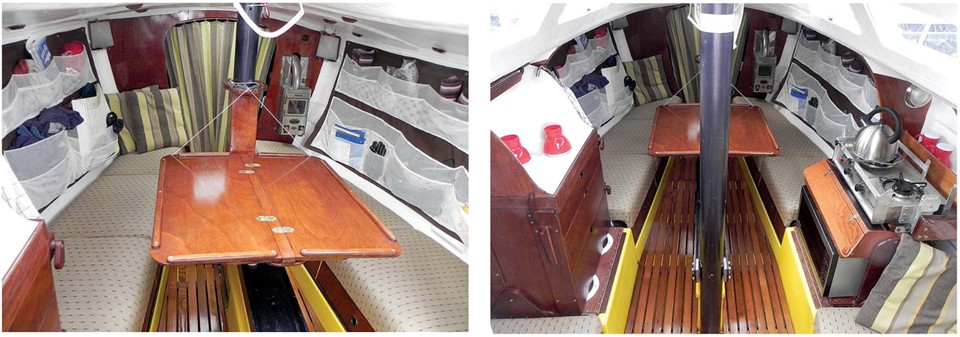
A fairly steep removable stainless-steel and aluminum ladder leads down into the cabin, where the open space creates an immediate first impression. Under the bubble, an area with more than 6 feet of standing headroom includes the workbench/sink counter and the stove opposite. In these areas, Jerry has fabricated many additions to turn this raceboat into a cruiser. The lifting-keel’s trunk and supporting structure, which includes two posts and an I-beam, divides the saloon. When the keel is fully retracted, it nearly touches the overhead.
The original settees and other furniture were made of birch plywood, and Jerry has had to scarf in new wood to replace some deteriorated sections. The settee furniture lifts off for easy access to storage. Karen reupholstered all the cushions and reconditioned the cedar cabin sole boards.
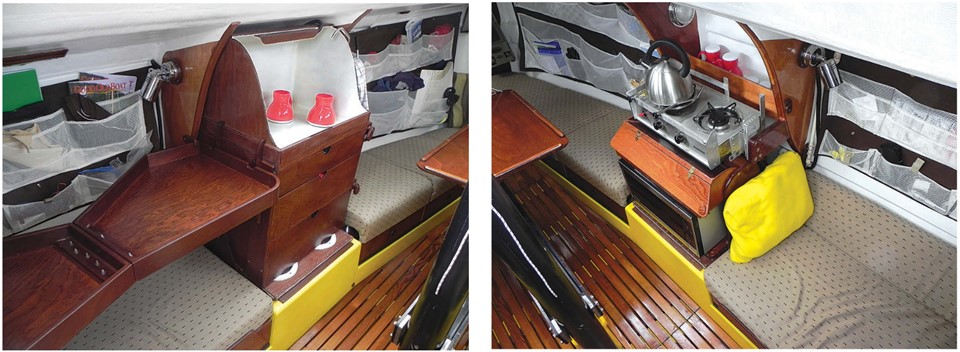
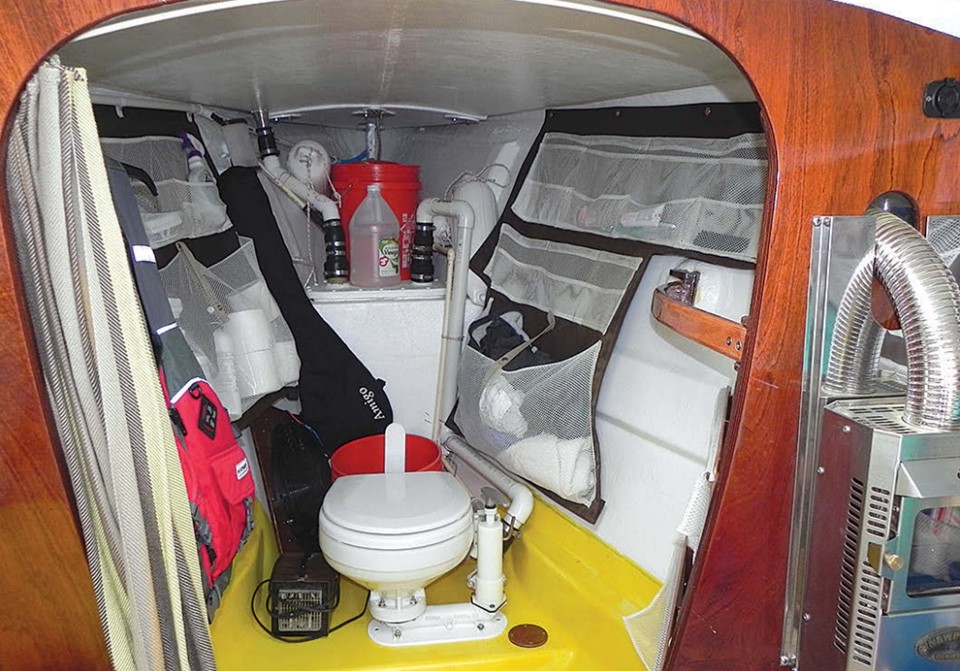
On Sunflower, the color scheme is carried inside, where the fiberglass furniture pan has been painted yellow. In all, there are four 6-foot-plus berths in an original Mega 30, with the forepeak reserved for a portable toilet and storage. As berths, the settees are minimally wide, and the aft quarter berths on Sunflower have been modified to slide out to gain width. Above them are clever folding “baby-changing” tables with large fiddles that vastly expand the galley counter space. The “sink” area has been modified to be an open-sided box that functions as a spray booth where dishes can be washed with a pressure garden sprayer. The flat surface also serves as a work counter and catchall.
Sunflower’s interior cabin sides are covered with storage nets made by Karen (originally there were seatback cushions with pocket bags above them). It does not appear that an original Mega 30 OD has a dining table, so Jerry fabricated a clever folding sapele wood table that pivots around the mast compression post. At rest in the marina, I found the pivoting feature very practical, as the table, even with items left on it, can be pushed aside to allow free movement around the cabin.
Since the original fiberglass overhead liner had deteriorated, Jerry removed it in favor of paint. His elegant solution to the many protruding hardware fasteners was to cut bolts flush with the nuts, then protect noggins with carefully sculpted backing blocks laminated from marine plywood and Masonite (see “Better Backing Blocks,” March 2010).
Jerry has also added a 19-gallon holding tank and two 17-gallon freshwater tanks made of fiberglass, plywood, and epoxy, each of them shaped to fit the available space. The Mega 30 had no real structural bulkheads, so Jerry tabbed the forward cabin divider to the hull and deck and reinforced it. Jerry’s opening portlights greatly improve the cabin’s ventilation.
For general cabin lighting, Jerry fabricated fixtures to house both 65-watt 12-volt CFL bulbs and 100-watt 110-volt CFL bulbs. Other lights are LED. He also upgraded the simple Mega 30 wiring with a fairly complex system for AC and DC power that includes extra junctions at key locations for future expansion. He also used big battery cables to upgrade the wiring to the electric winch motor that lifts the keel, vastly improving its performance.
Other improvements Jerry made to the cabin are a custom gimbaled aluminum frame for the Hillerange two-burner stove, a microwave oven below it, and a utensil cubby between them. A convection oven, toaster, and ice chest are behind the ladder. A marine head and a Dickenson cabin heater are forward. Fuel for the stove and cabin heater comes from two 20-pound propane tanks in a power-ventilated locker under the cockpit footwell where the saildrive once resided. One tank can be removed to accommodate a small Honda generator.
Despite all the improvements and plentiful storage that keep all the cruising gear contained, moving about in the cabin still involves crouching to go forward and some move-this-to-do-that activity. However, the keel-lift beam makes a good handhold and beverage holder.
Under way
With its powerful fractional rig, the Mega 30 moves easily in light air. The helm is quite responsive, but there is some excess weather helm unless the sail trim is just right. The rudder felt heavier than I expected and could possibly use more counterbalance area, unless it was simply trailing and lifting a bit. Otherwise, the boat tracked straight and tacked quickly. Sitting on the coaming and steering with a hiking stick would give the best view forward, although some owners report that, with plenty to lean against, standing to steer is more comfortable when heeled. The self-tacking jib makes a change of course easy on the crew. She’ll heel right over as the breeze picks up, but eventually stiffens. Sailing downwind, she behaved well and showed no unusual traits. Owners with fixed-keel Mega 30s report they are much stiffer than the lifting-keel version.
I found the cockpit seating to be comfortable and quite good for napping. I’d give it a 5 on the Penticoff Napability Index (PNI: 1-5; 5 = great ZZZs; 1 = don’t bother trying). The seat-to-seat distance is good for bracing legs when the boat heels.
The flip-up hatch (that needs a support strut) can be removed, which I’d recommend doing on nice days to improve access to the clutches and lines. Also, the bubble is somewhat in the way for furling the mainsail.
The rudder can kick up for trailering and gunkholing. Pinning it in the down position might be a good idea under way, as some owners suggest, for if the pull-down line is not tight, the rudder will rise, leading to very heavy helm pressure. The keel is not to be fully retracted except for towing or motoring without sails. An intermediate setting with a 3-foot 6-inch draft permits shoal-water cruising, but is probably best used with reduced sail.
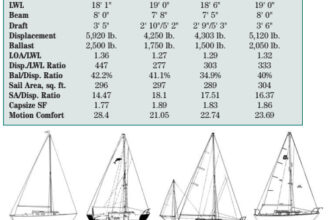
Some owners like to reef early in heavier winds while others tough it out and flatten the main with the backstay tensioner and Cunningham. PHRF ratings range from 138 to 144 seconds per mile, the latter number being the same as for a J/30. With a sail area/displacement ratio (SA/D) of 25, the Mega 30 falls into what is considered the high-performance racer range. I recalculated with 500 pounds more for crew and extra gear and, with an SA/D of 23, it is still in that category. While sailing in the company of Sunflower with my MacGregor 26D, I found Sunflower would do a horizon job on us in no time.
Conclusion
Did I fail to find much of the original Mega 30 hiding under all those changes Jerry and Karen have made? I hope the reader can see through them to the underlying boat. Really, they’ve not changed as much as you might imagine. They are doing what many trailer-sailors have done: start with a basic no-frills boat and add improvements for comfort, handling, convenience, and safety.
With old balsa-cored decks, you may find soft spots as Jerry did. Other issues are leaking hull-to-deck joints, leaky or cracked windows, and the challenge of applying bottom paint to the retracted keel. Regular replacement of the rollers or slides in the lifting-keel frame is recommended. Boats of this age are often found in yards deteriorating in the sun. The hull will be chalky and the windows crazed — expect a lot of work, as Jerry found when he brought his “hot-rod dreamboat” home. Two listings online recently were asking for around $10,000, while a “barn find” notice on the Mega 30 group list was asking $5,000. Anyone interested in the Mega will find the group online as mega30sailors at Yahoo groups. The Mega 30 is a big trailerable boat that you don’t have to crawl around inside. The speed is a bonus, so handicap racing with a local club may be its real forte. Fixed up right, the Mega 30 could be your “hot-rod dreamboat” as well.
Sunflower’s forestay tensioner — Jerry Powlas
I wanted twin forestays on Sunflower instead of a roller furler. The jibs remain attached to their stays using Quick Links.
The problem with having more than one forestay is that, in a conventional double-forestay rig, half of the available tension is always on the stay that is not in use. When a forestay is loose, the jib sags to leeward, causing poor windward performance. I wanted a device that would put all the available tension on the stay that had a sail hoisted on it, and came up with what we call a forestay tensioner.
When Sunflower’s tensioner senses forestay tension, the stay with the greater tension automatically trips the other tensioner to the loose position. In the tight position, 5⁄16 inch is removed from the stay, and in the loose position, 5⁄16 inch is added to the stay.
Allen Penticoff, a Good Old Boat contributing editor, is a freelance writer, sailor, and longtime aviator. He has trailer-sailed on every Great Lake and on many inland waters and has had keelboat adventures on fresh and salt water. He presently owns an American 14.5, a MacGregor 26D, and a 1955 Beister 42-foot steel cutter that he’s restoring.
Thank you to Sailrite Enterprises, Inc., for providing free access to back issues of Good Old Boat through intellectual property rights. Sailrite.com