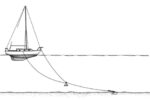
The head-to-wind drop under sail or power
Issue 101 : Mar/Apr 2015
No matter how you anchor, the basics are the same: have your ground tackle ready for instant use, choose your anchorage with care, and visualize your boat spaced evenly among neighboring boats while riding at the perimeter of a circle drawn by your rode as its radius. Good ground tackle and knowing how to use it are your boat’s best insurance policy. Two properly sized anchors and enough chain, marked rode, and chafe gear are the minimum for a cruising boat. I’ve rarely had to use more than two anchors, but when I did, it was mighty good to have them.
When choosing a spot in a crowded anchorage, it sometimes works to drop your hook just astern of and a few yards to one side of the boat that will be lying to windward of you. That will allow you full use of your swinging room. Be sure to note whether other boats are using all-chain rodes or a combination of chain and rope, and try to anchor nearer to boats of similar size to yours that are using similar ground tackle. A large, full-keel boat on all chain will swing differently from a small, fin-keeled boat on a combination rode.
It’s discourteous to anchor too near another boat if there’s room elsewhere, so when given the chance, I always anchor as far from other boats as possible. That way, if the wind shifts or pipes up, I can let out more rode without crowding anyone. A parking-lot mentality pervades some harbors as boats anchor practically atop one another, but you’re less likely to have problems if you stay away from the crowd — even if it means moving to another spot because someone’s crowded you. Pay attention to the weather forecast and perhaps choose a less crowded anchorage if the sky looks threatening.
Assuming you’ve chosen a reasonably protected spot, the most critical pieces of information are the depth where you’ll be dropping anchor and the quality of the bottom. Both can be obtained from the chart, which should be kept within reach of the helm, or from an old-fashioned lead line with a wad of tallow in its hollowed-out base. Knowing the nature of the bottom is important because it determines how well your anchor might hold and even what kind of anchor to use.
Upwind approach
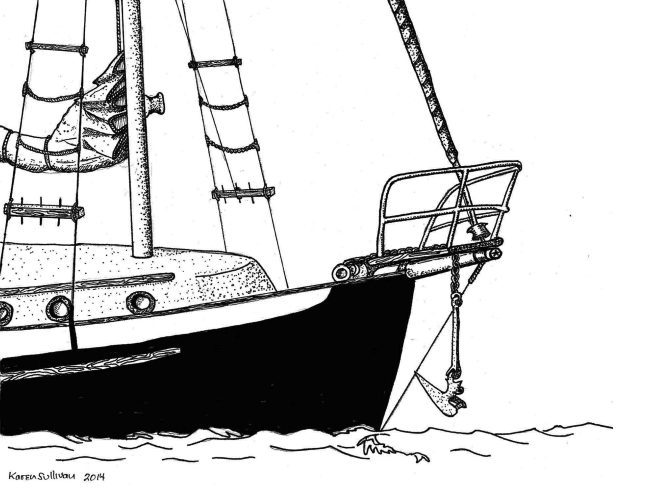
When you reach an area near your anchorage that’s calm and clear enough of obstacles for you to leave the helm unattended for a moment, heave-to or stop the boat. Walk forward and, if you have a bowsprit, ease the anchor off its bow roller, letting it hang above the surface of the water. Keep the dangling anchor high enough that it’s clear of the water and can’t be pushed against your hull by a wake and secure the rode on a cleat or bitt. If you don’t have a bowsprit and are worried about the dangling anchor hitting the hull, just have it ready to tip off the bow when you reach the drop spot. Eliminating the need to fiddle around with releasing the anchor will reduce the chance of drifting out of place once you’re in position to drop it.
The most common way to anchor is to glide upwind or up-current, stop, drop the hook, and back down. If you have a rope anchor rode, prepare a length of it three times the water depth ready to run out initially. Rope can be “faked” on the foredeck in a large figure eight laid perpendicular to the direction it will run or piled loosely, fisherman-style. If you have all-chain rode, just let it feed out from its locker.
Under sail
If you’re under sail, furl or lower the headsail before or just as you make the turn to glide to windward, because you won’t be needing it. If you don’t have a furling headsail, have sail ties ready at the lifeline (see “Simplify Sail Changes,” January 2015), and after lowering the sail to the deck, pull the sheet tight so it doesn’t flop into the water.
You should already know how far your boat will glide upwind in different conditions. Fix the helm so the boat continues to glide straight. As you approach the drop spot, either lower the mainsail — the halyard should be ready to run — or raise its topping lift high while easing the mainsheet. This de-powers the sail and it will act like a flag, but the boom may swing around, so be careful. Topping up the boom and easing the sheet to de-power the sail is a modern version of an old trick called “scandalizing.” Back when most boats were engineless and gaff-rigged rather than Marconi, they didn’t lower certain sails until they were sure the boat was securely anchored. On a gaff sail, you’d lower the peak to scandalize it, but on most modern sails, lifting the boom with the topping lift does the trick. If you have a mizzen, sheet it in tight to help weathercock the boat into the wind.
Under power
If it’s your first time solo, or if the harbor’s crowded, it might be best to try anchoring under power alone. Motor up to the drop point, stop the boat completely, and center the helm (you should be facing into the wind or current, whichever dominates). Make certain your dinghy painter won’t foul the prop, and engage reverse gear at low rpm if you need the engine’s help to go astern at a knot or two. Walk forward and lower the anchor, keeping an eye on your position relative to neighboring boats or other obstacles. Lay the chain out on the bottom as you go backward; try to avoid letting it land in one big pile or it could foul the anchor underneath. If your boat’s small enough, you might be able to slow the rumbling chain by pressing on it with the sole of your boot as it feeds out, but do this carefully.
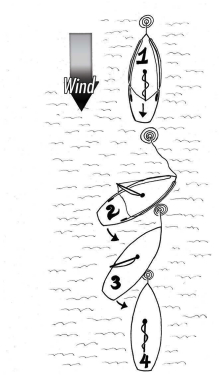
2. The boat turns sideways while backing down as anchor rode is let out. Pulling on the preventer to move the boom to windward causes the sail to fill and the boat to pivot around the mast.
3. The stern falls off the wind as the mainsail is backed. The preventer is eased, the anchor rode is lightly snubbed, and the bow comes into the wind. (Preventer lines are not drawn on steps 3 and 4 for clarity.)
4. The scandalized sail resumes luffing. This can be repeated on the other side if the bow falls off to port.
Backing down under sail
If the boat drifts sideways to the wind and the mainsail is still up, push or pull (depending on where you’re standing) the topped-up main boom to windward on the side opposite the direction you want the stern to move. For example, if the bow is falling off to starboard and you want to move the stern to starboard to straighten out the boat, push or pull the boom to windward on the port side. On sloops or cutters the sail will backfill and push the stern away from the wind as the boat pivots around the keel.
One way to manipulate the boom from the foredeck would be to hook up its preventers before going forward. If your preventers are led from the boom end to turning blocks on the foredeck, it might be possible to reach down and grab one to pull the boom to windward, because you probably have enough leverage to do that in light to moderate wind. On many boats, a properly scandalized mainsail won’t fill even if the boat turns sideways to the wind, but you can still use it to swing the stern one way or another as you back down on your anchor. Sails are for so much more than sailing!
“Milking” the anchor in
If you use a combination of chain and rope (we have 65 feet of chain and 300 feet of rope on our main anchor) and you have a small boat, let the rope feed through your hands once the chain’s gone out. Begin a series of soft tugs to straighten both the rode and the boat and to start “milking” the anchor into the bottom. A light touch is required; only a tiny snub every 10 to 15 seconds is all you need or you’ll upset the anchor. If you wait to lightly snub the anchor until you have more than a 3-to-1 scope let out, the weight and friction of the chain on the bottom could stop the boat before the anchor does, and you won’t know for sure how it’s holding. The idea is to let the rode slip through your hands, lightly snubbing and assessing the “feel” of the bottom as the anchor begins to dig in.
Meanwhile, keep pulling enough rode from its locker to ensure there’s enough slack on deck for cleating it off. If the boat’s big, or if it’s windy, or you’re going astern too fast, wrap the rode around a cleat, bitt, or samson post to slip and snub it.
This technique of feeling the way the anchor begins to “bite” tells you if the bottom promises to be good holding or not. For example, the difference between the feel of an anchor biting into sand or slipping over rocky shingle is dramatic. You can gauge this only by the feel of the rode and not from way back in the cockpit. Don’t forget to keep an eye on nearby obstacles, and interrupt the process to reposition the boat if necessary. When the anchor begins to set firmly, “sway” it in by leaning back slightly, with your feet spread wide fore and aft for balance, while snubbing harder and slipping the rode. This is what I mean by “milking” in the anchor. It’s like a gentle tug of war. Repeat until you feel it grab hard enough to stop the boat or begin to pull the rode out of your hands, then quickly get that rode secured on a cleat or bitt. I’ve done this on boats from 24 to 66 feet.
It goes without saying that you must use extreme care when handling any line under load. Tune out all distractions when handling anchors, chain, and rode. Even small boats can exert big forces. You risk injuries to fingers and feet if you let the rode run with insufficient line faked on deck and then try to cleat it off. If things feel out of control, stop the boat using the engine, have a think, and re-start the process.
If your rode is all-chain, you can still get a feel for the bottom characteristics by resting your hand lightly on the chain forward of the bow roller as you use the chain stopper. Chain rumbles and transmits vibrations up to the boat, so learn what these feel like. Rocks and mud make the chain feel and sound different as it moves over them. Even with a combination rode, you can sometimes hear the chain rumbling on the bottom if you’re belowdecks. This can be a signal to check whether the boat is changing position.
So far, so good. You’ve determined in advance how much scope you’ll need. Don’t scrimp. Let out the right amount as the boat continues downwind, then secure the rode and walk back to the cockpit. Increase the engine rpm very slowly, until the boat is pulling hard enough to confirm that the anchor’s set but not so hard as to break it out. The biggest mistake is too much reverse too soon, which can pop the anchor out before it’s able to bury itself, so be patient and let the anchor work itself in. This is especially important on bottoms with marginal holding.
Settling in
While the engine’s pulling, select an object abeam of you as a visual mark. Watch your mark to see if it stays in place against the backdrop of shore or other boats. If your mark moves forward against its backdrop, it means your boat is moving backward and your anchor may not be holding. Once the anchor’s set, remain alert for an hour or so while it buries itself under the surface from the force of gentle tugs by the boat.
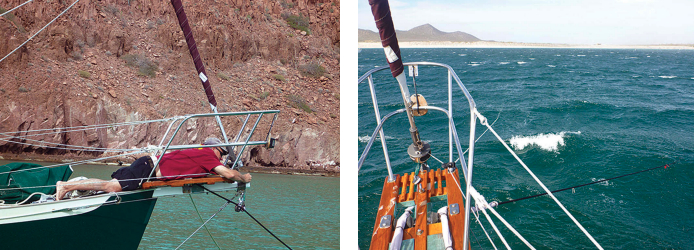
Some boats have the tendency to “hunt” back and forth at anchor while others stay put. If your boat has a bowsprit, you can reduce the amount of movement, not to mention chafe on the bobstay, by bringing the rode out to the end of the bowsprit. A sturdy snatch block that opens to admit the rode and can be unshackled when not needed will steady the boat. In crowded anchorages, this is a plus. A couple of Spectra loops of the type used in climbing gear, are strong enough to hold the snatch block to the bowsprit under all but the heaviest loads. If your boat doesn’t have a bowsprit, a bridle rigged to center the anchor rode in front of your boat can give the same reduction in movement.
Karen Sullivan sailed with her partner, Jim Heumann, from Port Townsend, Washington, to New Zealand in their Dana 24 from 2011 to 2013. Before that she cruised in Alaska’s Prince William Sound and soloed down the Inside Passage in her previous boat, also a Dana 24. A long time ago she sailed between Maine and the Caribbean in various boats. She is at work on a book about their Pacific crossing. Read more at: http://karenandjimsexcellentadventure.blogspot.com. In part 2 of this article, in the May 2015 issue, Karen willl discuss anchoring while going downwind, putting out a second anchor, weighing anchor, and what to do if it drags.
Thank you to Sailrite Enterprises, Inc., for providing free access to back issues of Good Old Boat through intellectual property rights. Sailrite.com