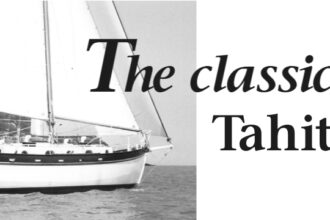
A solid, spacious cruiser with good performance
Issue 72 : May/Jun 2010
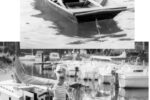
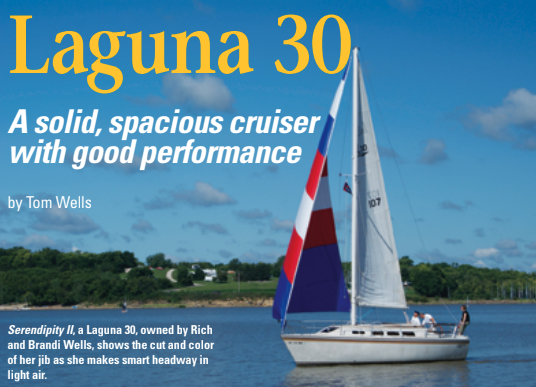
A young and growing family does not fit well into a 26-foot trailerable sailboat. That was the situation facing Rich and Brandi Wells (no relation to the author), who found a ready solution when they purchased a Laguna 30. They keep their Serendipity II at the Perry Yacht Club on Lake Perry, a sailing hotspot near Topeka, Kansas.
Rich and Brandi hosted a test sail for this review last August, on a day with clear skies and pleasant temperatures. Light winds were in the offing, but there was enough breeze at times to put the boat through her paces.
History and design
Bill Downing founded Laguna Yachts in Anaheim, California, in 1973 and began producing the Windrose 24. The boat proved so popular that the company quickly moved to a larger facility. In 1979, Laguna Yachts built a new facility in nearby Stanton. By this time, the Windrose line had grown to include the 18, 20, and 22, and the company had also acquired Coastal Recreation, the manufacturer of the popular Aquarius and Balboa lines of trailersailers. In 1980, the names of all Windrose boats were changed to Laguna. Production continued under the original ownership until 1986, when the company was sold. The new owners lasted just a year; in 1987 the firm was again sold and ceased to do business as Laguna Yachts. The company was moved to Chanute, Kansas, where it operated as Capital Yachts until it closed in 1995. The only Laguna model retained and produced was the Laguna 26, renamed the Classic 26.
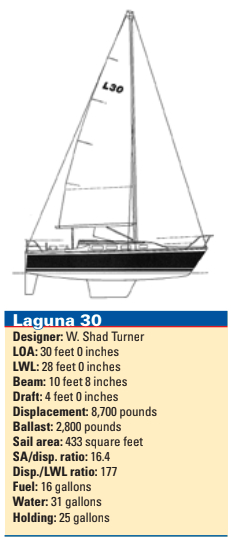
The Laguna 30 was introduced in 1983 and production ended in 1987. It was designed by W. Shad Turner, as were all of the Windrose and Laguna boats produced by the company. His other design work includes many of the popular Santana boats built by W.D. Schock, showing that he favored speed as a primary design goal. The lines he drew for the Laguna 30 were intended to give the boat a good turn of speed while preserving the features needed for cruising. The wide cabin trunk and the shoal keel would seem to be compromises to Shad Turner’s usual preferences, but he designed the keel with an airfoil shape and the boat proved to have very satisfactory performance. That’s because the displacement/LWL ratio of 177 is on the low side for a cruising boat and the sail area/displacement ratio of 16.4 is adequate.
Construction
The hull and deck of the Laguna 30 are solid hand-layup fiberglass. Bill Downing insisted on hand layup and
refused to use cheaper construction methods, such as the chopper gun. Hull areas that might flex under load were reinforced with Coremat and an inner fiberglass layer. Flat areas of the deck were reinforced with marine plywood and a second fiberglass layer to produce a very solid, stiff deck structure.
The keel shell was formed of fiberglass in the mold as an integral part of the hull. After the fiberglass cured, the ballast was placed inside it and encapsulated with more fiberglass on top. The result is a very shallow bilge. With this type of construction, there is no joint at the keel root to separate and leak, and there are no keel bolts to maintain. However, hard contact with a rock might be a bigger problem than with a bolted-on keel. Bill Downing states that no major keel issues were reported to Laguna Yachts.
Structural stiffness was enhanced with an interior liner, laid up in solid fiberglass similar to the hull. Flat liner areas were reinforced in the mold with Coremat and a second layup, rendering the whole liner assembly very resistant to twist or deflection. The liner was then tabbed to the hull all around the sheerline and in any location that could be reached. The liner and hull were clamped together while the resin cured. Bulkheads were bolted directly to the interior liner and so became a part of the structural envelope. The result is a very strong overall system, but it also means that access to the inside of the hull itself is nearly impossible in most locations. This could be a problem if the boat is holed below the waterline, so it’s a good thing the hull is so soundly constructed.
To form the hull-to-deck joint, a down-turned flange around the perimeter of the deck closed over an in-turned flange on the hull, much like a shoebox cover. The joint was heavily fiberglassed on the inside, through-bolted horizontally, and finished on the outside with a rubrail.
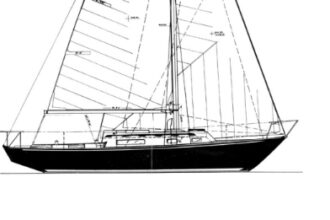
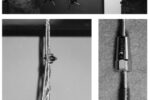
The Laguna 30 has a single-spreader masthead rig with upper shrouds and dual lower shrouds set well outboard. The mast is deck-stepped over an interior compression post incorporated into the forward saloon bulkhead.
On deck
The Laguna 30 has a beam of 10 feet 8 inches, and the cabin trunk extends for much of that width to provide the ample space below. As a result, the sidedecks are narrow. They are of adequate width, though, except at the chainplates, where crew going forward must either squeeze past the rigging or step inboard and onto the cabin trunk to pass. A molded fiberglass toerail extends from bow to stern. It’s not high enough to be a true bulwark but it does provide for safe footing along the sidedeck. A robust grabrail running the full length of the cabin trunk adds another measure of safety.
The cabintop is broad and flat and finished with an aggressive non-skid texture. The boats could be ordered with an optional opening hatch over the saloon but otherwise there is no provision for cabintop ventilation. The full-length grabrails also function as cabintop toerails, so the work area around the mast is ample and secure.
The companionway opening in the aft bulkhead is of normal width, but the cabintop is cut away on both sides outboard of the companionway. When the extremely wide sliding hatch is pushed forward, the clear opening overhead is huge. This is not a good feature in the event of a boarding sea; anyone sailing a Laguna 30 in brisk conditions should have a “hatch closed” rule. Also, with no sea hood covering the forward end of the hatch, mounting a functional dodger to help protect the area will be difficult. Unless the boat is intended for frequent use offshore, this is not a major drawback.
The foredeck incorporates an anchor locker. Bow cleats are provided, but there are no chocks. This makes protecting docklines and anchor rodes from chafe especially important, so the addition of chocks would be a valuable improvement to the foredeck area.
Dual lifelines supported through stainless-steel stanchions run the length of the boat from the bow pulpit to a stainless-steel stern pulpit. A folding swim ladder is standard and a gap in the stern pulpit provides access to the ladder when it is in the down position.
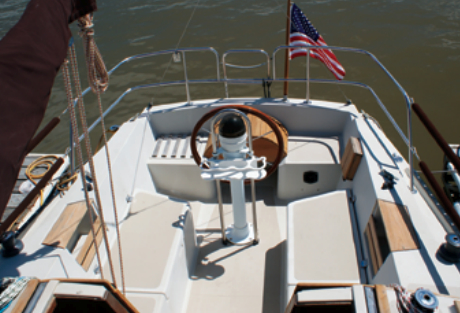
Seating in the cockpit is more than adequate. Port and starboard bench seats are 5 feet long, and the T-configuration provides good access and passage between the helm and the areas forward. Large cubbies in the coaming to port and starboard provide handy stowage for winch handles and other items. The starboard bench has a hinged cover that gives access to a shallow locker over an interior quarter berth. The port bench has a similar cover over a full-depth locker that provides access to the port side of the engine and to the battery bank.
The traveler is mounted on a track on the bridge deck aft of the companionway. While this location is not ideal for access from the helm, it is somewhat better than a cabintop traveler; with the mainsheet taken aft, its cam cleat can at least be tripped from behind the wheel.
The primary jibsheet winches are located so the helmsman might be able to control the jib. Self-tailing winches were an option on the boat and would indeed be a necessity for singlehanded control from the helm. Serendipity II does not have self-tailing winches.
Down below
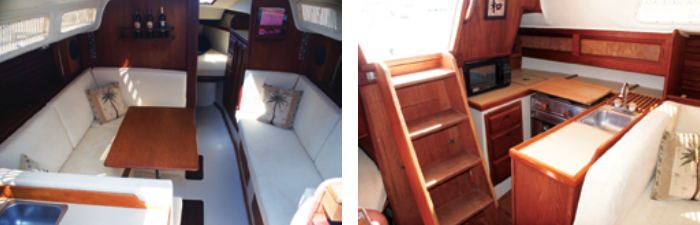
One of the more enticing features of the Laguna 30 is its well-designed and spacious interior. It has standing headroom of 6 feet 3 inches. The sole at the base of the companionway ladder is teak. Forward of the galley, the non-skid liner surface provides sure footing, and two small hatches in the forward end of the saloon sole provide access to the shallow bilge and the bilge pump. A teak parquet sole was optional.
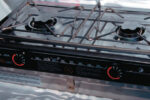
The U-shaped galley lies to port of the companionway. It features a two-burner pressurized alcohol stove with oven, dual stainless-steel sinks in a large countertop forward of the stove, and an icebox aft of the stove. Counter space is considerable for a 30-foot boat and, when the stove is not in use, a cutting board that covers the burners adds to the available space. A slotted cover can be placed over one of the sinks.
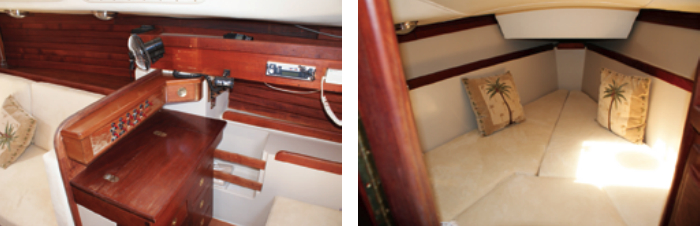
On the starboard side, opposite the galley, a forward-facing seat serves the nav station, which includes a sizable chart table and some storage. A single quarter berth extends aft from the nav station beneath the cockpit seating. A panel on the inboard side of the quarter berth is removable to provide access to the side of the engine.
The saloon is laid out attractively. A generous U-shaped settee to port wraps around a functional table that drops into place to form a double berth when needed. This arrangement provides easy access all around, when compared with the more standard L-shaped settee and fold-down table found in many boats. A straight settee to starboard completes the seating arrangements and serves as a single berth as well. The width of the cabin trunk and good use of the 10-foot 8-inch beam makes this a very spacious layout. Teak ceiling (a nautical term for any interior planking, generally to the hull sides) enhances insulating qualities as well as appearance.
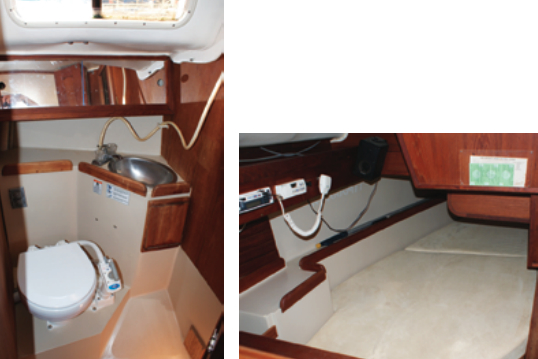
The head compartment is small at just over 3 feet in width but, with the sink located on an angled counter against the forward bulkhead, it’s functional. Locker space is provided above the counter and outboard of the marine toilet.
The V-berth forward, at just over 6 feet in length, creates berths for two, provided one of them is shorter than the other. Teak fiddles protect the edge of a narrow shelf molded into the liner along each side of the berth.
One of the limitations of this design is ventilation belowdecks. On a standard boat, none of the ports open except the one in the head. Serendipity II also has an opening port forward on the starboard side, but this was likely ordered from the builder as an upgrade. There are no cowl vents or Dorade boxes on the cabintop. While the huge companionway hatch allows ample air below when it’s open, sailing in any kind of sea will dictate that it be closed. Rich has installed a solar-powered vent in the forward hatch to improve airflow.
Propulsion
Serendipity II is equipped with a 15-hp Ducati diesel engine. Laguna Yachts literature lists the Universal 18 as the standard engine for the boat, but other powerplants were obviously installed in some early models. Late models were supplied with a Yanmar 2GM engine.
A nice feature on the Ducati aboard Serendipity II is an integral oil-change pump. Key maintenance points, such as the seawater-pump impeller plate, are accessible through a front panel behind the companionway ladder. Side access is more restricted, with the port side reached from within the seat locker. The starboard side can be reached through the removable panel in the quarter berth.
The boat moved smartly under power. The keel configuration and some prop-induced torque mean that constant attention to the helm is required when powering forward. Backing under power induces some port prop walk, but judicious use of the throttle and shift allows control once steerageway is gained.
Under sail
We conducted the test sail in fairly light conditions, but there was enough breeze to judge the general sailing qualities of the boat. Bruce Liese, the previous owner of the boat, joined Rich and Brandi as crew. A light-air genoa helped and, although the breeze was never more than 7 knots, the boat was able to hit almost 3 knots on reaches. Both Rich and Bruce report that the boat really comes into her own when the wind pipes up and, given the stiff feel and the fairly long waterline length, that is not surprising.
The Laguna 30 was responsive and tacked well even in the light air. The helm was balanced and had a fi rm feel and good feedback, even through the standard wheel steering.
With the wide footprint of the shrouds, only a rail-mounted genoa track is provided, limiting pointing ability somewhat. Adding an inboard track might improve sheeting angles when setting a small non-overlapping jib, but the improvement would not justify the cost.
Mainsail trim is easily accomplished at the bridge-deck-mounted traveler. The mainsheet exits the block at the traveler car through a cam cleat and the upward release angle makes it possible to lead the sheet aft for the helmsman to control it if necessary. However, adjusting the traveler requires the assistance of crew.
It is difficult to assess sailing qualities without a fresh breeze, but light-air handling and responsiveness mark the Laguna 30 as a good general performer. With her base PHRF rating of 180, she should be quite competitive with 30-foot boats of similar vintage. For comparison, the original Catalina 30 with standard rig carries the same 180 rating, while the C&C 30 rates 174.
Pricing and availability
With only around 40 hulls produced, availability may be limited at times. In the late summer of 2009, four boats were listed for sale: a 1984 model in California, at $22,500; a 1986 model in New York, at $24,500; a 1986 model in Michigan, at $26,500; and a 1986 model in Mississippi, at $20,000, the advertisement for which noted that the boat is “in need of TLC,” which is the likely reason for the lower asking price.
Conclusion
Nothing is bulletproof but, in the world of classic fiberglass boats, the Laguna 30 comes close. It was well designed and robustly constructed. Its simple layout makes sailing it a snap even for less experienced crew. The boat is not intended to be a bluewater passagemaker, but it is capable enough that one sailed from the West Coast to Hawaii. Compromises, such as the narrow sidedecks and below-average ventilation, can be taken in stride given the overall construction quality.
Anyone considering a Laguna 30 might factor in ventilation improvements and self-tailing winches as desirable projects but, in any case, the Laguna 30 can be considered a good value as a spacious, well-built coastal cruiser with good performance.
Tom Wells and his wife, Sandy, own and sail a 1979 Tartan 37, Higher Porpoise. They have been sailing together since the 1970s and look forward to cruising upon retirement. Tom’s musical contributions at the Annapolis boat show have earned him the title of Troubadour with Good Old Boat.
Thank you to Sailrite Enterprises, Inc., for providing free access to back issues of Good Old Boat through intellectual property rights. Sailrite.com