A thorough discussion of the many causes of metal corrosion
Issue 44: Sept/ Oct 2005
THE STUDY OF CORROSION CONSIDERS the reactions between a metal and its environment. From the standpoint of a boatowner, the study of corrosion also includes corrosion-suppression techniques. Therefore, in order to anticipate, minimize, or suppress corrosion, the boatowner must first consider its causes.
Corrosion theory
Corrosion is nature’s way of returning processed metals — both pure and alloy — to their original native states as minerals or chemical compounds. For example, in its natural state, iron ore exists as various iron-oxide compounds (FeO, Fe2O3, Fe3O4). In making iron and steel, the oxygen is driven off and elemental iron results (Fe0). To reverse this process, nature needs only to add water and oxygen. This natural reclamation process is corrosion.
Corrosion is a broad and complex subject; however, it can easily be understood and defined as an electrochemical process that involves three main steps, as shown in the illustration below.
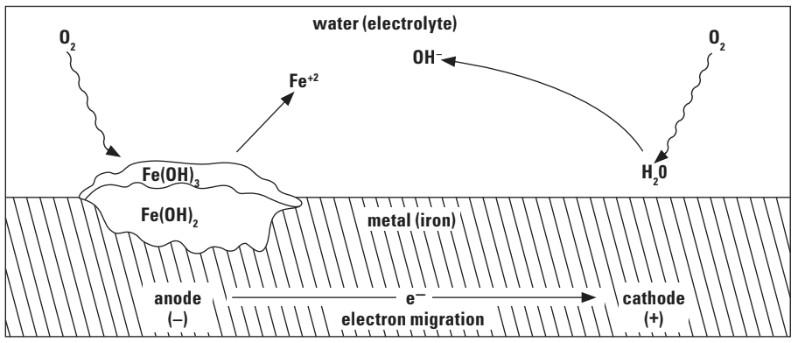
- At the anode, metal goes into solution. In this example, iron ions go into the water, where they are soon oxidized.
- At the same instant that the metal goes into solution, two electrons are released and begin to migrate through the metal to the cathode.
- Completing the electrical circuit, oxygen in the water moves to the cathode, where it uses the electrons that migrated to the cathode and forms hydroxyl ions (OH–).
The chemical reactions are as follows:
Anodic reaction
Fe0→Fe+2 + 2e–
Cathodic reaction
½O2 + H2O + 2e–→2(OH–)
Subsequent to the actual electrochemical corrosion process, additional chemical reactions occur that provide us with the precipitated corrosion products as well as visual indicators. In the case of iron, the most common are as follows:
The negatively charged hydroxyl ions that were produced at the cathode migrate toward the anode. At the same time, the positively charged iron ions move toward the cathode. They combine to produce ferrous hydroxide.
Fe+2 + 2OH– →Fe(OH)2
This compound is rapidly oxidized (combined with oxygen) to ferric hydroxide.
4Fe(OH)2 + O2 + 2H2O →4Fe(OH)3
When the ferric hydroxide is dehydrolyzed (the water is removed), ferric oxide (red rust) is all that remains.
2Fe(OH)3→3H2O + Fe2O3
The corrosion process in all metals is similar to that of iron; however, the end products are not called rust. Rust is peculiar to iron and steel and more of a colloquial term. It is more technically correct to refer to the products of corrosion as “a metal’s oxide.”
Every metal surface is covered with innumerable minute anodes and cathodes. These sites may be the result of stress, compositional differences, or surface irregularities, to name just a few. Regardless of the cause, a difference in electrical potential exists between each anode and cathode. It is this difference in potential that allows current to pass through the metal, resulting in reactions at the anodic and cathodic sites. The anode is the region of lower potential (–) and the site of metal loss, while the cathode is the region of higher potential (+). In general, the lower the potential of the anode, the greater the metal loss — and thus the more serious the corrosion problem.
The degree of corrosion is also a function of the ability of ions and electrons to migrate through the electrolyte (water) and take part in the chemical reactions. Waters that are higher in dissolved solids are more conductive and can cause more severe corrosion. Salt water, with its higher dissolved solids content, is more corrosive than fresh water.
Galvanic series
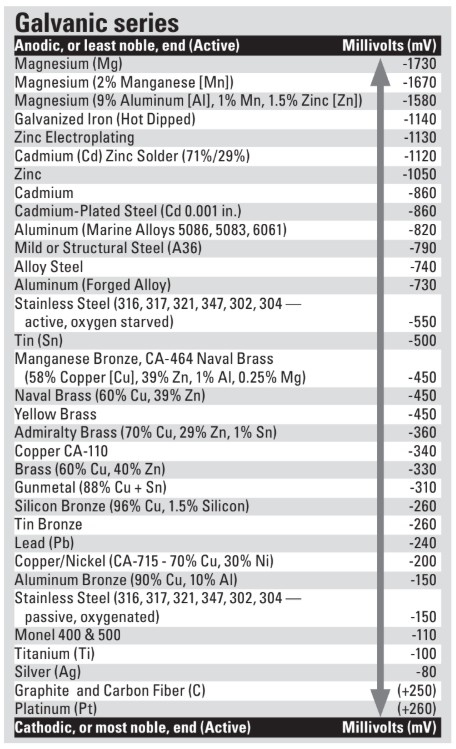
Any metals when immersed in water will soon develop a measurable electrical potential. Those of lower potential can be expected to corrode more easily and extensively than those of higher potential. When dissimilar metals are coupled, either by wiring or by simple contact with each other, and are immersed in water, the one with the lower potential will become the anode and actively corrode. The table to the right shows the galvanic series for metals immersed in sea water.
The most “noble” metals are those located toward the bottom of the series. These are electrically less negative (or more positive) and less chemically active (or more passive). These metals are said to be cathodic and are more resistant to corrosion. The metals nearer the top of the series are less noble. They are more electrically negative (or less positive) and more chemically active. As such, these metals are anodic and corrode most easily.
When two metals, as shown in the table, are coupled, the metal higher in the series will corrode. The driving force for galvanic corrosion is the potential difference that develops between the two metals. This difference in potential increases as the distance between them on the galvanic series increases. Any metals that are more than 200 millivolts apart on the series will cause the more anodic (higher on the series) to corrode.
Immersion is not necessary for galvanic corrosion to take place. Wood that is wet with sea water can act as the electrolyte and allow ion migration.
Common onboard galvanic couples include propellers and their shafts, stainless-steel screws in an aluminum mast, and dissimilar metals in the engine’s cooling system.
Polarization/passivation
Changing the potential of either the anode or the cathode or both to reduce the difference in electrical potential between them reduces the corrosion reaction and minimizes the associated metal loss. This shift to more of an equilibrium in corrosion potential is called polarization.
To some extent, polarization occurs naturally during the corrosion process, either by the depletion or removal of chemical reactants, such as oxygen or chloride, or the formation of a passivating monomolecular oxide film on the metal’s surface, as is the case with stainless steel.
Unfortunately, polarization is not always complete or effective in reducing the corrosion potential and must be aided by other means, such as chemical (coatings), mechanical (insulation), or even electrical (impressed current).
Should polarization be interrupted at any point, a very active anodic site will develop, accelerating corrosion.
Chemical factors
Understanding the ramifications of a metal’s aqueous environment helps greatly in determining the potential for and extent of a corrosion problem.
Acid/alkaline — Simply stated, pH can be defined as the hydrogen ion concentration. It is measured using a special, logarithmic pH scale, which ranges from 0 to 14, with 7 being neutral. The higher the concentration of hydrogen ion, the lower the pH and the more acidic. The lower the concentration of hydrogen ion, the higher the pH and the more alkaline, or basic. Most natural waters have a pH of 6.0 to 8.0, with sea water tending to be on the alkaline side.
The actual effect of pH on a given metal is determined by the behavior of its oxide. If the oxide is soluble in an acidic medium, the metal is considered acid soluble and will therefore corrode rapidly in this environment. On the other hand, if an alkaline medium dissolves the oxide, the metal will experience extensive corrosion in that high pH range. With the exception of the most noble metals, most metals fall into the first category.
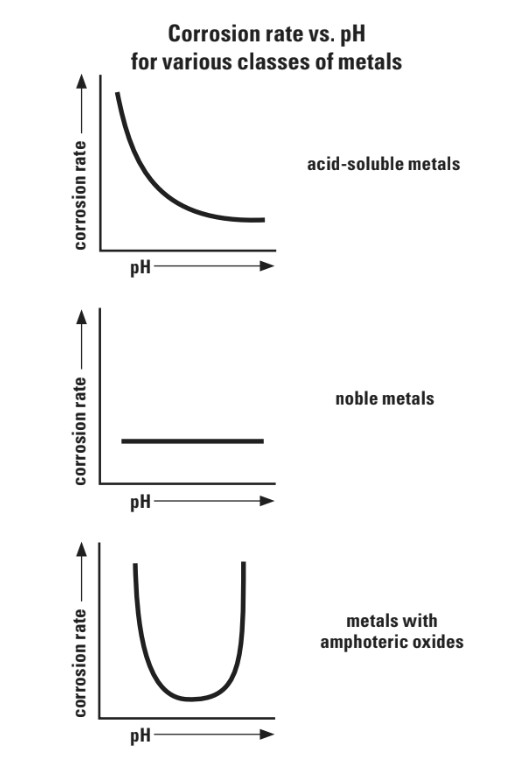
A metal oxide that rapidly dissolves in both acid and alkaline situations is referred to as being amphoteric. Amphoteric metals exhibit their greatest corrosion stability at an intermediate pH range. Two important shipboard metals that fall into this category are aluminum and zinc.
In addition to the pH of the water, the pH of several other shipboard situations can adversely affect the corrosion process. These include, but are not limited to:
- Rain water (acid rain)
- Teak cleaners/brighteners (many use both an acid and an alkali)
- Acid-cure silicone sealants
- Engine exhaust (upon combination with water, an acid is formed)
While an acidic pH environment is generally a cause for accelerated corrosion, strongly alkaline solutions can cause the deterioration of wood, be it the boat or its brightwork. Wood is comprised of cellulose fibers that are bound together with a natural adhesive called lignin. Strong alkaline solutions can dissolve lignin, leaving only the structurally weak cellulose. This “corrosion” process is called delignification.
Dissolved solids
The impact of dissolved solids on the corrosion process is somewhat complex. Not only the concentration is important; so are the various ions involved.
The extent of the corrosion is a function of the ability of both the ions and electrons to migrate through the water and participate in the various chemical reactions. Waters that are high in dissolved solids are more conductive and are responsible for severe corrosion. Sea water, with its high concentration of dissolved solids, is extremely conductive and much more corrosive than fresh water.
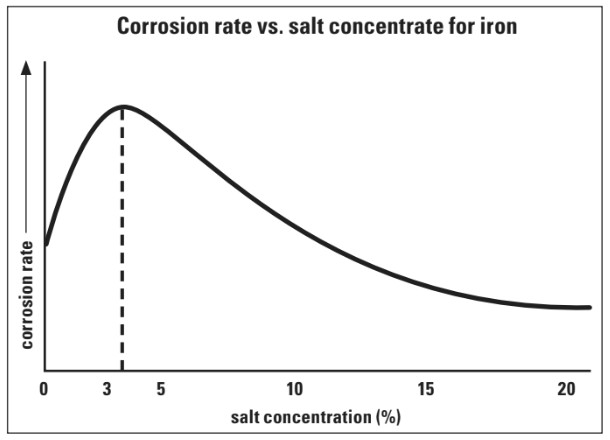
Salinity — The presence of salt, or more specifically the chloride ion, makes water extremely corrosive. The figure at right illustrates the effect of salt concentration on the corrosion rate of iron. Note that the corrosion rate is at its highest at a salt concentration of 3.5 percent, which coincidentally is just about the salt concentration of sea water. The chloride ion aids corrosion in two ways. It increases the electrical conductivity of the water, and it tends to interfere with and break up the protective oxide films formed by some metals.
Oxygen — The greater the amount of dissolved oxygen in the water, the greater its corrosiveness. This is due to the fact that an increase in oxygen allows for an increase in the rates of the various chemical reactions at or near the cathode, thus promoting corrosion. In sea water, the corrosion rate of mild steel increases in direct proportion to an increase in dissolved oxygen. A doubling of dissolved oxygen doubles the corrosion rate. Generally speaking, as water temperature increases, the amount of dissolved oxygen decreases.
Suspended matter — Sand, silt, mud, clay, and other particles suspended in the water pose very little in the way of a corrosion problem. However, when they are allowed to settle out on a metallic surface, they can quickly form a porous deposit and establish a differential aeration cell. The area beneath the deposit is oxygen-deficient and becomes anodic while the open surface is now cathodic. With a difference in electrical potential formed, corrosion begins. The differential aeration cell can lead to aggressive localized pitting. This condition is commonly referred to as under-deposit corrosion. Good housekeeping, especially in the bilge and lockers, can just about eliminate under-deposit corrosion.
Microbiological — Microbiological corrosion can occur directly or indirectly. Direct involvement takes the form of corrosion that results from the biological process associated with the metabolism of the bacteria. Examples of corrosive microorganisms include sulfate-reducing bacteria (Desulfovibrio desulfuricans) and sulfur-oxidizing bacteria (Thiobacillus thiooxidans). While sulfate-reducing bacteria consume hydrogen and accelerate the corrosion process at the cathode, the sulfur-oxidizing bacteria manufacture sulfuric acid and a low pH. Beneath both of these colonies, severe localized pitting results.
The corrosion that is associated with indirect microbiological activity is usually the byproduct of bacterial metabolism, which results in a deposit and the formation of a differential aeration cell. Organisms such as Beggiatoa and Thiothrix are well known as troublesome fouling organisms. Generally, microbiological corrosion takes the form of localized pitting.
Like sailboats, microorganisms are cosmopolitan, in that they can be found throughout the world. They inhabit water, land, and air, and they are quite adaptable to shipboard life, given the right environment. Cleanliness is their enemy.
Physical factors
Understanding certain physical aspects of the relationship between water and a metal can provide insights into the corrosion potential. Common physical factors include:
Temperature — Generally, corrosion increases with an increase in temperature. Nowhere is this physical factor more in evidence than in the closed recirculating cooling system of a sailboat’s engine. It is in this environment that a rise from 60° to 180°F may increase the corrosion rate by as much as 400 percent. Fortunately, antifreeze products routinely incorporate a corrosion inhibitor in their formulations. To insure that temperature protection as well as corrosion inhibition are constantly maintained, it is a good practice to drain, flush, and recharge the system with fresh antifreeze on a routine basis.
With an increase in the temperature, some metals or alloys can even change their electrical potential. At approximately 150°F, the zinc coating on galvanized steel no longer provides corrosion protection. It becomes cathodic, while the steel becomes anodic and corrodes.
Lastly, should a temperature variation occur within one piece of metal, the cooler portion becomes cathodic, while the warmer part becomes anodic and corrodes.
Dissimilar metals — As was discussed earlier, when two dissimilar metals are in contact with each other and exposed to a conductive solution, a difference in electrical potential develops. The metal lowest in electrical potential becomes anodic and corrodes.
One of the most routine shipboard practices involving dissimilar metals is the use of stainless-steel fasteners on an aluminum mast. The fasteners are cathodic to the anodic spar. To reduce the electrical potential between the two, the fasteners are normally coated with an insulating paste. If they are not, corrosion of the spar area adjacent to the fastener will take place and the hole will eventually enlarge.
Cathode-to-anode ratio — The rate of corrosion increases in direct proportion to an increase in the ratio of cathodic surface to anodic surface. Where the area of cathodic surface is greater than that of the anodic surface, an unfavorable cathode-to-anode ratio exists. If the ratio is significantly high, the resulting corrosion will be severe localized pitting. Therefore, whenever possible it is favorable to maintain a low cathode-to-anode ratio.
Stainless-steel fasteners on aluminum spars are good examples of low cathode-to-anode ratios.
Metallurgy — Metals are never uniform. All metals exhibit surface flaws such as nicks, scratches, and cuts. These areas will eventually become anodic to the rest of the metal.
Differences in the metal’s microstructure can promote the formation of a galvanic cell and subsequent corrosion. This includes such microscopic items as a difference in metal grain densities, the inclusion of a non-homogeneous metal or compound in the grain structure, and the presence of a precipitate at the metal’s grain boundary. Metals that have been stressed or are under stress normally develop anodic sites at the stressed area.
Unfortunately, an increase in metal purity is no guarantee that corrosion will decrease, but it does help.
Types of corrosion
The corrosion of a metal’s surface can take many forms. The major types that are routinely encountered in the marine environment are highlighted below:
Uniform attack — Sometimes referred to as atmospheric corrosion, uniform attack is characterized by the even, steady loss of metal over the entire metal surface. When the difference in electrical potential is not great, the anodic and cathodic sites tend to shift from place to place on the metal’s surface. This results in uniform metal loss. Given appropriate conditions, all metals can exhibit some uniform attack.
If your boat is made of steel, chances are that you’re quite familiar with uniform attack. Any areas that are missing paint will quickly develop this common form of corrosion. If you don’t sail a steel boat, you’re not immune from uniform attack. Inboard engines are predominantly made of cast iron. Where the protective coating of paint is missing, uniform attack can occur. Exhaust manifolds and risers are excellent candidates for uniform attack.
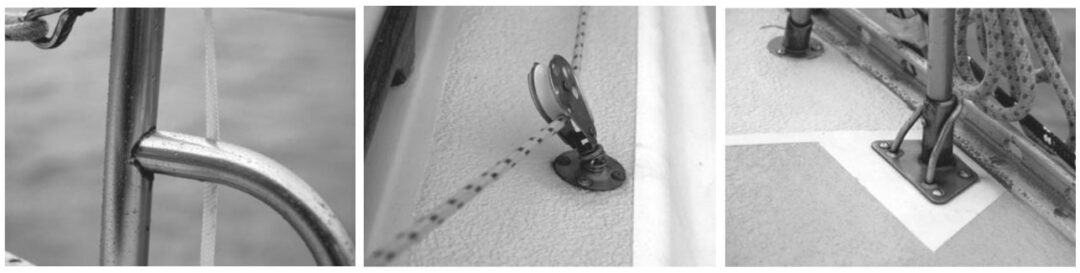
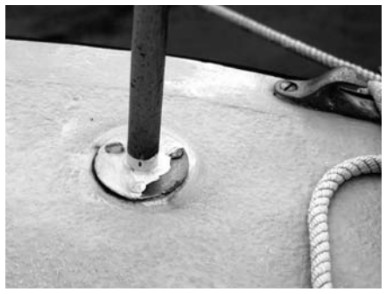
Pitting — Pitting corrosion is one of the most destructive and intense forms of localized attack. This is the result of the formation of a highly active, localized anodic site. Pitting can occur under deposits, at high temperature zones, at imperfections on the metal surface, at holidays in paint coatings, and around bits of weld spatter. Pitting is the most common cause of metal failure. Even if not fully perforated, pits create stress concentration sites that lead to failure when stress is applied. It is an insidious form of corrosion, since it is not readily apparent. Areas where pitting corrosion can occur include under deposits, on keel bolts, inside stanchion bases, inside lower terminals of wire rigging, and beneath plastic lifeline coverings.
Erosion — This form of corrosive attack is one in which metal loss is accelerated by the velocity or abrasion of a flowing medium (water). This form of localized attack often occurs at areas where water changes directions. Cavitation can cause erosion corrosion. It causes damage due to the formation of bubbles in the water as they collapse against a metal surface. The resultant shock physically dislodges metal grains from the surface. The presence of deep, circular pits, along with an overall roughened surface, is evidence of cavitation. Areas susceptible to cavitation include the suction side of pump impellers and boat propellers. Attack can even occur inside diesel engines, caused by the pressure created by piston slaps.
Selective leaching — Selective leaching (known as de-alloying) is the preferential disintegration of one element from the alloy matrix. Three common forms, in order of general importance, are dezincification, degraphitization, and de-aluminification.
Dezincification is the selected removal of zinc from copper-zinc alloys (brass). This results in a weak porous copper structure having a reddish, coppery color. There are two forms of dezincification. The “plug type” form is localized and characterized by deep penetration. This form occurs in waters of high salt content. The “layer type” form is more general and uniform in nature and will occur over the entire metal surface. Resistance to dezincification varies with the alloy. For example, brass of 70 percent copper and 30 percent zinc is less resistant than admiralty brass (70 percent copper, 29 percent zinc, 1 percent tin), which is less resistant than inhibited admiralty brass (admiralty brass plus a small amount of arsenic, antimony, or phosphorus). Bronze, Monel, stainless steel, or even hot-dipped galvanized are better choices.
Cast iron is subject to a similar problem called degraphitization. When iron is selectively removed, the result is a weak structure of graphite and iron oxides.
De-aluminification is a form of selective leaching associated with aluminum bronzes and a seawater environment.
Boats sailed in fresh water are generally safe from selective leaching. If you’re a saltwater sailor, places where selective leaching may occur include fittings and fasteners made of yellow brass (dezincification), cast iron keels (degraphitization), and possibly components fabricated of aluminum bronze (de-aluminification).
Under-deposit corrosion — Under-deposit corrosion is generally the result of the formation of an oxygen-differential aeration cell. The water above the deposit is oxygen rich, while the area beneath the deposit is oxygen deficient. This difference in oxygen concentration establishes a difference in electrical potential, with an anode being formed beneath the deposit. The result is extensive localized corrosion, which establishes a self-perpetuating corrosion cycle. The metal that is lost through the corrosion process precipitates out and creates another deposit, which in turn establishes another differential aeration cell and more corrosion.
To exacerbate the situation, aggressive ions such as chloride and sulfate may be incorporated in and beneath the deposit. When a seawater-saturated organic mass is the deposit, the resulting corrosion is sometimes called poultice corrosion.
When colonies of microorganisms, including barnacles, form the deposit or are found to be present beneath a deposit, the resultant corrosion is categorized as being microbiologically induced. This microbiological form of corrosion was discussed on Page 20.
Under-deposit corrosion is probably the most insidious form of localized attack because it’s often overlooked until a premature failure occurs. Look for signs of under-deposit corrosion in places where water can collect and allow its suspended solids to settle out. On a metal boat, the first place to check is the bilge with its many nooks and crannies. Keep those areas free of debris. Also check anchor and chain lockers. Monitor the engine temperature in order to determine if the heat exchanger is fouled. This fouling is the precursor to under-deposit corrosion.
Remember, it doesn’t have to be dirt to be a deposit. A piece of waterlogged wood left in contact with a steel deck can initiate under-deposit corrosion.
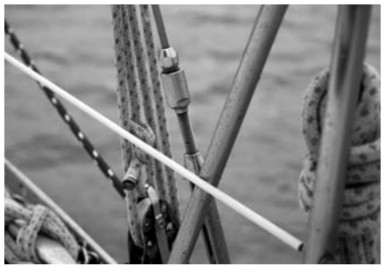
While not a deposit, the vinyl coating on stainless steel lifelines has been known to create conditions for the establishment of oxygen-differential cells and promote corrosion of the stainless steel wire. You also want to take a peek at metal components that have been wrapped with tape.
Crevice corrosion — Crevice corrosion is categorized by localized attack occurring within or immediately adjacent to a crevice or other area that is shielded from the bulk environment. In addition to cracks, flaws, and scratches on the metal surface, fasteners, welded lap joints, and sealants can cause crevice corrosion.
The small volume of stagnant solution within the crevice is oxygen deficient and quickly becomes anodic, due to the formation of an oxygen-differential aeration cell. Attack is localized and can be severe due to the unfavorable cathode-to-anode ratio. Tracing rust stains to their source can minimize this form of corrosion. Look for signs of crevice corrosion in swaged fittings, closed-body turnbuckles, tight corners and flanges on metal structures (pulpits), and in the narrow confined spaces around fasteners and fittings.
Cracking — Cracking can be divided into two main categories, both of which are associated with the configuration of the crack. Intergranular cracking occurs between metal grain boundaries, while transgranular cracking crosses grain boundaries.
Intergranular cracking refers to localized attack at metal grain boundaries. This form of stress cracking is most prevalent in austenitic and martensitic stainless steels, which have been improperly heat treated and left in a stressed state. The metal can crack perpendicular to the direction of stress.
When austenitic stainless steels containing moderate amounts of carbon are welded, the metallurgy of the heat-affected zone is changed and becomes more susceptible to corrosion attack. This type of intergranular cracking is often referred to as weld decay.
Hot-short cracking is another form of intergranular cracking. It can take place during manufacturing or when a metal is hot-worked or even welded. Upon cooling, low-melting elements in the grain boundaries can result in the formation of minute cracks. These cracks provide the environment in which other forms of corrosion can develop, especially crevice corrosion.
Transgranular cracking is the result of cyclical stress as opposed to constant stress and is a mechanically assisted form of stress cracking. Two types of transgranular cracking are corrosion fatigue and fretting corrosion.
Corrosion fatigue takes place under the simultaneous conditions of a corrosive environment and recurring stress. Fittings that are exposed to sea water and subject to continual flexing, such as chainplates, are good candidates for corrosion fatigue.
The constant abrasion between load-bearing metal surfaces subject to vibration can result in a form of transgranular cracking called fretting corrosion. Proper material combinations, lubrication or even insulation, or the elimination of vibration can minimize this form of attack.
Stray-current corrosion — Stray current is the unintentional or uncontrolled leakage of electrical current flow from one wetted metal surface, through an electrolyte, to another wetted metal surface. This condition is usually caused by a faulty electrical system. The point where the current leaves the metal and enters the electrolyte (water) is the anode. This is the area where corrosion takes place. The point where the current leaves the electrolyte and reenters the metal is the cathode. In a DC circuit, current flow will be from the hot side (+) to ground (–). The anode and cathode need not be close. In fact, they may be yards apart. The path of stray-current leakage may be across any moist surface including wetted wood. With stray-current flow, it makes little or no difference if the metals are the same or different. Unlike DC stray current, AC stray current will corrode both wetted metal surfaces.
A common source of stray-current leakage is from a hot wire with deteriorated insulation or a connection exposed to moisture or bilge water. The best prevention against stray-current corrosion is a properly installed and maintained electrical system.
The most common components that can experience stray-current corrosion are the metallic through-hull fixtures. These are followed by the propeller and its shaft, then the rudder shaft.
Fuel-system corrosion — While not a specific corrosion type, fuel-system corrosion is often overlooked. As such, it is one that can lead to serious consequences, usually at an inopportune time.
Deposits can form in diesel fuel tanks when water separates from the fuel and when asphaltenes, waxes, and just plain dirt ultimately settle to the bottom. Add to this cocktail some microbes and, in addition to the fouling of close-tolerance fuel-system and engine components, a severe cycle of corrosion and further fouling develops. The best defense is using good quality fuel, routinely changing the fuel filter, and judiciously applying a microbiocide fuel additive.
See Marine corrosion, Part 2, in the November 2005 issue for more about ferrous and non-ferrous construction materials and how to avoid corrosion.
For further reading . . .
Boatowner’s Illustrated Handbook of Wiring, by Charlie Wing, and Boatowner’s Mechanical and Electrical Manual by Nigel Calder (now in a new third edition), are two useful assets for more information about corrosion.
Thank you to Sailrite Enterprises, Inc., for providing free access to back issues of Good Old Boat through intellectual property rights. Sailrite.com