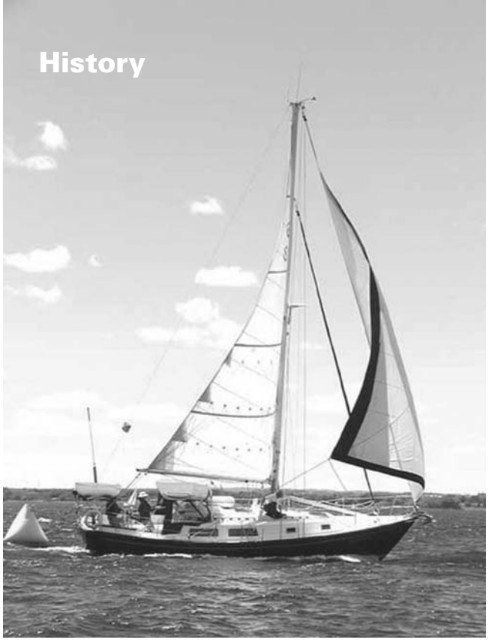
This handsome Canadian cruising design is back again
Issue 44: Sept/Oct 2005
SOME SAILORS FALL IN LOVE WITH every boat they see. Others, like owners of the classic Cabot 36, are firmly monogamous. And why roam? She’s rare — they only made 49 — and the older she gets the more she turns heads. Add her pedigree — design by Ted Brewer and Bob Wallstrom, a chapter of praises in Richard Henderson’s Choice Yacht Designs, plus several articles over the years — and you know why boats like the Cabot 36 engender loyalty out of plain old fiberglass.
Trouble is, she lived a short production life, leaving her admirers with two questions: “Whatever happened to this good old boat?” And, “Is she gone for good?” The answer to the first is, “She fell on hard times.” The answer to the second is simply, “No.” YachtSmiths International of Halifax, Nova Scotia, a builder with a special interest in classic revivals, has found and refurbished her molds. The first in a new line of Cabots hit the Halifax Boat Show last February.
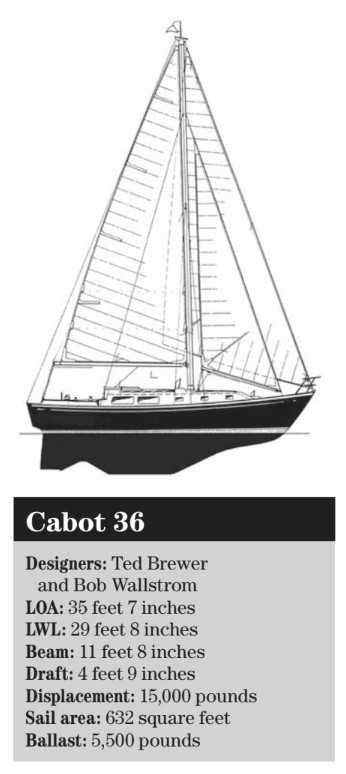
Production began in Sydney, Nova Scotia, in early 1973, when two entrepreneurs from Toronto, Ontario, created Cabotcraft Industries and commissioned the design team of Bob Wallstrom and Ted Brewer for an offshore cruiser. The Cabot 36 is a cutter-rigged sloop designed to be a beauty and built to be a beast. She has nice lines, gorgeous teak jewelry, and an ample layout below. In Choice Yacht Designs, Richard Henderson describes her bustle as a little extra protuberance aft that means a lower quarter wave and extra interior room. She is also high enough in the stern to minimize the chance of getting swamped in following seas.
The keel’s leading edge sweeps back, making it more resistant to fouling and collision damage. George Kephart of Poolsville Maryland, who sailed his Cabot for at least six months of every year for 16 years and half- way around the world, says there are a few rocks just south of the airport in Athens, Greece, that are the worse for wear after an encounter with his Cabot, the Sarah Fraser. He says, “She’s the most seakindly boat of her size I’ve ever been in.”

Hull plug
Tony Waldegrave, who has run the Cabot Owner’s Association since the late 1970s, can show you a plug from his hull that has a good inch-and-a-half of Airex foam core and fiberglass. Richard Henderson reports that Ted Brewer was accustomed to asking sailing guests to take a whack at a sample of this material with an ax or sledgehammer: “Ted’s point was well made, that this kind of construction makes a very strong hull . . . light weight, good insulation, and great stiffness.”
Hull #31, the only yawl produced by Cabotcraft, survived a vicious storm in December of 1982, with winds of up to 70 miles an hour that blew directly into the harbor at Cabo San Lucas, Mexico. Sail magazine reported that “the remains of 27 large boats lay scattered” on the rocks. Dancing Bear, the Cabot yawl, then owned by Bob Hume of Dana Point, California, survived without structural damage. The only other survivor was a steel-hulled yacht owned by the famous French sailor, Bernard Moitessier.
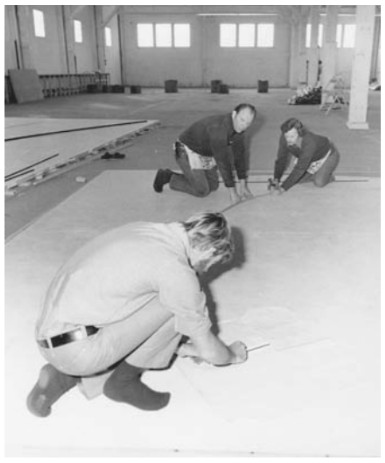
So what happened to this storied boat? Well, for one, production was never without its trials. The facility at Point Edward Industrial Park in Sydney was an old brick-and-timber navy base from World War II, heated from a central steam plant and used by the coast guard. In late 1973, John Perring, the key fiberglass man, Bob Wallstrom, and Jim Marsh, manager of the new plant, had to start on the lofting under low ceilings cluttered with beams, bracing, and old steam pipes. Improving that facility took time and energy away from boatbuilding.
So did the task of improving human capacities. Cape Breton, like much of the rest of Canada at the time, relied on its natural resources and just didn’t have a plentiful supply of managers and tradespeople, especially in the relatively new technologies of fiberglass boat construction.
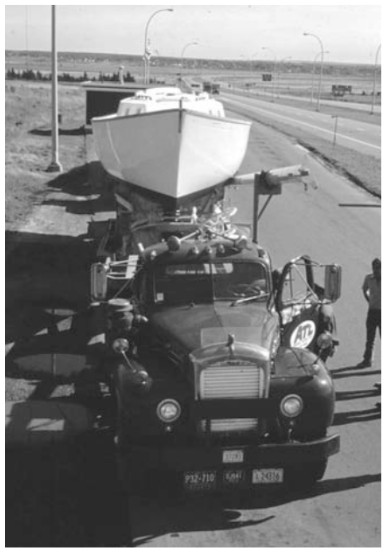
The story of the first boat to show at the U.S. Sailboat Show in Annapolis, Maryland, in 1974 conveys the chaos that besieged the first years. By the time the crew had to leave for Annapolis, the boat still was not done and had to be towed behind an old 1950s Mack truck followed by a working crew in a Winnebago. Every time the convoy stopped, out of the Winnebago jumped the proud crew from Cabotcraft to continue putting her together. Bob Wallstrom later drew a cartoon showing a bunch of guys on top of the Winnebago with table saw, thickness planer, and shaper, and one carpenter carrying joiner work over a swaying catwalk to the boat behind.
Government partner
By 1976, the company’s private investors turned the operation over to their government partner, the Cape Breton Development Corporation (Devco), and Roy Mac Keen was hired to right a ship that was listing. Roy had managed a marina in the Bahamas for the colorful Canadian horse-racing millionaire, E. P. Taylor, as well as a shipyard for R. T. Symonette, then prime minister of the Bahamas.
While production and costs improved, Cabotcraft could not avoid the economic downturn that few other Canadian boat companies survived. The Canadian dollar was at $1.03 in 1976 when Cabotcraft was struggling to sell its product. The oil crisis was pushing up the cost of resin. Inflation was hot, and government legislation that had given some protection to Canadian boatbuilders was removed.
Despite plans to diversify (adding a 30-foot version for which Bob Wallstrom was going to do the design, plus molds for the 41-foot Cape Islander fi shing vessel), the business simply wasn’t there. In July of 1978, Devco pulled the plug. Cabotcraft’s assets were disposed of, and for the next 25 years the molds for this well-respected boat lay forgotten in a Nova Scotian field.
In 2002, Brian Smyth, now director of engineering for YachtSmiths International, was in the Bahamas with his wife, Susan, and their three children, delivering a boat for a client. They were moored beside a yacht of such lovely classic lines they just had to make inquiries. She was a Cabot. On return to Nova Scotia, Brian scoured the records of the Boatbuilders Association, where he recalled seeing the molds for sale a few years before.
The two-part hull mold was discovered inverted in a fi eld and screwed together to prevent water from entering. The wood bracing was rotting, but the interior seemed fine. The deck mold, also inverted, had a skin coat of fiberglass in it. The liner mold also had pieces in it from an earlier layup and was in the worst shape. It was wintertime, so everything had to be carefully freed from a buildup of ice and snow.
Reconstruction of the first new Cabot was something of an archaeological dig, trying to restore and fit together pieces that had suffered some deterioration and changed shape over years of abandonment. The hull molds, for example, resting on stem and stern, had relaxed.
Original position
“The way we handled that,” Brian says, “was to take 2 x 8s and spread the sheer back out to its original position. When we spread the sheer out, it shortened the boat. It flexes. And we just did that until it came back in line with the deck mold, which we knew had not distorted very much.” In future construction they’ll have a metal template made from the deck mold.
The skin that remained on the deck mold suggested that someone over the years had tried a one-off edition of the boat. When YachtSmiths popped that skin off and set it aside, it discovered significant osmosis in the mold. The Halifax Boat Show, in which the company had purchased space, was just weeks away. Shades of the former company descended. Using tooling gel to restore the mold would have delayed production a few weeks. The problem cooked for a few days until, in a moment of serendipity, Brian noticed the perfect condition of the discarded deck skin. With some quick and clever rehab, it became the mold for the first deck.
The hull liner mold was also a sow’s ear that became a silk purse. The original Cabot’s liner was fiberglass with wood trim and cabinetry. Years of weathering, however, had deteriorated the mold so badly that parts had to be cut away, leaving YachtSmiths not much more than a template of the original. But the result, says Brian, is that “the new Cabot will have way more wood.” In fact, he offers a full mahogany or teak interior to suit clients’ wishes.
YachtSmiths hired E.Y.E. Marine Consultants of Nova Scotia to do a structural analysis and new layup using Lloyd’s of London draft rules, so new Cabots will meet or exceed Lloyd’s requirements for offshore vessels. And the company has reconnected with Tom Johansen, who originated the famous Airex core material in the first boat. “Tom is the guru. He’s done it all in fiberglass,” Brian says. “He didn’t know we were building the Cabot and was all excited.” The new layup will include another Tom Johansen product, Corecell. While the new layup, like the original, is done by hand, plans are to introduce infusion technologies for future construction.
So the Cabot is back, her beauty and reputation intact.
Thank you to Sailrite Enterprises, Inc., for providing free access to back issues of Good Old Boat through intellectual property rights. Sailrite.com