Timing is everything when picking out a light
Issue 84 : May/Jun 2012
You’ve been under way for days. It’s 0200 and you’re on watch on the blackest of nights, straining through binoculars to pick up the blink of the light that marks the channel entrance. It must be directly ahead. Your nautical GPS chart plotter says you should be in range. What went wrong with your navigation?
Probably nothing is wrong with your navigation — you might not be close enough to the light for it to be visible to you.
When using a lighted aid to navigation as a landfall, you need to be able to calculate the time at which it should become visible. Then, when you see a light, to positively identify it you need an easy way to time it.
Horizon distance and height of eye
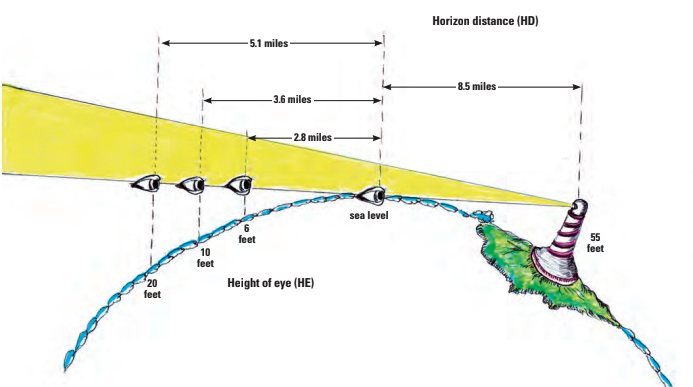
Have you ever stood on the beach on a crystal-clear day and looked out at the horizon? It seems like you can see for a million miles. In reality, the average human sees the horizon at a distance of only 2.8 miles. This is due to the curvature of the earth. Of course, you can increase your horizon distance if you elevate yourself. This is why lifeguard towers are elevated.
The earth’s curvature has the same effect on lighted aids to navigation like buoys, small light structures, or towering light- houses. The distance from which light can be seen depends on the height of the light beam above the water’s surface.
In chart navigation, your height or the height of a light is called “height of eye,” or HE.
You can calculate the distance to the horizon (which we’ll call HD) from your HE with this simple formula:
HD = (square root of the height of the object) x 1.144 nautical miles
Say you are 6 feet tall. The square root of 6 = 2.45
HD = 2.45 x 1.144 = 2.8 miles
If you want to see farther, you could walk over to the lifeguard tower and climb to the top. Let’s say the tower stands 10 feet off the beach and you stand on top of it. Now you have elevated your HE to 16 feet (tower height of 10 feet plus your height of 6 feet). The square root of 16 is 4.
HD = 4 x 1.144 = 4.58 miles (4.6 miles)
You have increased your horizon distance to 4.6 miles.
Geographic range of a light
When you combine the horizon distance from your own height of eye with that of another object of known height, you can determine when you can expect to see the object.
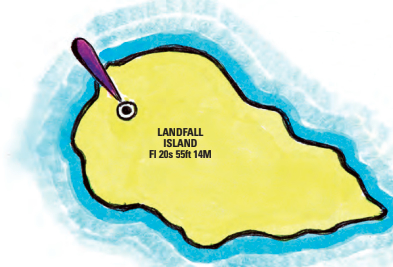
On your nautical chart you see a lighthouse on an island with, next to it, the notation “Fl 20s 55ft 14M.” This means the light beam is 55 feet above the water and is visible for 14 miles. However, the 14 miles is a theoretical distance based on the candlepower of the light. It does not take into account the curvature of the earth.
To calculate the distance from which you can expect to see the light, first calculate the HD of the light. The square root of 55 is 7.42.
HD of light = 7.42 x 1.144 = 8.48 miles. (8.5 miles)
Then add your HD to that of the light. Assuming you are 6 feet tall, your HD will be 2.8 miles.
Sighting distance = 2.8 + 8.5 = 11.3 miles
On your nautical chart or chart plotter, measure 11.3 nautical miles back along your sailing trackline from the charted light symbol. When you arrive at this position, use binoculars to scan the horizon ahead. You should see the friendly wink of your light just where you expected it to be.
Keep in mind that this calculation does not take into account haze, fog, or rough weather. Any of these could reduce the distance from which the light is visible.
Increase horizon distance
As seen above, horizon distance increases as you elevate your height of eye. When you stand up in the cockpit of your sailboat, your eye will be about 6 feet above the water. By climbing up onto your coachroof, you will raise your eye to about 10 feet above the water. Hoist yourself partway up your mast, and you can raise your eye 20 feet or more above the water.
The higher you elevate your eye, the greater your horizon distance. Add the new HD to the HD of the lighthouse to determine from how far away you can expect to sight the light from your new elevation.
Time the light three times
Never assume that a blink over the horizon or closer to you is coming from the lighted buoy, light structure, or lighthouse you’re seeking. Too many mariners have made this assumption, with disastrous results. There’s good reason to heed the old saying, “Time any light three times at night!”
All aids to navigation (ATON) that are lighted — buoys, lights, lighthouses — show the light period next to the chart symbol of the light. A light period defines a light’s total time, in seconds, of light and dark. For example, 2.5s, 3s, 4s, 6s, 20s. Quick-flashing ATON don’t show their periods because they flash at a constant rate of at least once per second.
Some lights show groups of flashes. On the chart, look for the group in parentheses. For example, “Fl (2 + 1).” This means that you will see two flashes, a short period of darkness, one flash, and then a longer period of darkness.
The total time of flashes and darkness adds up to the period. “Fl (2 + 1) 20s” means the entire sequence of flashes and darkness adds up to 20 seconds. Fl 6s means a single flash repeated every 6 seconds. Iso stands for isophase, or equal intervals of light and dark. For example, “Iso 6s” means the light stays on for three seconds and off for three seconds.
An occulting light is on for longer than it is off. “Oc W 10s” indicates a white light that is steady but goes out for a brief period, with the pattern repeating every 10 seconds.
Always time a light period from the start of the sequence to the start of the next sequence. You don’t need a stopwatch or watch for this. In fact, if you’re alone on deck at nighttime, this would be tough to do while you look through binoculars. Instead, count off the seconds — you can do this without having to glance away from the light.
One way to count is with the old “one thousand and one, one thousand and two . . .” method. But for more accuracy, use “one-hippopotamus, two-hippopotamus.” As silly as it sounds, this has proved itself time and again to be super accurate. With a bit of practice, you can time any light to within 1⁄10 of a second with this method.
Captain John’s navigation tip
Follow the light through three consecutive periods to verify that it’s the right one. Remember the mantra of the pros: “Time any light three times at night!” Make this a standard practice aboard your cruising sailboat and pass it along to your sailing crew.
Confidence builder
By using the horizon-distance calculation to predict when a lighted ATON will become visible from the deck of your boat, you will make landfalls confidently and with bull’s-eye accuracy. And by carefully timing the light sequence, you can verify that you’ve found the correct light to lead you safely into harbor.
John Jamieson served in the U.S. Coast Guard for more than 20 years and is the author of Seamanship Secrets, from International Marine. He teaches cruising sailors the top sailing-seamanship skills they need to know for safer sailing anywhere in the world. Visit his membership website at www.skippertips.com.
Thank you to Sailrite Enterprises, Inc., for providing free access to back issues of Good Old Boat through intellectual property rights. Sailrite.com