New wires bring a Yanmar diesel back to life
Issue 84 : May/Jun 2012
For the last few years of its 14-year life, our normally faithful Yanmar diesel engine occasionally refused to obey the turn of the starter key. Sometimes it would take two, three, or four twists of the key before the starter would begin to turn over the engine. I talked to other Yanmar owners who had experienced this problem, and their solutions included replacing the key switch on the instrument panel and replacing the starter and/or the starter solenoid. Surprisingly, most owners reported that, in spite of these modifications, the problem was not entirely solved.
I spent some time reading online cruisers’ forums concerning the problem. Some claimed the problem was due to square-cut teeth on the starter pinion gear “dead-heading” against the ring gear on the flywheel. Others claimed a fix by installing a solenoid between the keyswitch and the starter solenoid.
I removed my starter and confirmed that the starter pinion gear teeth were properly wedge-shaped to ensure ease of engagement. I found no indication of dead-heading on the ring gear.
The interposing solenoid is recommended by Yanmar for use with the 6-meter wiring-harness extension to overcome excessive voltage drop inherent in the longer wiring. As I had only the 3-meter harness extension on my vessel, I felt that the relay was an unnecessary complication and therefore not an appropriate solution.
I considered cutting the starter-circuit wires away from the wiring-harness plugs and splicing them directly, as I suspected that the problem might be in the harness connectors. I decided instead to install new wires between the key switch and the starter solenoid. I believe simple continuous wires are always more reliable than solenoid switches and spliced wires. This fix is much less expensive than replacing the key switch, solenoid, or starter.
Materials needed
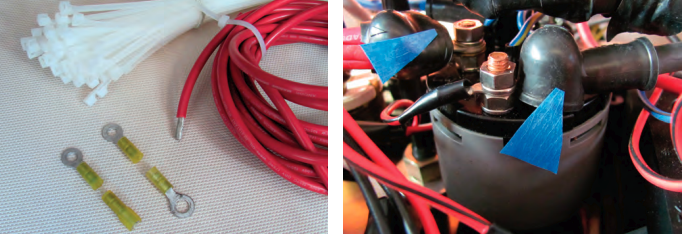
Purchase a roll of marine-grade tinned multi-strand wire long enough to connect the instrument-panel key switch to the starter solenoid in one continuous run. It is recommended to observe the new BIA marine-wiring-code colors, so this wire should be yellow with a red stripe. A plain red wire is used to bring power from the starter to the other terminal on the key switch. Be sure to purchase a known brand of wire: you cannot go wrong with Ancor.
If you don’t have rosin-core solder and heat-shrink insulation aboard, lay in a supply, as you cannot complete a proper marine electrical installation without these necessities. I used a roll of 8 AWG wire that I had aboard, but 12 AWG would have been sufficient for the 30-ampere load of the starter solenoid. You’ll also need two ring terminals of 3⁄16-inch diameter for the key-switch terminals, as well as one ring terminal of 5⁄16-inch diameter and one female socket terminal for the starter and solenoid terminals, all appropriately sized for your wire. Be sure to crimp and solder the terminals onto the wires and then cover the terminals with heat-shrink insulation.
Installation
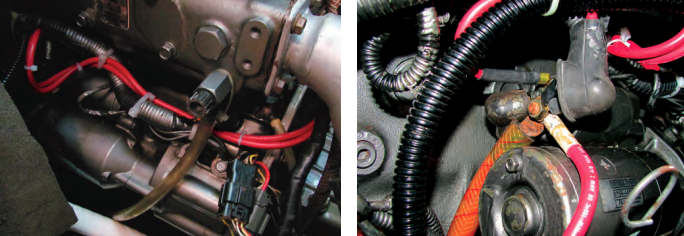
I found that, after ensuring the battery switch was in the off position, it was a simple matter to remove the existing wires from the key switch and install the new wires in their places. I then routed the two new conductors along the existing wiring harness and secured them to it with wire ties. I made sure that the new wires and the existing wires could not contact any fuel hoses. As both of my wires were red, I remembered to mark one of the wires on both ends so I could tell one from the other.
At the engine, all I had to do was unplug the existing wire from the starter solenoid, plug in the new wire, remove the existing wire from the starter post on the solenoid, and replace it with the new wire. I wrapped the terminals on the old wires with electrical tape and tied the wires back.
I accomplished this project in less than a half-day at a material cost of less than $30. In the five months since I completed this modification, my engine has cranked with each and every twist of the key. I am very confident that I have now solved this problem.
Harry Hungate and his wife, Jane Lothrop, have lived aboard and cruised on their Corbin 39 cutter, Cormorant,since departing Annapolis, Maryland, in 1997. They crossed the Indian Ocean and the Red Sea in 2009 and are now in their third year of cruising in the Mediterranean. They are looking forward to completing their circumnavigation of the world in 2012.
Thank you to Sailrite Enterprises, Inc., for providing free access to back issues of Good Old Boat through intellectual property rights. Sailrite.com